The Russian proletariat found its revolutionary audacity not only in itself. Its very position as minority of the nation suggests that it could not h… - Leon Trotsky
""
The Russian proletariat found its revolutionary audacity not only in itself. Its very position as minority of the nation suggests that it could not have given its struggle a sufficient scope — certainly not enough to take its place at the head of the state — if it had not found a mighty support in the thick of the people. Such a support was guaranteed to it by the agrarian problem.
English
Collect this quote
About
Leon Trotsky
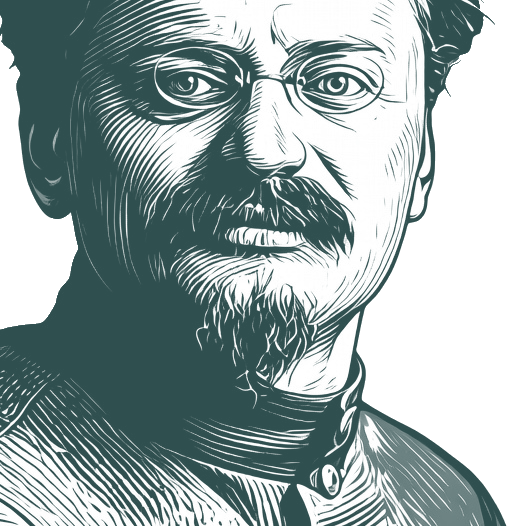
Leon Trotsky (Лев Давидович Троцкий; born Lev Davidovich Bronstein; Лев Давидович Бронштейн]; 7 November (O.S. 26 October) 1879 – 21 August 1940) was a Russian Marxist, intellectual, and revolutionary. In the early Soviet Union, he founded the Politburo, served as People's Commissar for Foreign Affairs, and created and led the Red Army. After Lenin's death, Trotsky was exiled for his opposition to Joseph Stalin's policies. His 1940 assassination (with an ice axe) in Mexico was carried out by a Soviet agent (Ramón Mercader) at Stalin's behest.
Pen Names:
Троцкий
•
Перо
•
Антид Ото
•
Л. Седов
•
Старик
Native Name:
Лейба Давидович Бронштейн
•
Лев Давидович Троцкий
Alternative Names:
Lev Bronstein
•
Lev Davidovich Bronshtein
•
Lev Davidovich Bronstein
•
Leon Trotski
•
Trotsky
•
Lev Davidovich Bronshteyn
•
Lev Bronshteyn
•
Lev Trotsky
•
Trotskiy
•
Lev Trotskiy
•
Lev Davidovich Trotsky
•
Lev Davidovich Trotskiy
In Stalin each [Soviet bureaucrat] easily finds himself. But Stalin also finds in each one a small part of his own spirit. Stalin is the personification of the bureaucracy. That is the substance of his political personality.
Lenin refused to recognise moral norms established by slave-owners for their slaves and never observed by the slave-owners themselves; he called upon the Proletariat to extend the class struggle into the moral sphere too. Who fawns before the precepts established by the enemy will never vanquish that enemy!
Works in ChatGPT, Claude, or Any AI
Add semantic quote search to your AI assistant via MCP. One command setup.
It is only possible to safeguard the supremacy of the working class by forcing the bourgeoisie accustomed to rule, to realize that it is too dangerous an undertaking for it to revolt against the dictatorship of the proletariat, to undermine it by conspiracies, sabotage, insurrections, or the calling in foreign troops.