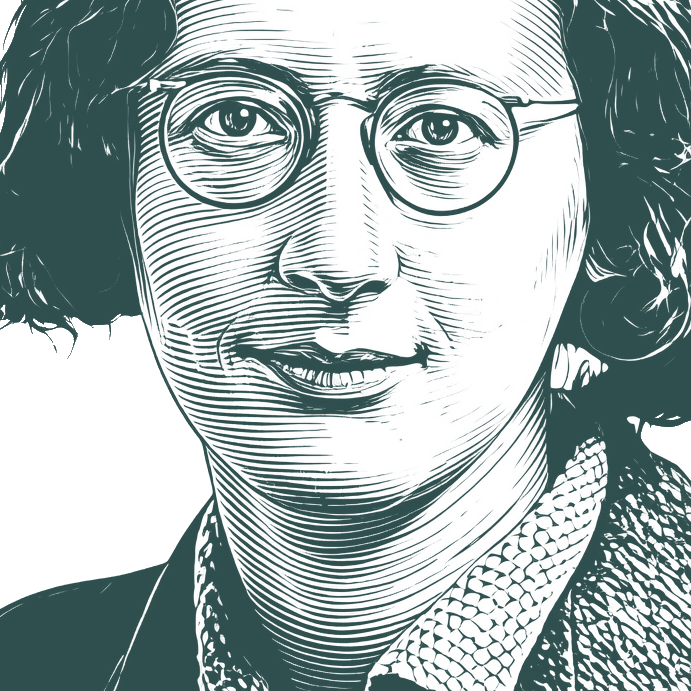
And forgive us our debts, as we also forgive our debtors.'
To remit debts is to renounce our own personality. It means renouncing everything that goe… - Simone Weil
""
And forgive us our debts, as we also forgive our debtors.' To remit debts is to renounce our own personality. It means renouncing everything that goes to make up our ego, without any exception. It means knowing that in the ego there is nothing whatever, no psychological element, that external circumstances could not do away with. It means accepting that truth. It means being happy that things should be so.
Simone Adolphine Weil (3 February 1909 – 24 August 1943) was a French social and religious philosopher, and Christian mystic. Politically active, during the Spanish Civil War she joined the Anarchist military unit known as the Durruti Column, and took part in the French Resistance during World War II. She was the sister of mathematician André Weil, with whom she shared an interest in ancient Greek and Indian thought.
There is no area in our minds reserved for superstition, such as the Greeks had in their mythology; and superstition, under cover of an abstract vocabulary, has revenged itself by invading the entire realm of thought. Our science is like a store filled with the most subtle intellectual devices for solving the most complex problems, and yet we are almost incapable of applying the elementary principles of rational thought. In every sphere, we seem to have lost the very elements of intelligence: the ideas of limit, measure, degree, proportion, relation, comparison, contingency, interdependence, interrelation of means and ends. To keep to the social level, our political universe is peopled exclusively by myths and monsters; all it contains is absolutes and abstract entities. This is illustrated by all the words of our political and social vocabulary: nation, security, capitalism, communism, fascism, order, authority, property, democracy. We never use them in phrases such as: There is democracy to the extent that... or: There is capitalism in so far as... The use of expressions like "to the extent that" is beyond our intellectual capacity. Each of these words seems to represent for us an absolute reality, unaffected by conditions, or an absolute objective, independent of methods of action, or an absolute evil; and at the same time we make all these words mean, successively or simultaneously, anything whatsoever. Our lives are lived, in actual fact, among changing, varying realities, subject to the casual play of external necessities, and modifying themselves according to specific conditions within specific limits; and yet we act and strive and sacrifice ourselves and others by reference to fixed and isolated abstractions which cannot possibly be related either to one another or to any concrete facts. In this so-called age of technicians, the only battles we know how to fight are battles against windmills.
Every human being has probably had some lucid moments in his life when he has definitely acknowledged to himself that there is no final good here below. But as soon as we have seen this truth we cover it up with lies. Many people even take pleasure in proclaiming it, seeking a morbid joy in their sadness, without ever having been able to bear facing it for a second. Men feel that there is a mortal danger in facing this truth squarely for any length of time. That is true. Such knowledge strikes more surely than a sword; it inflicts a death more frightening than that of the body. After a time it kills everything within us that constitutes our ego. In order to bear it we have to love truth more than life itself.
Works in ChatGPT, Claude, or Any AI
Add semantic quote search to your AI assistant via MCP. One command setup.
Man only escapes from the laws of this world in lightning flashes. Instants when everything stands still, instants of contemplation, of pure intuition, of mental void, of acceptance of the moral void. It is through such instants that he is capable of the supernatural.