British comic book author (born 1953)
Alan Moore (born 18 November 1953) is a British writer, most famous for his influential work in comic-books and graphic novels.
Bio from: Wikiquote (CC BY-SA 4.0) · Portrait adapted from: Wikimedia Commons, Fimb (CC BY)
From Wikidata (CC0)
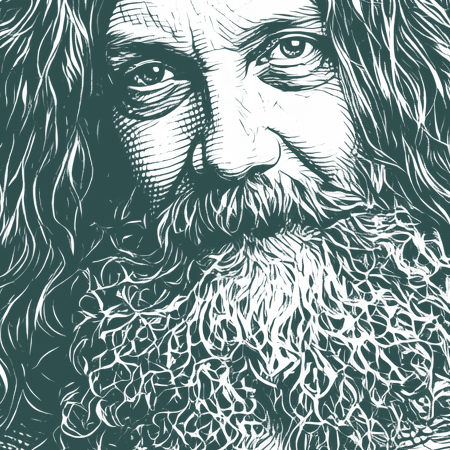
When modern horror films or fundamentalists talk about “demons,” they mean something very different than what Socrates meant by the term. It was a lot closer to what I was talking about: the essential drive, the highest self, if you like. So maybe there is a connection, when I met, or appeared to meet, a demon. It was a little bit frightening at first, but after a while we found that we got on OK and we could have a civilized conversation, and I found him very engaging, very pleasant. And it struck me that this was a brilliant literal example of the process of demonization. That when I had approached the demon with fear and loathing, it was fearsome and loathsome. When I approached it with respect, then it was respectable. And I thought, All right, there’s a kind of mirroring that is going on here that is probably applicable to a wide number of social situations. The people or classes of people that we demonize, and that we treat with fear and loathing, respond accordingly. We are projecting a persona of manner of behavior upon them, as well as responding to a manner of behavior that’s already there. When we’re looking at the flaws in their personality that we are able to recognize, the fact that we can recognize them suggests that they are probably in some way a version of flaws that we have ourselves.
There's been a growing dissatisfaction and distrust with the conventional publishing industry, in that you tend to have a lot of formerly reputable imprints now owned by big conglomerates. As a result, there's a growing number of professional writers now going to small presses, self-publishing, or trying other kinds of [distribution] strategies. The same is true of music and cinema. It seems that every movie is a remake of something that was better when it was first released in a foreign language, as a 1960s TV show, or even as a comic book. Now you've got theme park rides as the source material of movies. The only things left are breakfast cereal mascots. In our lifetime, we will see Johnny Depp playing Captain Crunch.
"I heard joke once: Man goes to doctor. Says he's depressed. Life seems harsh, and cruel. Says he feels all alone in threatening world. Doctor says: "Treatment is simple. The great clown - Pagliacci - is in town. Go see him. That should pick you up." Man bursts into tears. "But doctor..." he says "I am Pagliacci." Good joke. Everybody laugh. Roll on snare drum. Curtains."
In our every cell, furled at the nucleus, there is a ribbon two yards long and just ten atoms wide. Over a hundred million miles of DNA in very human individual, enough to wrap five million times around our world and make the Midgard serpent blush for shame, make even the Ourobouros worm swallow hard in disbelief. This snake-god, nucleotide, twice twisted, scaled in adenine and cytosine, in thymine and in guanine, is a one-man show, will be the actors, props and setting, be the apple and the garden both. The player bides his time, awaits his entrance to a drum-roll of igniting binaries. This is the only dance in town, this anaconda tango, this slow spiral up through time from witless dirt to paramecium, from blind mechanic organism to awareness. There, below the birthing stars, Life sways and improvises. Every poignant gesture drips with slapstick; pathos; an unbearably affecting bravery. To dare this stage, this huge and overwhelming venue. Squinting through the stellar footlights, hoping there's an audience, that there's someone out there, but dancing anyway. But dancing anyway.
Enhance Your Quote Experience
Enjoy ad-free browsing, unlimited collections, and advanced search features with Premium.
A god is the idea of a god. The idea of a god is a god. The idea of Glycon is Glycon, if I can enhance that idea with an anaconda and a speaking tube, fair enough. I am unlikely to start believing that this glove puppet created the universe. It’s a fiction, all gods are fiction. It’s just that I happen to think that fiction’s real. Or that it has its own reality, that is just as valid as ours. I happen to believe that most of the important things in the material world start out as fiction. That everything around us was once fiction – before there was the table there was the idea of a table, and the idea of a table before tables was fiction. This is the most important world, the world of fictional things. That’s the world where all this starts.
Fascism is a complete abdication of personal responsibility. You are surrendering all responsibility for your own actions to the state on the belief that in unity there is strength, which was the definition of fascism represented by the original roman symbol of the bundle of bound twigs. Yes, it is a very persuasive argument: “In unity there is strength.” But inevitably people tend to come to a conclusion that the bundle of bound twigs will be much stronger if all the twigs are of a uniform size and shape, that there aren’t any oddly shaped or bent twigs that are disturbing the bundle. So it goes from “in unity there is strength” to “in uniformity there is strength” and from there it proceeds to the excesses of fascism as we’ve seen them exercised throughout the 20th century and into the 21st. Now anarchy, on the other hand, is almost starting from the principle that “in diversity, there is strength,” which makes much more sense from the point of view of looking at the natural world. Nature, and the forces of evolution — if you happen to be living in a country where they still believe in the forces of evolution, of course — did not really see fit to follow that “in unity and in uniformity there is strength” idea. If you want to talk about successful species, then you’re talking about bats and beetles; there are thousands of different varieties of different bat and beetle.
All of us collectively are fumbling towards an apprehension of something that feels like a kind of group awareness – we are trying to feel the shape of it, it’s not here yet, and a lot of us are probably saying a lot of silly things. That’s understandable. There is something strange looming on the human horizon. If you draw a graph of all our consciousness, there is a point we seem to be heading towards. Our physics, our philosophy, our art, our literature – there is a kind of coherence there, it may look disorganised at first glance, but there is a fumbling towards a new way of apprehending of certain basic fundamentals.
If I realised the power of magic to worry and terrify people before, then I certainly would have used it before. Everyone freezes before it for different reasons – perhaps because it means madness to them, or because it means opening the door to a whole lot of stuff that the Age of Reason should have firmly bolted the door upon. A lot of concepts that we got rid of a long time ago that would be a bit creepy to have them back.