British philosopher and logician (1872–1970)
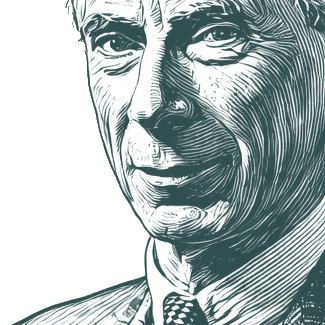
Bertrand Arthur William Russell, 3rd Earl Russell (May 18, 1872 – February 2, 1970) was a British philosopher, logician, mathematician, historian, and social critic. In 1950, he was awarded a Nobel Prize in Literature.
Bio from: Wikiquote (CC BY-SA 4.0) · Portrait adapted from: Wikimedia Commons, Bassano Ltd (Public domain / CC0)
From Wikidata (CC0)

Many orthodox people speak as though it were the business of sceptics to disprove received dogmas rather than of dogmatists to prove them. This is, of course, a mistake. If I were to suggest that between the Earth and Mars there is a china teapot revolving about the sun in an elliptical orbit, nobody would be able to disprove my assertion provided I were careful to add that the teapot is too small to be revealed even by our most powerful telescopes. But if I were to go on to say that, since my assertion cannot be disproved, it is intolerable presumption on the part of human reason to doubt it, I should rightly be thought to be talking nonsense. If, however, the existence of such a teapot were affirmed in ancient books, taught as the sacred truth every Sunday, and instilled into the minds of children at school, hesitation to believe in its existence would become a mark of eccentricity and entitle the doubter to the attentions of the psychiatrist in an enlightened age or of the Inquisitor in an earlier time.
So much of modern mathematical work is obviously on the border-line of logic, so much of modern logic is symbolic and formal, that the very close relationship of logic and mathematics has become obvious to every instructed student. The proof of their identity is, of course, a matter of detail: starting with premisses which would be universally admitted to belong to logic, and arriving by deduction at results which as obviously belong to mathematics, we find that there is no point at which a sharp line can be drawn, with logic to the left and mathematics to the right. If there are still those who do not admit the identity of logic and mathematics, we may challenge them to indicate at what point, in the successive definitions and deductions of Principia Mathematica, they consider that logic ends and mathematics begins. It will then be obvious that any answer must be quite arbitrary.
[T]he plan we are advocating amounts essentially to this: that a certain small income, sufficient for necessaries, should be secured to all, whether they work or not, and that a larger income, as much larger as might be warranted by the total amount of commodities produced, should be given to those who are willing to engage in some work which the community recognizes as useful.
While it is true that science cannot decide questions of value, that is because they cannot be intellectually decided at all, and lie outside the realm of truth and falsehood. Whatever knowledge is attainable, must be attained by scientific methods; and what science cannot discover, mankind cannot know.
Cock-sure certainty is the source of much that is worst in our present world, and it is something of which the contemplation of history ought to cure us, not only or chiefly because there were wise men in the past, but because so much that was thought wisdom turned out to be folly – which suggests that much of our own supposed wisdom is no better. I do not mean to maintain that we should lapse into a lazy scepticism. We should hold our beliefs, and hold them strongly. Nothing great is achieved without passion, but underneath the passion there should always be that large impersonal survey which sets limits to actions that our passions inspire.
A habit of finding pleasure in thought rather than action is a safeguard against unwisdom and excessive love of power, a means of preserving serenity in misfortune and peace of mind among worries. A life confined to what is personal is likely, sooner or later, to become unbearably painful; it is only by windows into a larger and less fretful cosmos that the more tragic parts of life become endurable.
Works in ChatGPT, Claude, or Any AI
Add semantic quote search to your AI assistant via MCP. One command setup.