American fiction writer and essayist (1962–2008)
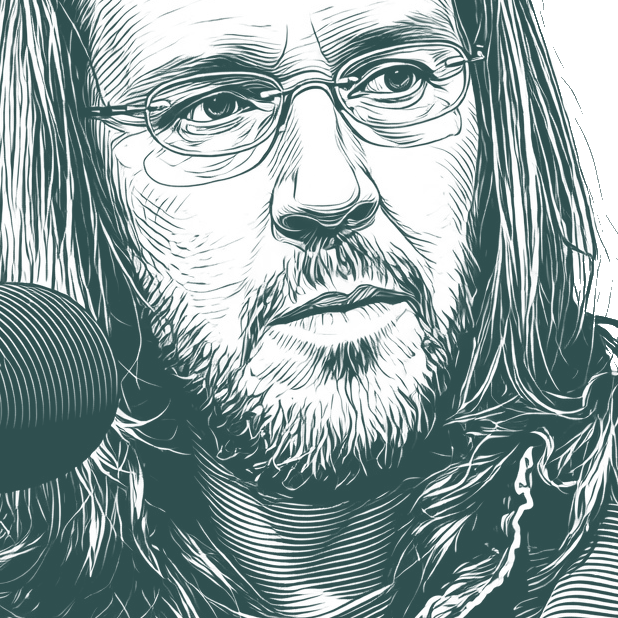
David Foster Wallace (21 February 1962 – 12 September 2008) was an American novelist, essayist, and short story writer. His works include The Broom of the System (novel), Infinite Jest (novel), The Girl With Curious Hair (short story collection), Brief Interviews with Hideous Men (short story collection), A Supposedly Fun Thing I'll Never Do Again (essay collection), and the posthumously-published The Pale King (novel) and Both Flesh and Not (essay collection).
Bio from: Wikiquote (CC BY-SA 4.0) · Portrait adapted from: Wikimedia Commons, Steve Rhodes (CC BY)
From Wikidata (CC0)

"From the line, watching, three things are striking: (a) what on TV is a brisk crack is here a whooming roar that apparently is what a shotgun really sounds like; (b) trapshooting looks comparatively easy, because now the stocky older guy who's replaced the trim bearded guy at the rail is also blowing these little fluorescent plates away one after the other, so that a steady rain of lumpy orange crud is falling into the Nadir's wake; (c) a clay pigeon, when shot, undergoes a frighteningly familiar-looking midflight peripeteia — erupting material, changing vector, and plummeting seaward in a corkscrewy way that all eerily recalls footage of the 1986 Challenger disaster.
All the shooters who precede me seem to fire with a kind of casual scorn, and all get eight out of ten or above. But it turns out that, of these six guys, three have military-combat backgrounds, another two are L. L. Bean-model-type brothers who spend weeks every year hunting various fast-flying species with their "Papa" in southern Canada, and the last has got not only his own earmuffs, plus his own shotgun in a special crushed-velvet-lined case, but also his own trapshooting range in his backyard (31) in North Carolina. When it's finally my turn, the earmuffs they give me have somebody else's ear-oil on them and don't fit my head very well. The gun itself is shockingly heavy and stinks of what I'm told is cordite, small pubic spirals of which are still exiting the barrel from the Korea-vet who preceded me and is tied for first with 10/10. The two brothers are the only entrants even near my age; both got scores of 9/10 and are now appraising me coolly from identical prep-school-slouch positions against the starboard rail. The Greek NCOs seem extremely bored. I am handed the heavy gun and told to "be bracing a hip" against the aft rail and then to place the stock of the weapon against, no, not the shoulder of my hold-the-gun arm but the shoulder of my pull-the-trigger arm. (My initial error in this l
The truth is you already know what it’s like. You already know
the difference between the size and speed of everything that flashes
through you and the tiny inadequate bit of it all you can ever let anyone
know. As though inside you is this enormous room full of what
seems like everything in the whole universe at one time or another and
yet the only parts that get out have to somehow squeeze out through
one of those tiny keyholes you see under the knob in older doors. As if
we are all trying to see each other through these tiny keyholes.
But it does have a knob, the door can open. But not in the way you
think. But what if you could? Think for a second — what if all the infinitely dense and shifting worlds of stuff inside you every moment of your life turned out now to be somehow fully open and expressible afterward,
after what you think of as you has died, because what if afterward
now each moment itself is an infinite sea or span or passage of time in
which to express it or convey it, and you don’t even need any organized
English, you can as they say open the door and be in anyone else’s
room in all your own multiform forms and ideas and facets? Because
listen — we don’t have much time, here’s where Lily Cache slopes
slightly down and the banks start getting steep, and you can just make
out the outlines of the unlit sign for the farmstand that’s never open
anymore, the last sign before the bridge — so listen: What exactly do
you think you are? The millions and trillions of thoughts, memories,
juxtapositions — even crazy ones like this, you’re thinking — that flash
through your head and disappear? Some sum or remainder of these?
Your history? Do you know how long it’s been since I told you I was a
fraud? Do you remember you were looking at the respicem watch
hanging from the rearview and seeing the time, 9:17? What are you looking at right now? Coincidence? What if no time has passed at all?*
The truth is you’ve already heard this. That this is what it’s like.
But most days, if you’re aware enough to give yourself a choice, you can choose to look differently at this fat, dead-eyed, over-made-lady who just screamed at her little child in the checkout line — maybe she’s not usually like this; maybe she’s been up three straight nights holding the hand of her husband who’s dying of bone cancer, or maybe this very lady is the low-wage clerk at the Motor Vehicles Dept. who just yesterday helped your spouse resolve a nightmarish red-tape problem through some small act of bureaucratic kindness. Of course, none of this is likely, but it’s also not impossible — it just depends on what you want to consider. If you’re automatically sure that you know what reality is and who and what is really important — if you want to operate on your default-setting — then you, like me, will not consider possibilities that aren’t pointless and annoying. But if you’ve really learned how to think, how to pay attention, then you will know you have other options. It will actually be within your power to experience a crowded, loud, slow, consumer-hell-type situation as not only meaningful but sacred, on fire with the same force that lit the stars — compassion, love, the sub-surface unity of all things. Not that that mystical stuff’s necessarily true: The only thing that’s capital-T True is that you get to decide how you’re going to try to see it. You get to consciously decide what has meaning and what doesn’t. You get to decide what to worship…
Unlimited Quote Collections
Organize your favorite quotes without limits. Create themed collections for every occasion with Premium.
That distinctive singular stamp of himself is one of the main reasons readers come to love an author. The way you can just tell, often within a couple paragraphs, that something is by Dickens, or Chekhov, or Woolf, or Salinger, or Coetzee, or Ozick. The quality’s almost impossible to describe or account for straight out — it mostly presents as a vibe, a kind of perfume of sensibility — and critics’ attempts to reduce it to questions of “style” are almost universally lame.
There are, apparently, persons who are deeply afraid of their own emotions, particularly the painful ones. Grief, regret, sadness. Sadness especially, perhaps. Dolores describes these persons as afraid of obliteration, emotional engulfment. As if something truly and thoroughly felt would have no end or bottom. Would become infinite and engulf them. I am saying that such persons usually have a very fragile sense of themselves as persons. As existing at all,
Think of the old cliché about “the mind being an excellent servant but a terrible master.” This, like many clichés, so lame and unexciting on the surface, actually expresses a great and terrible truth. It is not the least bit coincidental that adults who commit suicide with firearms almost always shoot themselves in the head. And the truth is that most of these suicides are actually dead long before they pull the trigger.
There is no such thing as not worshipping. Everybody worships. The only choice we get is what to worship. And an outstanding reason for choosing some sort of God or spiritual-type thing to worship — be it J.C. or Allah, be it Yahweh or the Wiccan mother-goddess or the Four Noble Truths or some infrangible set of ethical principles — is that pretty much anything else you worship will eat you alive. If you worship money and things — if they are where you tap real meaning in life — then you will never have enough. Never feel you have enough. It's the truth. Worship your own body and beauty and sexual allure and you will always feel ugly, and when time and age start showing, you will die a million deaths before they finally plant you. On one level, we all know this stuff already — it's been codified as myths, proverbs, clichés, bromides, epigrams, parables: the skeleton of every great story. The trick is keeping the truth up-front in daily consciousness. Worship power — you will feel weak and afraid, and you will need ever more power over others to keep the fear at bay. Worship your intellect, being seen as smart — you will end up feeling stupid, a fraud, always on the verge of being found out. And so on.
What he'd do, he'd never go out to the length of the chain. He'd never even get out to where the chain got tight. Even if the mailman pulled up, or a salesman. Out of dignity, this dog pretended like he chose this one area to stay in that just happened to be inside the length of the chain. Nothing outside of that area right there interested him. He just had zero interest. So he never noticed the chain. He didn't hate it. The chain. He just up and made it not relevant. maybe he wasn't pretending — maybe he really up and chose that little circle for his own world. He had a power to him. All of his life on that chain.
But most days, if you're aware enough to give yourself a choice, you can choose to look differently at this fat, dead-eyed, over-made-up lady who just screamed at her kid in the checkout line. Maybe she's not usually like this. Maybe she's been up three straight nights holding the hand of a husband who is dying of bone cancer. Or maybe this very lady is the low-wage clerk at the motor vehicle department, who just yesterday helped your spouse resolve a horrific, infuriating, red-tape problem through some small act of bureaucratic kindness. Of course, none of this is likely, but it's also not impossible. It just depends what you want to consider. If you're automatically sure that you know what reality is, and you are operating on your default setting, then you, like me, probably won't consider possibilities that aren't annoying and miserable. But if you really learn how to pay attention, then you will know there are other options. It will actually be within your power to experience a crowded, hot, slow, consumer-hell type situation as not only meaningful, but sacred, on fire with the same force that made the stars: love, fellowship, the mystical oneness of all things deep down.
Not that that mystical stuff is necessarily true. The only thing that's capital-T True is that you get to decide how you're gonna try to see it.
This, I submit, is the freedom of a real education, of learning how to be well-adjusted. You get to consciously decide what has meaning and what doesn't. You get to decide what to worship.
almost nothing important that ever happens to you happens because you engineer it. Destiny has no beeper; destiny always leans trenchcoated out of an alley with some sort of 'psst' that you usually can't even hear because you're in such a rush to or from something important you've tried to engineer.