Over periods of 10,000 years the distinctions between Western and Eastern and African cultures lose all meaning. Over a time span of 100,000 years we are all Africans. And over a time span of 300 million years we are all amphibians, waddling uncertainly out of dried-up ponds onto the alien and hostile land.
theoretical physicist and mathematician (1923–2020)
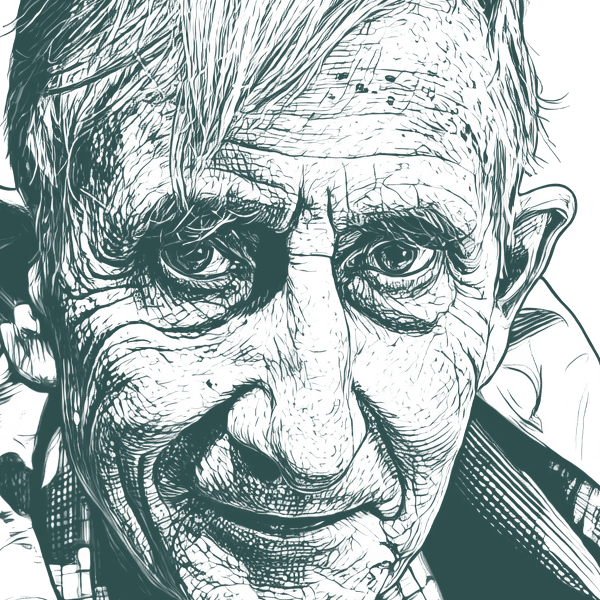
Freeman John Dyson (15 December 1923 – 28 February 2020) was an English-born American physicist, mathematician, and futurist, famous for his work in quantum mechanics, nuclear weapons design and policy, and the search for extraterrestrial intelligence. He was the winner of the Templeton Prize in the year 2000.
Bio from: Wikiquote (CC BY-SA 4.0) · Portrait adapted from: Wikimedia Commons, ioerror (CC BY-SA)
Birth Name:
Freeman John Dyson
Alternative Names:
Freeman J. Dyson
From Wikidata (CC0)
Showing quotes in randomized order to avoid selection bias. Click Popular for most popular quotes.
The essence of Hilbert's program was to find a decision process that would operate on symbols in a purely mechanical fashion, without requiring any understanding of their meaning. Since mathematics was reduced to a collection of marks on paper, the decision process should concern itself only with the marks and not with the fallible human intuitions out of which the marks were reduced. In spite of the prolonged efforts of Hilbert and his disciples, the Entscheidungsproblem was never solved. Success was achieved only in highly restricted domains of mathematics, excluding all the deeper and more interesting concepts. Hilbert never gave up hope, but as the years went by his program became an exercise in formal logic having little connection with real mathematics. Finally, when Hilbert was seventy years old, Kurt Godel proved by a brilliant analysis that the Entscheindungsproblem as Hilbert formulated it cannot be solved.
Godel proved that in any formulation of mathematics, including the rules of ordinary arithmetic, a formal process for separating statements into true and false cannot exist. He proved the stronger result which is now known as Godel's theorem, that in any formalization of mathematics including the rules of ordinary arithmetic there are meaningful arithmetical statements that cannot be proved true or false. Godel's theorem shows conclusively that in pure mathematics reductionism does not work. To decide whether a mathematical statement is true, it is not sufficient to reduce the statement to marks on paper and to study the behavior of the marks. Except in trivial cases, you can decide the truth of a statement only by studying its meaning and its context in the larger world of mathematical ideas.
The primary difference between the classical layer and the quantum layer is that the classical layer deals with facts and the quantum layer deals with probabilities. In situations where classical laws are valid, we can predict the future by observing the past. In situations where quantum laws are valid, we can observe the past but we cannot predict the future. In the quantum layer, events are unpredictable.
I am saying to modern scientists and theologians: don't imagine that our latest ideas about the Big Bang or the human genome have solved the mysteries of the universe or the mysteries of life. Here are Bacon's words again: "The subtlety of nature is greater many times over than the subtlety of the senses and understanding". In the last four hundred years, science has fulfilled many of Bacon's dreams, but it still does not come close to capturing the full subtlety of nature.
When I was a boy in England long ago, people who traveled on
trains with dogs had to pay for a dog ticket. The question arose
whether I needed to buy a dog ticket when I was traveling with a
tortoise. The conductor on the train gave me the answer: “Cats is
dogs and rabbits is dogs but tortoises is insects and travel free
according.
Science is not a monolithic body of doctrine. Science is a culture, constantly growing and changing. The science of today has broken out of the molds of classical nineteenth-century science, just as the paintings of Pablo Picasso and Jackson Pollock broke out of the molds of nineteenth century art. Science has as many competing styles as painting or poetry. The diversity of science also finds a parallel in the diversity of religion.
In contrast to Kuhn, Galison in his classic work Image and Logic, published in 1997, describes the history of particle physics as a history of tools rather than ideas. According to Image and Logic, the progress of science is tool-driven. The tools of particle physics are of two kinds, optical and electronic. The optical tools are devices such as cloud chambers, bubble chambers, and photographic emulsions, which display particle interactions visually by means of images. The images record the tracks of particles. An experienced experimenter can see at once from the image when a particle is doing something unexpected. Optical tools are more likely to lead to discoveries that are qualitatively new.
On the other hand, electronic tools are better for answering quantitative questions. Electronic detectors such as the Geiger counters that measure radioactivity in the cellars of old houses are based on logic. They are programmed to ask simple questions each time they detect a particle, and to record whether the answers to the questions are yes or no. They can detect particle collisions as at rates of millions per second, sort them into yes's and no's, and count the number that answered yes and the number that answered no. The history of particle physics may be divided into two periods, the earlier period ending about 1980 when optical detectors and images were dominant, and the later period when electronic detectors and logic were dominant. Before the transition, science advanced by making qualitative discoveries of new particles and new relationships between particles. After the transition, with the zoo of known particles more or less complete, the science advanced by measuring their interactions with greater and greater precision. In both periods, before and after the transition, tools were the driving force of progress.
Enhance Your Quote Experience
Enjoy ad-free browsing, unlimited collections, and advanced search features with Premium.
Black holes were invented by J. Robert Oppenheimer and Hartland Snyder in 1939. Starting from Einstein's theory of general relativity, Oppenheimer and Snyder found solutions of Einstein's equations that described what happens to a massive star when it has exhausted its supplies of nuclear energy. The star collapses gravitationally and disappears from the visible universe, leaving behind only an intense gravitational field to mark its presence. The star remains in a state of permanent free fall, collapsing endlessly inward into the gravitational pit without ever reaching the bottom. This solution of Einstein's equations was profoundly novel. It has had enormous impact on the later development of astrophysics.
In desperation I asked Fermi whether he was not impressed by the agreement between our calculated numbers and his measured numbers. He replied, "How many arbitrary parameters did you use for your calculations?" I thought for a moment about our cut-off procedures and said, "Four." He said, "I remember my friend Johnny von Neumann used to say, with four parameters I can fit an elephant, and with five I can make him wiggle his trunk." With that, the conversation was over.
Anyone who compares the bibliography with the reprinted papers will notice that mathematics and physics have not been given equal treatment. There is a strong bias in favor of mathematics. The bias arises from the fact that mathematical papers, provided that are correct and not trivial, have permanent value, whereas most papers in physics journals are ephemeral. For this reason, it is customary to publish complete collected works of mathematicians but only selected works of physicists.