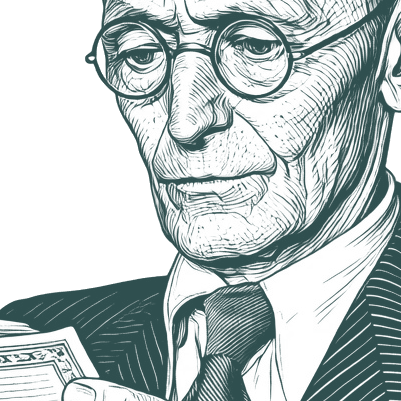
Nobel Prize winning German-Swiss poet, novelist and painter (1877–1962)
Hermann Karl Hesse (2 July 1877 – 9 August 1962) was a German-Swiss poet, novelist, and painter. In 1946, he received the Nobel Prize in Literature. His most famous works include Steppenwolf, Siddhartha, and The Glass Bead Game (also known as Magister Ludi) all of which explore an individual's search for spirituality.
Bio from: Wikiquote (CC BY-SA 4.0) · Portrait adapted from: Wikimedia Commons (CC BY-SA)
From Wikidata (CC0)
I believe . . . that the petal of a flower or a tiny worm on the path says far more, contains far more than all the books in the library. One cannot say very much with mere letters and words. Sometimes I'll be writing a Greek letter, a theta or an omega, and tilt my pen just the slightest bit; suddenly the letter has a tail and becomes a fish; in a second it evokes all the streams and rivers of the world, all that is cool and humid, Homer's sea and the waters on which Saint Peter wandered; or becomes a bird, flaps its tail, shakes out its feathers, puffs itself up, laughs, flies away. You probably don't appreciate letters like that, very much, do you, Narcissus? But I say: with them God wrote the world.
I have no idea whether parents can be of help, and I do not blame mine. It was my own affair to come to terms with myself and to find my own way, and like most well-brought-up children, I managed it badly.
Everyone goes through this crisis. For the average person this is the point when the demands of his own life come into the sharpest conflict with his environment, when the way forward has to be sought with the bitterest means at his command. Many people experience the dying and rebirth - which is our fate - only this once during their entire life. Their childhood becomes hollow and gradually collapses, everything they love abandons them and they suddenly feel surrounded by the loneliness and mortal cold of the universe. Very many are caught forever in this impasse, and for the rest of their lives cling painfully to an irrevocable past, the dream of the lost paradise - which is the worst and most ruthless of dreams.
Limited Time Offer
Premium members can get their quote collection automatically imported into their Quotewise collections.
For me, trees have always been the most penetrating preachers. I revere them when they live in tribes and families, in forests and groves. And even more I revere them when they stand alone. They are like lonely persons. Not like hermits who have stolen away out of some weakness, but like great, solitary men, like Beethoven and Nietzsche. In their highest boughs the world rustles, their roots rest in infinity; but they do not lose themselves there, they struggle with all the force of their lives for one thing only: to fulfil themselves according to their own laws, to build up their own form, to represent themselves. Nothing is holier, nothing is more exemplary than a beautiful, strong tree. When a tree is cut down and reveals its naked death-wound to the sun, one can read its whole history in the luminous, inscribed disk of its trunk: in the rings of its years, its scars, all the struggle, all the suffering, all the sickness, all the happiness and prosperity stand truly written, the narrow years and the luxurious years, the attacks withstood, the storms endured. And every young farmboy knows that the hardest and noblest wood has the narrowest rings, that high on the mountains and in continuing danger the most indestructible, the strongest, the ideal trees grow.