To transform the world, we must begin with ourselves; and what is important in beginning with ourselves is the intention. The intention must be to understand ourselves and not to leave it to others to transform themselves or to bring about a modified change through revolution, either of the left or of the right. It is important to understand that this is our responsibility, yours and mine...
Indian spiritual philosopher, mystic, speaker and writer (1895–1986)
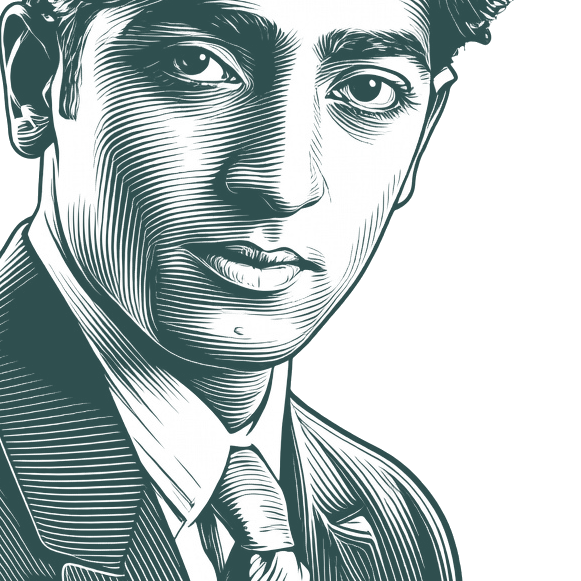
Jiddu Krishnamurti (11 May 1895 – 17 February 1986) was a spiritual teacher, public speaker, and writer, on psychological, sociological, and spiritual subjects.
Bio from: Wikiquote (CC BY-SA 4.0) · Portrait adapted from: Wikimedia Commons (Public domain / CC0)
Pen Names:
K
Native Name:
జిడ్డు
Alternative Names:
J. Krishnamurti
•
Krishnamurti
•
J Krishnamurti
•
Jiddu Krishnamurthy
•
Alsion
•
K.
From Wikidata (CC0)
Showing quotes in randomized order to avoid selection bias. Click Popular for most popular quotes.
"To stand alone is to be uncorrupted, innocent, free of all tradition, of dogma, of opinion, of what another says, and so on. Such a mind does not seek because there is nothing to seek; being free, such a mind is completely still without a want, without movement.
But this state is not to be achieved; it isn't a thing that you buy through discipline; it doesn't come into being by giving up sex, or practicing a certain yoga.
It comes into being only when there is understanding of the ways of the self, the 'me', which shows itself through the conscious mind in everyday activity, and also in the unconscious. What matters is to understand for oneself, not through the direction of others, the total content of consciousness, which is conditioned, which is the result of society, of religion, of various impacts, impressions, memories - to understand all that conditioning and be free of it. But there is no "how" to be free. If you ask how to be free, you are not listening."
Are we wasting our lives? By that word “wasting” we mean dissipating our energy in various ways, dissipating it in specialized professions. Are we wasting our whole existence, our life? If you are rich, you may say, “Yes, I have accumulated a lot of money, it has been a great pleasure.” Or if you have a certain talent, that talent is a danger to a religious life. Talent is a gift, a faculty, an aptitude in a particular direction, which is specialization. Specialization is a fragmentary process. So you must ask yourself whether you are wasting your life. You may be rich, you may have all kinds of faculties, you may be a specialist, a great scientist or a businessman, but at the end of your life has all that been a waste? All the travail, all the sorrow, all the tremendous anxiety, insecurity, the foolish illusions that man has collected, all his gods, all his saints and so on — have all that been a waste? You may have power, position, but at the end of it — what? Please, this is a serious question that you must ask yourself. Another cannot answer this question for you.
To find out actually what takes place when you die you must
die. This isn't a joke. You must die - not physically but
psychologically, inwardly, die to the things you have cherished and
to the things you are bitter about. If you have died to one of your
pleasures, the smallest or the greatest, naturally, without any
enforcement or argument, then you will know what it means to die.
To die is to have a mind that is completely empty of itself, empty
of its daily longing, pleasure; and agonies. Death is a renewal, a
mutation, in which thought does not function at all because thought
is old. When there is death there is something totally new. Freedom
from the known is death, and then you are living.
And the brain has been trained to record because then in that recording there is safety, there is security, there is strength, a vitality, and therefore in that recording the mind creates the image about oneself. Right? And that image will constantly get hurt. So is it possible to live without a single image? Go into it, sir. Don't please go to sleep. Single image about yourself, about your husband, wife, children, friend and so on, about the politicians, about the priests, about the ideals, not a single shadow of an image? We are saying it is possible, must be, otherwise you will always be getting hurt, always living in a pattern. In that there is no freedom. And when you call me an idiot, to be so attentive at that moment. Right? When you give complete attention there is no recording. It is only when there is not attention, inattention, you record. I wonder if you capture this. Is it getting too difficult? Too abstract? That is, you flatter me. I like it. The liking at that moment is inattention. In that moment there is no attention. Therefore recording takes place. But when you flatter me, instead of calling me an idiot, now you have gone to the other extreme, flatter me, to listen to it so completely, without any reaction, then there is no centre which records.
First, we must be very clear that you and the speaker are treating life not as a problem but as a tremendous movement. If your brain is trained to solve problems, then you will treat this movement as a problem to be solved. Is it possible to look at life with all its questions, with all its issues, which is tremendously complex, to look at it not as a problem, but to observe it clearly, without bias, without coming to some conclusion which will then dictate your observation? You have to observe this vast movement of life, not only your own particular life, but the life of all humanity, the life of the earth, the life of the trees, the life of the whole world — look at it, observe it, move with it, but if you treat it as a problem, then you will create more problems.
There are those who don’t believe in God and yet do good. There are those who believe in God and kill for that belief; those who prepare for war because they claim they want peace, and so on. So one has to ask oneself what need there is to believe at all in anything, though this doesn’t deny the extraordinary mystery of life. But belief is a word, a thought, and this is not the thing, anymore than your name is actually you.
Through experience you hope to touch the truth of your belief, to prove it to yourself, but this belief conditions your experience. It isn’t that the experience comes to prove the belief, but rather that the belief begets the experience. Your belief in God will give you the experience of what you call God. You will always experience what you believe and nothing else.
Most of us, as we grow older, become frightened; we are afraid of living, afraid of losing a job, afraid of tradition, afraid of what the neighbours, or what the wife or husband would say, afraid of death. Most of us have fear in one form or another; and where there is fear there is no intelligence.
You cannot find truth through anybody else. How can you? Surely, truth is not something static; it has no fixed abode; it is not an end, a goal. On the contrary, it is living, dynamic, alert, alive. How can it be an end? If truth is a fixed point, it is no longer truth; it is then a mere opinion. Sir, truth is the unknown, and a mind that is seeking truth will never find it. For mind is made up of the known; it is the result of the past, the outcome of time — which you can observe for yourself. Mind is the instrument of the known; hence it cannot find the unknown; it can only move from the known to the known. When the mind seeks truth, the truth it has read about in books, that "truth" is self-projected, for then the mind is merely in pursuit of the known, a more satisfactory known than the previous one. When the mind seeks truth, it is seeking its own self-projection, not truth. After all, an ideal is self-projected; it is fictitious, unreal. What is real is what is, not the opposite. But a mind that is seeking reality, seeking God, is seeking the known. When you think of God, your God is the projection of your own thought, the result of social influences. You can think only of the known; you cannot think of the unknown, you cannot concentrate on truth. The moment you think of the unknown, it is merely the self-projected known. So, God or truth cannot be thought about. If you think about it, it is not truth. Truth cannot be sought; it comes to you. You can go after only what is known. When the mind is not tortured by the known, by the effects of the known, then only can truth reveal itself. Truth is in every leaf, every tear; it is to be known from moment to moment. No one can lead you to truth; and if anyone leads you, it can only be to the known.