The Ambassador answered us that it was founded on the laws of their Prophet; that it was written in their Koran; that all nations who should not have acknowledged their authority were sinners; that it was their right and duty to make war upon them wherever they could be found, and to make slaves of all they could take as prisoners; and that every Mussulman who was slain in battle was sure to go to Paradise. He said, also, that the man who was the first to board a vessel had one slave over and above his share, and that when they sprang to the deck of an enemy's ship, every sailor held a dagger in each hand and a third in his mouth; which usually struck such terror into the foe that they cried out for quarter at once. That it was a law that the first who boarded an Enemy’s Vessell should have one slave.
Founding Father, U.S. president from 1797 to 1801
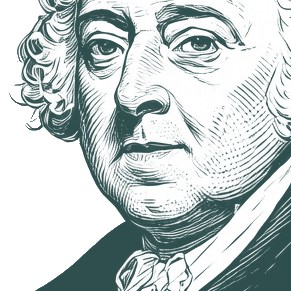
John Adams (30 October 1735 – 4 July 1826) was an American lawyer, author, statesman, and diplomat. He served as the second president of the United States (1797–1801), the first vice president (1789–1797), and as a Founding Father was a leader of American independence from the British Empire. Adams was a political theorist in the Age of Enlightenment who promoted republicanism and a strong central government. His innovative ideas were frequently published. He was also a dedicated diarist and correspondent, particularly with his wife and key advisor Abigail. He was the father of John Quincy Adams.
Bio from: Wikiquote (CC BY-SA 4.0) · Portrait adapted from: Wikimedia Commons, Gilbert Stuart (Public domain / CC0)
Pen Names:
Novanglus
Alternative Names:
J. Adams
From Wikidata (CC0)

Showing quotes in randomized order to avoid selection bias. Click Popular for most popular quotes.
Here we shall be obliged to consider the reputed opinion of another philosopher, I mean Dr. Franklin. I say reputed, because I am not able to affirm that it is really his. It is, however, so generally understood and reported, both in Europe and America, that his judgment was in opposition to two assemblies, and in favor of a single one, that in a disquisition like this it ought not to be omitted.
Enhance Your Quote Experience
Enjoy ad-free browsing, unlimited collections, and advanced search features with Premium.
The Second Day of July 1776, will be the most memorable Epocha, in the History of America. I am apt to believe that it will be celebrated, by succeeding Generations, as the great anniversary Festival. It ought to be commemorated, as the Day of Deliverance by solemn Acts of Devotion to God Almighty. It ought to be solemnized with Pomp and Parade, with Shews, Games, Sports, Guns, Bells, Bonfires and Illuminations from one End of this Continent to the other from this Time forward forever more. You will think me transported with Enthusiasm but I am not. I am well aware of the Toil and Blood and Treasure, that it will cost Us to maintain this Declaration, and support and defend these States. Yet through all the Gloom I can see the Rays of ravishing Light and Glory. I can see that the End is more than worth all the Means. And that Posterity will tryumph in that Days Transaction, even altho We should rue it, which I trust in God We shall not.
If the Christian religion, as I understand it, or as you understand it, should maintain its ground, as I believe it will, yet Platonic, Pythagoric, Hindoo, and cabalistic Christianity, which is Catholic Christianity, and which has prevailed for 1,500 years, has received a mortal wound, of which the monster must finally die. Yet so strong is his constitution, that he may endure for centuries before he expires.
Unlimited Quote Collections
Organize your favorite quotes without limits. Create themed collections for every occasion with Premium.
Now to what higher object, to what greater character, can any mortal aspire than to be possessed of all this knowledge, well digested and ready at command, to assist the feeble and friendless, to discountenance the haughty and lawless, to procure redress to wrongs, the advancement of rights, to assert and maintain liberty and virtue to discourage and abolish tyranny and vice.
A meeting we accordingly had, and conned the paper over. I was delighted with its high tone and the flights of oratory with which it abounded, especially that concerning negro slavery, which, though I knew his Southern brethren would never suffer to pass in Congress, I certainly never would oppose. There were other expressions which I would not have inserted, if I had drawn it up, particularly that which called the King tyrant. I thought this too personal; for I never believed George to be a tyrant in disposition and in nature; I always believed him to be deceived by his courtiers on both sides of the Atlantic, and in his official capacity only, cruel. I thought the expression too passionate, and too much like scolding, for so grave and solemn a document; but as Franklin and Sherman were to inspect it afterwards, I thought it would not become me to strike it out. I consented to report it, and do not now remember that I made or suggested a single alteration. We reported it to the committee of five. It was read, and I do not remember that Franklin or Sherman criticized any thing. We were all in haste. Congress was impatient, and the instrument was reported, as I believe, in Jefferson’s handwriting, as he first drew it. Congress cut off about a quarter of it, as I expected they would; but they obliterated some of the best of it, and left all that was exceptionable, if any thing in it was. I have long wondered that the original draught has not been published. I suppose the reason is, the vehement philippic against negro slavery.
from all I have read of the history of Greece and Rome, England and France, and all I have observed at home and abroad, eloquence in public assemblies is not the surest road to fame or preferment, at least, unless it be used with caution, very rarely, and with great reserve. The examples of Washington, Franklin, and Jefferson, are enough to show that silence and reserve in public, are more efficacious than argumentation or oratory. A public speaker who inserts himself, or is urged by others, into the conduct of affairs, by daily exertions to justify his measures, and answer the objections of opponents, makes himself too familiar with the public, and unavoidably makes himself enemies. Few persons can bear to be outdone in reasoning or declamation or wit or sarcasm or repartee or satire, and all these things are very apt to grow out of public debate. In this way, in a course of years, a nation becomes full of a man’s enemies, or at least, of such as have been galled in some controversy, and take a secret pleasure in assisting to humble and mortify him.