The science of government it is my duty to study, more than all other sciences; the arts of legislation and administration and negotiation ought to take the place of, indeed exclude, in a manner, all other arts. I must study politics and war, that our sons may have liberty to study mathematics and philosophy. Our sons ought to study mathematics and philosophy, geography, natural history and naval architecture, navigation, commerce and agriculture in order to give their children a right to study painting, poetry, music, architecture, statuary, tapestry and porcelain.
Founding Father, U.S. president from 1797 to 1801
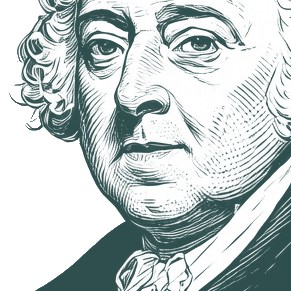
John Adams (30 October 1735 – 4 July 1826) was an American lawyer, author, statesman, and diplomat. He served as the second president of the United States (1797–1801), the first vice president (1789–1797), and as a Founding Father was a leader of American independence from the British Empire. Adams was a political theorist in the Age of Enlightenment who promoted republicanism and a strong central government. His innovative ideas were frequently published. He was also a dedicated diarist and correspondent, particularly with his wife and key advisor Abigail. He was the father of John Quincy Adams.
Bio from: Wikiquote (CC BY-SA 4.0) · Portrait adapted from: Wikimedia Commons, Gilbert Stuart (Public domain / CC0)
Pen Names:
Novanglus
Alternative Names:
J. Adams
From Wikidata (CC0)

It is more important that innocence be protected than it is that guilt be punished, for guilt and crimes are so frequent in this world that they cannot all be punished.
But if innocence itself is brought to the bar and condemned, perhaps to die, then the citizen will say, 'whether I do good or whether I do evil is immaterial, for innocence itself is no protection,' and if such an idea as that were to take hold in the mind of the citizen that would be the end of security whatsoever.
I do not say that democracy has been more pernicious on the whole, and in the long run, than monarchy or aristocracy. Democracy has never been and never can be so durable as aristocracy or monarchy; but while it lasts, it is more bloody than either. … Remember, democracy never lasts long. It soon wastes, exhausts, and murders itself. There never was a democracy yet that did not commit suicide. It is in vain to say that democracy is less vain, less proud, less selfish, less ambitious, or less avaricious than aristocracy or monarchy. It is not true, in fact, and nowhere appears in history. Those passions are the same in all men, under all forms of simple government, and when unchecked, produce the same effects of fraud, violence, and cruelty. When clear prospects are opened before vanity, pride, avarice, or ambition, for their easy gratification, it is hard for the most considerate philosophers and the most conscientious moralists to resist the temptation. Individuals have conquered themselves. Nations and large bodies of men, never.
Enhance Your Quote Experience
Enjoy ad-free browsing, unlimited collections, and advanced search features with Premium.
While our country remains untainted with the principles and manners which are now producing desolation in so many parts of the world; while she continues sincere, and incapable of insidious and impious policy, we shall have the strongest reason to rejoice our local destination. But should the people of America once become capable of that deep simulation towards one another, and towards foreign nations, which assumes the language of justice and moderation, while it is practising iniquity and extravagance, and displays in the most captivating manner the charming pictures of candour, frankness, and sincerity, while it is rioting in rapine and insolence, this country will be the most miserable habitation in the world.
Daughter! Get you an honest Man for a Husband, and keep him honest. No matter whether he is rich, provided he be independent. Regard the Honour and moral Character of the Man more than all other Circumstances. Think of no other Greatness but that of the soul, no other Riches but those of the Heart. An honest, Sensible humane Man, above all the Littlenesses of Vanity, and Extravagances of Imagination, labouring to do good rather than be rich, to be usefull rather than make a show, living in a modest Simplicity clearly within his Means and free from Debts or Obligations, is really the most respectable Man in Society, makes himself and all about him the most happy.
"It was the general opinion of ancient nations, that the divinity alone was adequate to the important office of giving laws to men... and modern nations, in the consecrations of kings, and in several superstitious chimeras of divine rights in princes and nobles, are nearly unanimous in preserving remnants of it... Is the jealousy of power, and the envy of superiority, so strong in all men, that no considerations of public or private utility are sufficient to engage their submission to rules for their own happiness? Or is the disposition to imposture so prevalent in men of experience, that their private views of ambition and avarice can be accomplished only by artifice? — … There is nothing in which mankind have been more unanimous; yet nothing can be inferred from it more than this, that the multitude have always been credulous, and the few artful. The United States of America have exhibited, perhaps, the first example of governments erected on the simple principles of nature: and if men are now sufficiently enlightened to disabuse themselves of artifice, imposture, hypocrisy, and superstition, they will consider this event as an era in their history. Although the detail of the formation of the American governments is at present little known or regarded either in Europe or America, it may hereafter become an object of curiosity. It will never be pretended that any persons employed in that service had any interviews with the gods, or were in any degree under the inspiration of heaven, any more than those at work upon ships or houses, or labouring in merchandize or agriculture: it will for ever be acknowledged that these governments were contrived merely by the use of reason and the senses. As Copley painted Chatham, West, Wolf, and Trumbull, Warren and Montgomery; as Dwight, Barlow, Trumbull, and Humphries composed their verse, and Belknap and Ramzay history; as Godfrey invented his quadrant, and Rittenhouse his planetarium; as Boylston practised inoculation, and <a