American author and humorist (1835–1910)
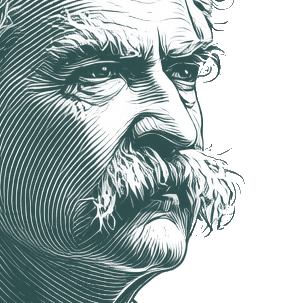
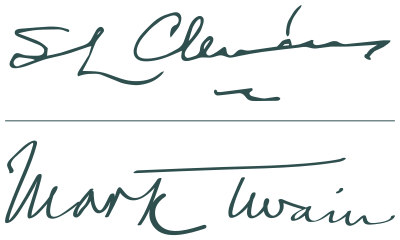
Samuel Langhorne Clemens (November 30, 1835 – April 21, 1910), known as Mark Twain, was an American humorist, novelist, writer, and lecturer.
Bio from: Wikiquote (CC BY-SA 4.0) · Portrait adapted from: Wikimedia Commons (Public domain / CC0)
Pen Names:
Sieur Louis de Conte
•
Thomas Jefferson Snodgrass
•
Quintus Curtius Snodgrass
•
J. W. Bothwell
Birth Name:
Samuel Langhorne Clemens
Alternative Names:
Samuel L. Clemens
•
Samuel Clemens
•
Louis de Conte
From Wikidata (CC0)
Showing quotes in randomized order to avoid selection bias. Click Popular for most popular quotes.
I know your race. It is made up of sheep. It is governed by minorities, seldom or never by majorities. It suppresses its feelings and its beliefs and follows the handful that makes the most noise. Sometimes the noisy handful is right, sometimes wrong; but no matter, the crowd follows it. The vast majority of the race, whether savage or civilized, are secretly kind-hearted and shrink from inflicting pain, but in the presence of the aggressive and pitiless minority they don't dare to assert themselves. Think of it! One kind-hearted creature spies upon another, and sees to it that he loyally helps in iniquities which revolt both of them. Speaking as an expert, I know that ninety- nine out of a hundred of your race were strongly against the killing of witches when that foolishness was first agitated by a handful of pious lunatics in the long ago. And I know that even to-day, after ages of transmitted prejudice and silly teaching, only one person in twenty puts any real heart into the harrying of a witch. And yet apparently everybody hates witches and wants them killed. Some day a handful will rise up on the other side and make the most noise — perhaps even a single daring man with a big voice and a determined front will do it — and in a week all the sheep will wheel and follow him, and witch-hunting will come to a sudden end.
Monarchies, aristocracies, and religions are all based upon that large defect in your race — the individual's distrust of his neighbor, and his desire, for safety's or comfort's sake, to stand well in his neighbor's eye. These institutions will always remain, and always flourish, and always oppress you, affront you, and degrade you, because you will always be and remain slaves of minorities. There was never a country where the majority of the people were in their secret hearts loyal to any of these institutions.
Against our traditions we are now entering upon an unjust and trivial war, a war against a helpless people, and for a base object — robbery. At first our citizens spoke out against this thing, by an impulse natural to their training. Today they have turned, and their voice is the other way. What caused the change? Merely a politician's trick — a high-sounding phrase, a blood-stirring phrase which turned their uncritical heads: Our Country, right or wrong! An empty phrase, a silly phrase. It was shouted by every newspaper, it was thundered from the pulpit, the Superintendent of Public Instruction placarded it in every schoolhouse in the land, the War Department inscribed it upon the flag. And every man who failed to shout it or who was silent, was proclaimed a traitor — none but those others were patriots. To be a patriot, one had to say, and keep on saying, "Our Country, right or wrong," and urge on the little war. Have you not perceived that that phrase is an insult to the nation? For in a republic, who is "the Country"? Is it the Government which is for the moment in the saddle? Why, the Government is merely a servant — merely a temporary servant; it cannot be its prerogative to determine what is right and what is wrong, and decide who is a patriot and who isn't. Its function is to obey orders, not originate them. Who, then, is "the country?" Is it the newspaper? Is it the pulpit? Is it the school-superintendent? Why, these are mere parts of the country, not the whole of it; they have not command, they have only their little share in the command. They are but one in the thousand; it is in the thousand that command is lodged; they must determine what is right and what is wrong; they must decide who is a patriot and who isn't.