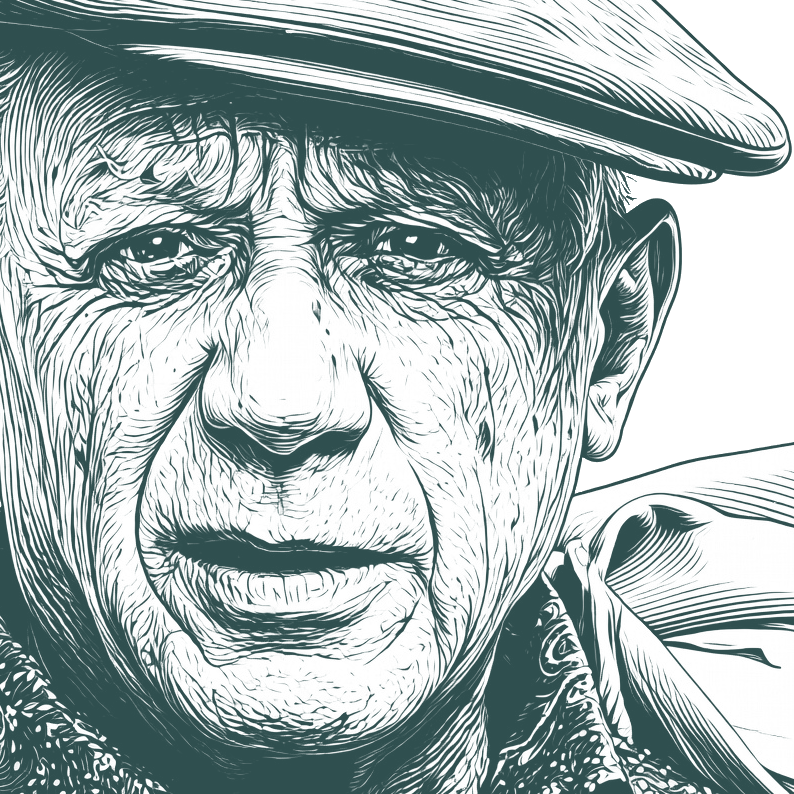
Spanish painter and sculptor (1881–1973)
Pablo Ruiz Picasso (25 October 1881 – 8 April 1973) was a Spanish artist who lived and worked in Paris for many years. Around 1906–1908 together with Georges Braque Picasso initiated cubism, based on a strong inspiration of Paul Cézanne's work.
From: Wikiquote (CC BY-SA 4.0)
Alternative Names:
Pablo Ruiz Y Picasso
•
Pablo Ruiz
•
Pablo Ruys Picasso
•
Pablo Ruiz Picasso
•
Pablo Ruys
•
Picasso
•
Pablo Ruiz y Picasso
•
Pablo Diego José Francisco de Paula Juan Nepomuceno Crispín Crispiniano de la Santissima Trinidad Ruiz Blasco Picasso
•
Pablo Diego Jose Francisco de Paula Juan Nepomuceno Crispin Crispiniano de la Santissima Trinidad Ruiz Blasco Picasso
•
P. Picasso
•
Pablo Diego José Francisco de Paula Juan Nepomuceno Cipriano de la Santísima Trinidad Ruiz Picasso
•
Pablo Diego José Francisco de Paula Juan Nepomuceno Crispín Cipriano de la Santísima Trinidad María de los Remedios Alarcón y Herrera Ruiz Picasso
•
Pablo Diego José Francisco de Paula Juan Nepomuceno Crispín Crispiniano de la Santísima Trinidad María de los Remedios Alarcón y Herrera Ruiz Picasso
From Wikidata (CC0)
Showing quotes in randomized order to avoid selection bias. Click Popular for most popular quotes.
Enhance Your Quote Experience
Enjoy ad-free browsing, unlimited collections, and advanced search features with Premium.
It would be very curious to record by means of photographs, not the stage of the picture, but its metamorphoses. Perhaps one would perceive the path taken by the mind in order to put its dreams into a concrete form. But what is really very curious is to observe that fundamentally the picture does not change, that despite appearances the initial vision remains almost intact (Boisgeloup, winter 1934).
How can you expect a beholder to experience my picture as I experienced it? A picture comes to me a long time beforehand; who knows how long a time beforehand, I sensed, saw, and painted it and yet the next day even I do not understand what I have done. How can anyone penetrate my dreams, my instincts, my desires, my thought, which have taken a long time to fashion themselves and come to the surface, above all to grasp what I put there, perhaps involuntary.
The idea of research has often made painting go astray, and made the artist lose himself in mental lucubrations. Perhaps this has been the principal fault of modern art. The spirit of research has poisoned those who have not fully understood all the positive and conclusive elements in modern art and has made them attempt to paint the invisible and, therefore, the unpaintable.
It is not what the artist does that counts. But what he is. Cézanne would never have interested me if he had lived and thought like Jaques-Emile Blanche, even if the apple he had painted had been ten times more beautiful. What interests us is the anxiety of Cézanne, the teaching of Cézanne, the anguish of Van Gogh, in short the inner drama of the man. The rest is false. [Boisgeloup, winter 1934].