In the countries more fortunate than ours, the people discover their land in the ‘histories' of their countries which introduces them in their childhood to their land. In our case only the reverse has been true. It is the history of our country that has obscured the understanding, of our land... The way in which we receive education since our childhood leads everyday to a feeling of separation between us and our land till at some point we feel rebellious against it. Even the educated people of our country cry out in a dazed fashion from time to time: what do you call a country? What is its special spirit or ethos, and where is this spirit embedded or lay embedded before? Such questions do not lead you to what you are looking for... The prisms of the glasses given by others may be suitable for moving along familiar roads; they may be very necessary to wring oil out of the oil-presses ‘of examinations, but while trying to disown past mistakes and acquire new truths they are very unsuitable.
Bengali poet, philosopher and polymath (1861–1941)
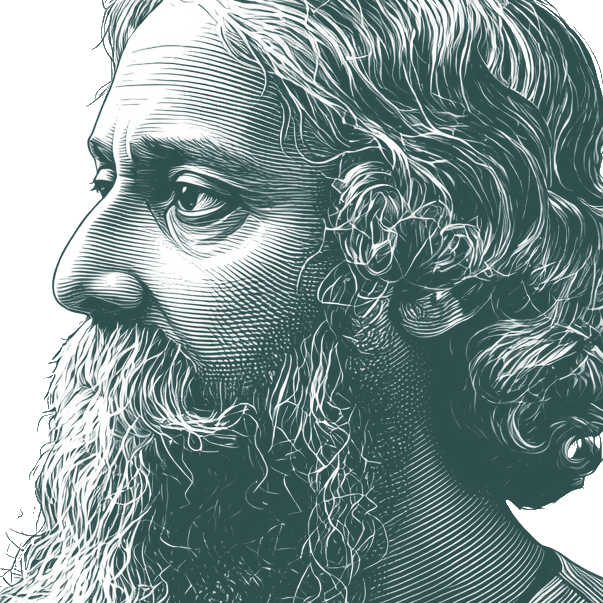
Rabindranath Tagore (7 May 1861 – 7 August 1941), also known as Rabi Thakur, was a Bengali philosopher, poet, and winner of the Nobel Prize for literature in 1913.
Bio from: Wikiquote (CC BY-SA 4.0) · Portrait adapted from: Wikimedia Commons, Generalstabens litografiska anstalt (Public domain / CC0)
Pen Names:
ভানুসিংহ
Native Name:
রবীন্দ্রনাথ
Alternative Names:
Rabīndranātha Thākur
•
Kabiguru
•
Tagore
•
Bishwakabi
•
R. Tagore
•
Rabindranat Tagor
•
Bhanu Singha Thakur
•
Gurudev
•
Biswakabi
•
Nyi Wang Gönpo
•
Tagore, rabindranath
•
Ravindranath Thakur
From Wikidata (CC0)

Showing quotes in randomized order to avoid selection bias. Click Popular for most popular quotes.
I AM RESTLESS
AM restless. I am athirst for far-away things.
My soul goes out in a longing to touch the skirt of the dim distance.
O Great Beyond, O the keen call of thy flute!
I forget, I ever forget, that I have no wings to fly, that I am bound in this spot evermore.
I am eager and wakeful, I am a stranger in a strange land.
Thy breath comes to me whispering an impossible hope.
Thy tongue is known to my heart as its very own.
O Far-to-seek, O the keen call of thy flute!
I forget, I ever forget, that I know not the way, that I have not the winged horse.
I am listless, I am a wanderer in my heart.
In the sunny haze of the languid hours, what vast vision of thine takes shape in the blue of the sky!
O Farthest end, O the keen call of thy flute!
I forget, I ever forget, that the gates are shut everywhere in the house where I dwell alone!
Works in ChatGPT, Claude, or Any AI
Add semantic quote search to your AI assistant via MCP. One command setup.
One of the many suppressed longings of creation which cry after fulfilment is for neglected joys within reach; while we are busy pursuing chimerical impossibilities we famish our lives...The emptiness left by easy joys, untasted, is ever growing in my life. And the day may come when I shall feel that, could I but have the past back, I would strive no more after the unattainable, but drain to the full these little, unsought, everyday joys which life offers.
When such imagination and sympathy are essential to write India’s history, We cannot depend on others. There is no objection to receiving, help from others when it comes to the collection of facts, but to weave these facts into a whole and make them alive we have to use our own strength. If Indians write the history of India there is some chance of partisanship or bias, but it is contempt and lack of sympathy which distort historical writing far more than bias or partisanship: Besides, while writing history, foreigners get tempted to impose the ideals of one country upon another; that also cannot be considered a blessing: Whether it will be possible or not, we shall rescue OUT own history from the hands of others: we shall look at India with out free eyes—that joyous time has arrived”
PREMIUM FEATURE
Advanced Search Filters
Filter search results by source, date, and more with our premium search tools.
Our passions and desires are unruly, but our character subdues these elements into a harmonious whole. Does something similar to this happen in the physical world? Are the elements rebellious, dynamic with individual impulse? And is there a principle in the physical world which dominates them and puts them into an orderly organization? … It is the constant harmony of chance and determination which makes it eternally new and living.
It is for dignity of being that we aspire through the expansion of our consciousness in a great reality of Man to which we belong. We realize it through admiration and love, through hope that soars beyond the actual, beyond our own span of life into an endless time wherein we live the life of all men.
When I bring to you coloured toys, my child, I understand why there is such a play of colours on clouds, on water, and why flowers are painted in tints — -when I give coloured toys to you, my child.
When I sing to make you dance I truly now why there is music in leaves, and why waves send their chorus of voices to the heart of the listening earth — -when I sing to make you dance.
When I bring sweet things to your greedy hands I know why there is honey in the cup of the flowers and why fruits are secretly filled with sweet juice — -when I bring sweet things to your greedy hands.
When I kiss your face to make you smile, my darling, I surely understand what pleasure streams from the sky in morning light, and what delight that is that is which the summer breeze brings to my body — -when I kiss you to make you smile.
In love, at one of its poles you find the personal, and at the other the impersonal. At one you have the positive assertion — Here I am; at the other the equally strong denial — I am not. Without this ego what is love? And again, with only this ego how can love be possible? Bondage and liberation are not antagonistic in love. For love is most free and at the same time most bound. If God were absolutely free there would be no creation. The infinite being has assumed unto himself the mystery of finitude. And in him who is love the finite and the infinite are made one.