Bengali poet, philosopher and polymath (1861–1941)
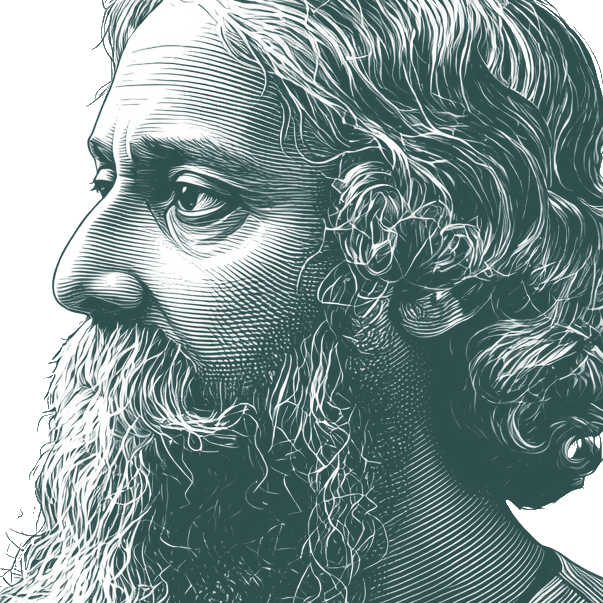
Rabindranath Tagore (7 May 1861 – 7 August 1941), also known as Rabi Thakur, was a Bengali philosopher, poet, and winner of the Nobel Prize for literature in 1913.
Bio from: Wikiquote (CC BY-SA 4.0) · Portrait adapted from: Wikimedia Commons, Generalstabens litografiska anstalt (Public domain / CC0)
From Wikidata (CC0)

When I bring to you coloured toys, my child, I understand why there is such a play of colours on clouds, on water, and why flowers are painted in tints — -when I give coloured toys to you, my child.
When I sing to make you dance I truly now why there is music in leaves, and why waves send their chorus of voices to the heart of the listening earth — -when I sing to make you dance.
When I bring sweet things to your greedy hands I know why there is honey in the cup of the flowers and why fruits are secretly filled with sweet juice — -when I bring sweet things to your greedy hands.
When I kiss your face to make you smile, my darling, I surely understand what pleasure streams from the sky in morning light, and what delight that is that is which the summer breeze brings to my body — -when I kiss you to make you smile.
Limited Time Offer
Premium members can get their quote collection automatically imported into their Quotewise collections.
In a letter dated 10 November 1937, Tagore explained the true story: ‘A certain high official in His Majesty’s service, who was also my friend, had requested that I write a song of felicitation towards the Emperor. The request simply amazed me. It caused a great stir in my heart. In response to that great mental turmoil, I pronounced the victory in Jana Gana Mana of that Bhagya Bidhata (Bengali pronunciation; “dispenser of destiny”) of India who has from age after age held steadfast the reins of India’s chariot through rise and fall, through the straight path and the curved. That Lord of Destiny, that Reader of the Collective Mind of India, that Perennial Guide, could never be George V, George VI, or any other George. Even my official friend understood this about the song. After all, even if his admiration for the crown was excessive, he was not lacking in simple common sense.’
Clouds heap upon clouds and it darkens. Ah, love, why dost thou let me wait outside at the door all alone?
In the busy moments of the noontide work I am with the crowd, but on this dark lonely day it is only for thee that I hope.
If thou showest me not thy face, if thou leavest me wholly aside, I know not how I am to pass these long, rainy hours.
I keep gazing on the far-away gloom of the sky, and my heart wanders wailing with the restless wind.
When such imagination and sympathy are essential to write India’s history, We cannot depend on others. There is no objection to receiving, help from others when it comes to the collection of facts, but to weave these facts into a whole and make them alive we have to use our own strength. If Indians write the history of India there is some chance of partisanship or bias, but it is contempt and lack of sympathy which distort historical writing far more than bias or partisanship: Besides, while writing history, foreigners get tempted to impose the ideals of one country upon another; that also cannot be considered a blessing: Whether it will be possible or not, we shall rescue OUT own history from the hands of others: we shall look at India with out free eyes—that joyous time has arrived”