The combination of these two facts — the longing in the depth of the heart for absolute good, and the power, though only latent, of directing attention and love to a reality beyond the world and of receiving good from it — constitutes a link which attaches every man without exception to that other reality. Whoever recognizes that reality recognizes also that link. Because of it, he holds every human being without any exception as something sacred to which he is bound to show respect. This is the only possible motive for universal respect towards all human beings. Whatever formulation of belief or disbelief a man may choose to make, if his heart inclines him to feel this respect, then he in fact also recognizes a reality other than this world's reality. Whoever in fact does not feel this respect is alien to that other reality also.
French philosopher, writer, and social activist (1909–1943)
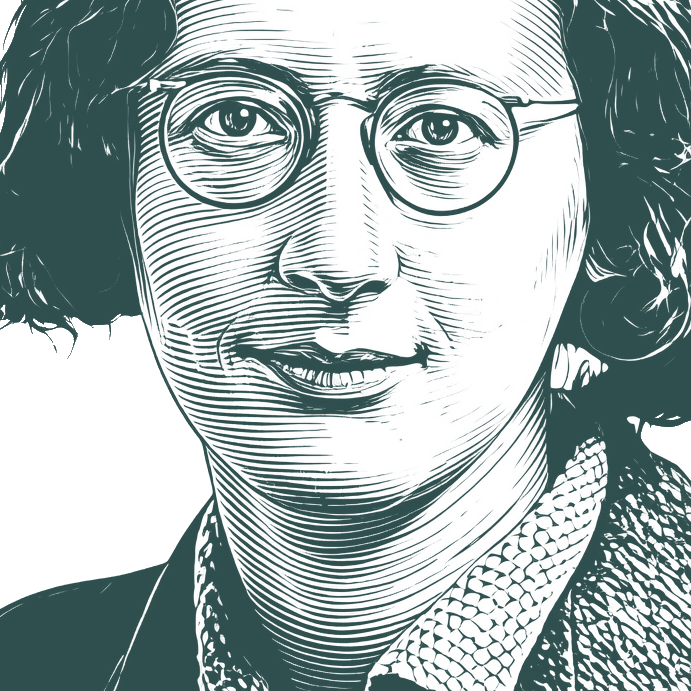
Simone Adolphine Weil (3 February 1909 – 24 August 1943) was a French social and religious philosopher, and Christian mystic. Politically active, during the Spanish Civil War she joined the Anarchist military unit known as the Durruti Column, and took part in the French Resistance during World War II. She was the sister of mathematician André Weil, with whom she shared an interest in ancient Greek and Indian thought.
Bio from: Wikiquote (CC BY-SA 4.0) · Portrait adapted from: Wikimedia Commons (Public domain / CC0)
Pen Names:
Émile Novis
•
S. Galois
Alternative Names:
Simone Adolphine Weil
From Wikidata (CC0)

There is a reality outside the world, that is to say, outside space and time, outside man's mental universe, outside any sphere whatsoever that is accessible to human faculties. Corresponding to this reality, at the centre of the human heart, is the longing for an absolute good, a longing which is always there and is never appeased by any object in this world. Another terrestrial manifestation of this reality lies in the absurd and insoluble contradictions which are always the terminus of human thought when it moves exclusively in this world.
Just as the reality of this world is the sole foundation of facts, so that other reality is the sole foundation of good. That reality is the unique source of all the good that can exist in this world: that is to say, all beauty, all truth, all justice, all legitimacy, all order, and all human behaviour that is mindful of obligations. Those minds whose attention and love are turned towards that reality are the sole intermediary through which good can descend from there and come among men. Although it is beyond the reach of any human faculties, man has the power of turning his attention and love towards it. Nothing can ever justify the assumption that any man, whoever he may be, has been deprived of this power. It is a power which is only real in this world in so far as it is exercised. The sole condition for exercising it is consent. This act of consent may be expressed, or it may not be, even tacitly; it may not be clearly conscious, although it has really taken place in the soul. Very often it is verbally expressed although it has not in fact taken place. But whether expressed or not, the one condition suffices: that it shall in fact have taken place. To anyone who does actually consent to directing his attention and love beyond the world, towards the reality that exists outside the reach of all human faculties, it is given to succeed in doing so. In that case, sooner or later, there descends upon him a part of the good, which shines through him upon all that surrounds him.
Our patriotism comes straight from the Romans. This is why French children are encouraged to seek inspiration for it in Corneille. It is a pagan virtue, if these two words are compatible. The word pagan, when applied to Rome, early possesses the significance charged with horror which the early Christian controversialists gave it. The Romans really were an atheistic and idolatrous people; not idolatrous with regard to images made of stone or bronze, but idolatrous with regard to themselves. It is this idolatry of self which they have bequeathed to us in the form of patriotism.
Enhance Your Quote Experience
Enjoy ad-free browsing, unlimited collections, and advanced search features with Premium.
That is why St. John of the Cross calls faith a night. With those who have received a Christian education, the lower parts of the soul become attached to these mysteries when they have no right at all to do so. That is why such people need a purification of which St. John of the Cross describes the stages. Atheism and incredulity constitute an equivalent of such a purification.
Religion in so far as it is a source of consolation is a hindrance to true faith; and in this sense atheism is a purification. I have to be an atheist with that part of myself which is not made for God. Among those in whom the supernatural part of themselves has not been awakened, the atheists are right and the believers wrong.
Concern for the symbol has completely disappeared from our science. And yet, if one were to give oneself the trouble, one could easily find, in certain parts at least of contemporary mathematics... symbols as clear, as beautiful, and as full of spiritual meaning as that of the circle and mediation. From modern thought to ancient wisdom the path would be short and direct, if one cared to take it.
Wrongly or rightly you think that I have a right to the name of Christian. I assure you that when in speaking of my childhood and youth I use the words vocation, obedience, spirit of poverty, purity, acceptance, love of one's neighbor, and other expressions of the same kind, I am giving them the exact signification they have for me now. Yet I was brought up by my parents and my brother in a complete agnosticism, and I never made the slightest effort to depart from it; I never had the slightest desire to do so, quite rightly, I think. In spite of that, ever since my birth, so to speak, not one of my faults, not one of my imperfections really had the excuse of ignorance. I shall have to answer for everything on that day when the Lamb shall come in anger. You can take my word for it too that Greece, Egypt, ancient India, and ancient China, the beauty of the world, the pure and authentic reflections of this beauty in art and science, what I have seen of the inner recesses of human hearts where religious belief is unknown, all these things have done as much as the visibly Christian ones to deliver me into Christ's hands as his captive. I think I might even say more. The love of these things that are outside visible Christianity keeps me outside the Church... But it also seems to me that when one speaks to you of unbelievers who are in affliction and accept their affliction as a part of the order of the world, it does not impress you in the same way as if it were a question of Christians and of submission to the will of God. Yet it is the same thing.
The prospects of revolution seem therefore quite restricted. For can a revolution avoid war? It is, however, on this feeble chance that we must stake everything or abandon all hope. An advanced country will not encounter, in the case of revolution, the difficulties which in backward Russia served as a base for the barbarous regime of Stalin. But a war of any scope will give rise to others as formidable.