I will defend the absolute value of Mozart over Miley Cyrus, of course I will, but we should be wary of false dichotomies. You do not have to choose between one or the other. You can have both. The human cultural jungle should be as varied and plural as the Amazonian rainforest. We are all richer for biodiversity. We may decide that a puma is worth more to us than a caterpillar, but surely we can agree that the habitat is all the better for being able to sustain each.
British comedian, actor, writer, presenter, and activist
Sir Stephen John Fry (born 24 August 1957) is an English actor, broadcaster, comedian, director, narrator and writer. He first came to prominence as one half of the comic double act Fry and Laurie, alongside Hugh Laurie, with the two starring in A Bit of Fry & Laurie (1989–1995) and Jeeves and Wooster (1990–1993). He also starred in the sketch series Alfresco (1983–1984) alongside Laurie, Emma Thompson, and Robbie Coltrane and in Blackadder (1986–1989) alongside Rowan Atkinson. Since 2011 he has served as president of the mental health charity Mind. In 2025, he was knighted for services to mental health awareness, the environment and charity.
Fry's film acting roles include playing his idol Oscar Wilde in the film Wilde (1997), for which he was nominated for the Golden Globe Award for Best Actor; Inspector Thompson in Robert Altman's murder mystery Gosford Park (2001); and Mr. Johnson in Whit Stillman's Love & Friendship (2016). He has also had roles in the films Chariots of Fire (1981), A Fish Called Wanda (1988), The Life and Death of Peter Sellers (2004), V for Vendetta (2005), and Sherlock Holmes: A Game of Shadows (2011). He portrays the Cheshire Cat in Alice in Wonderland (2010) and its 2016 sequel, and the Master of Lake-town in the film series adaptation of The Hobbit. Between 2001 and 2017, he hosted the British Academy Film Awards 12 times.
Fry's television roles include Lord Melchett in the BBC television comedy series Blackadder, the title character in the television series Kingdom, as well as recurring guest roles as Dr. Gordon Wyatt on the American crime series Bones and Arthur Garrison MP on the Channel 4 period drama It's a Sin. He has also written and presented several documentary series, including the Emmy Award-winning Stephen Fry: The Secret Life of the Manic Depressive, which saw him explore his bipolar disorder, and the travel series Stephen Fry in America. He was the longtime host of the BBC television quiz show QI, with his tenure lasting from 2003 to 2016, during which he was nominated for six British Academy Television Awards. He appears frequently on other panel games, such as the radio programmes Just a Minute and I'm Sorry I Haven't a Clue. In 2006, the British public ranked Fry number 9 in ITV's poll of TV's 50 Greatest Stars.
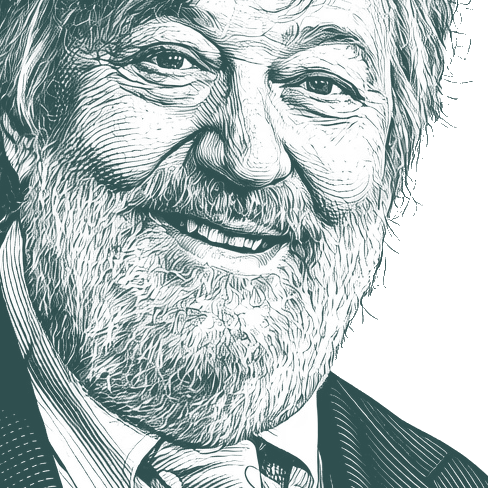
Bio from: Wikipedia (CC BY-SA 4.0) · Portrait adapted from: Wikimedia Commons, Elena Ternovaja (CC BY-SA)
Birth Name:
Stephen John Fry
Alternative Names:
Sir Stephen Fry
•
Sir Stephen John Fry
From Wikidata (CC0)
Showing quotes in randomized order to avoid selection bias. Click Popular for most popular quotes.
"... Our language, tiger, our language: hundreds of thousands of available words, frillions of legitimate new ideas... And yet, oh, and yet, we, all of us, spend all our days saying to each other the same things time after weary time: "I love you," "Don't go in there," "Get out," "You have no right to say that," "Stop it," "Why should I," "That hurt," "Help," "Marjorie is dead.
I actually got a Ugandan Minister to say, on camera— he's the Minister of Ethics and Integrity, it's the only such ministry in the world— and I said to him, "Look, even if these three utterly false supports on which you base your homophobia are true, which they aren't, there's so much more to worry about in your country than the odd gay person going to bed with the other gay person. For example, you have almost an epidemic of child rape in this country, which is just frightening."
And he said, "Ah, but it is the right kind of child rape."
I said, "That was on camera. Do you know that was on camera?"
He said, "Yes."
I said, "Can you just explain what you meant?"
"Well, it is men raping girls. Which is natural."
Enhance Your Quote Experience
Enjoy ad-free browsing, unlimited collections, and advanced search features with Premium.
I used many times to touch my own chest and feel, under its asthmatic quiver, the engine of the heart and lungs and blood and feel amazed at what I sensed was the enormity of the power I possessed. Not magical power, but real power. The power simply to go on, the power to endure, that is power enough, but I felt I had also the power to create, to add, to delight, to amaze and to transform.
Straight people are encouraged by culture and society to believe that their sexual impulses are the norm, and therefore when their affairs of the heart and loins go wrong (as they certainly will), when they are flummoxed, distraught and defeated by love, they are forced to believe that it must be their fault. We gay people at least have the advantage of being brought up to expect the world of love to be imponderably and unmanageably difficult, for we are perverted freaks and sick aberrations of nature.They - poor normal lambs - naturally find it harder to understand why, in Lysander's words, 'the course of true love never did run smooth'.
The tribal belonging, the sexual association, the sense of party – these are what popular music offer, and they have always been exclusion zones for me. Partly because of my musical constipation – can’t dance, can’t join in the chorus – partly because of my sense of physical self, feeling a fool, tall, uncoordinated and gangly.
We expect a very high standard of living. We expect food to be cheap and available. We expect energy to be cheap and available. … And we pay this group of styleless sexless people whom we call politicians a small amount of money in order to lay off our own guilt. Our own cant and hypocrisy is laid at their door. And apparently, it's they who are the hypocrites. It is they who are corrupt. It is they who refuse to solve the problems of the world. Well, it isn't. It's us. It's me, and it's you. ... Suppose you're prime minister, you've got all these illegal immigrants. What are you supposed to do? Are you supposed to hide the true facts? That's hardly something the public would accept, so you campaign and you say "we don't know how many there are - let's do something about it", and then you're accused of incompetence. Well, of course you don't know how many there are: they're illegal immigrants. Do we expect magic from our politicians? We're not going to get it. They're just human beings like you and me. ... As someone who worked hard for a Labour victory in the 90s, do I regret it? Not really. It was bound to happen. And it'll happen with the next government, and the one after it. Because all governments serve us. They serve the filth.
PREMIUM FEATURE
Advanced Search Filters
Filter search results by source, date, and more with our premium search tools.
Music was a kind of penetration. Perhaps absorption is a less freighted word. The penetration or absorption of everything into itself. I don't know if you have ever taken LSD, but when you do so the doors of perception, as Aldous Huxley, Jim Morrison and their adherents ceaselessly remind us, swing wide open. That is actually the sort of phrase, unless you are William Blake, that only makes sense when there is some LSD actually swimming about inside you. In the cold light of the cup of coffee and banana sandwich that are beside me now it appears to be nonsense, but I expect you to know what it is taken to mean. LSD reveals the whatness of things, their quiddity, their essence. The wateriness of water is suddenly revealed to you, the carpetness of carpets, the woodness of wood, the yellowness of yellow, the fingernailness of fingernails, the allness of all, the nothingness of all, the allness of nothing. For me music gives access to everyone of these essences, but at a fraction of the social or financial cost of a drug and without the need to cry 'Wow!' all the time, which is LSD's most distressing and least endearing side effects.
...Music in the precision of its form and the mathematical tyranny of its laws, escapes into an eternity of abstraction and an absurd sublime that is everywhere and nowhere at once. The grunt of rosin-rubbed catgut, the saliva-bubble blast of a brass tube, the sweaty-fingered squeak on a guitar fret, all that physicality, all that clumsy 'music making', all that grain of human performance...transcends itself at the moment of its happening, that moment when music actually becomes, as it makes the journey from the vibrating instrument, the vibrating hi-fi speaker, as it sends those vibrations across to the human tympanum and through to the inner ear and into the brain, where the mind is set to vibrate to frequencies of its own making.
The nothingness of music can be moulded by the mood of the listener into the most precise shapes or allowed