Princess Diana holds in the threshold for a second longer, checks over her shoulder that her Prince is out of earshot and whispers softly in my ear, ‘Sorry to leave early, though secretly I’m quite glad. It’s Spitting Image tonight, and I want to watch it in my room. They hate it of course. I absolutely adore it.
British comedian, actor, writer, presenter, and activist
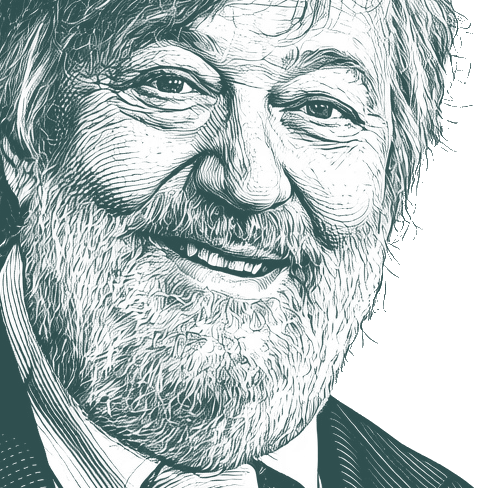
Sir Stephen John Fry (born 24 August 1957) is an English actor, broadcaster, comedian, director, narrator and writer. He first came to prominence as one half of the comic double act Fry and Laurie, alongside Hugh Laurie, with the two starring in A Bit of Fry & Laurie (1989–1995) and Jeeves and Wooster (1990–1993). He also starred in the sketch series Alfresco (1983–1984) alongside Laurie, Emma Thompson, and Robbie Coltrane and in Blackadder (1986–1989) alongside Rowan Atkinson. Since 2011 he has served as president of the mental health charity Mind. In 2025, he was knighted for services to mental health awareness, the environment and charity.
Fry's film acting roles include playing his idol Oscar Wilde in the film Wilde (1997), for which he was nominated for the Golden Globe Award for Best Actor; Inspector Thompson in Robert Altman's murder mystery Gosford Park (2001); and Mr. Johnson in Whit Stillman's Love & Friendship (2016). He has also had roles in the films Chariots of Fire (1981), A Fish Called Wanda (1988), The Life and Death of Peter Sellers (2004), V for Vendetta (2005), and Sherlock Holmes: A Game of Shadows (2011). He portrays the Cheshire Cat in Alice in Wonderland (2010) and its 2016 sequel, and the Master of Lake-town in the film series adaptation of The Hobbit. Between 2001 and 2017, he hosted the British Academy Film Awards 12 times.
Fry's television roles include Lord Melchett in the BBC television comedy series Blackadder, the title character in the television series Kingdom, as well as recurring guest roles as Dr. Gordon Wyatt on the American crime series Bones and Arthur Garrison MP on the Channel 4 period drama It's a Sin. He has also written and presented several documentary series, including the Emmy Award-winning Stephen Fry: The Secret Life of the Manic Depressive, which saw him explore his bipolar disorder, and the travel series Stephen Fry in America. He was the longtime host of the BBC television quiz show QI, with his tenure lasting from 2003 to 2016, during which he was nominated for six British Academy Television Awards. He appears frequently on other panel games, such as the radio programmes Just a Minute and I'm Sorry I Haven't a Clue. In 2006, the British public ranked Fry number 9 in ITV's poll of TV's 50 Greatest Stars.
Bio from: Wikipedia (CC BY-SA 4.0) · Portrait adapted from: Wikimedia Commons, Elena Ternovaja (CC BY-SA)
Birth Name:
Stephen John Fry
Alternative Names:
Sir Stephen Fry
•
Sir Stephen John Fry
From Wikidata (CC0)
Showing quotes in randomized order to avoid selection bias. Click Popular for most popular quotes.
We expect a very high standard of living. We expect food to be cheap and available. We expect energy to be cheap and available. … And we pay this group of styleless sexless people whom we call politicians a small amount of money in order to lay off our own guilt. Our own cant and hypocrisy is laid at their door. And apparently, it's they who are the hypocrites. It is they who are corrupt. It is they who refuse to solve the problems of the world. Well, it isn't. It's us. It's me, and it's you. ... Suppose you're prime minister, you've got all these illegal immigrants. What are you supposed to do? Are you supposed to hide the true facts? That's hardly something the public would accept, so you campaign and you say "we don't know how many there are - let's do something about it", and then you're accused of incompetence. Well, of course you don't know how many there are: they're illegal immigrants. Do we expect magic from our politicians? We're not going to get it. They're just human beings like you and me. ... As someone who worked hard for a Labour victory in the 90s, do I regret it? Not really. It was bound to happen. And it'll happen with the next government, and the one after it. Because all governments serve us. They serve the filth.
Well I don’t know about you, but when I recall childhood pain, I don’t recall the pains of toothache, a thrashed backside, broken bones, stubbed toes, gashed knees or twisted ankles – I recall the pains of loneliness, boredom, abandonment, humiliation, rejection and fear. Those are the pains on which I might and, still sometimes do, dwell, and those pains, almost without exception, were inflicted on me by other children and by myself.
There are young men and women up and down the land who happily (or unhappily) tell anyone who will listen that they don’t have an academic turn of mind, or that they aren’t lucky enough to have been blessed with a good memory, and yet can recite hundreds of pop lyrics and reel off any amount of information about footballers. Why? Because they are interested in those things. They are curious. If you are hungry for food, you are prepared to hunt high and low for it. If you are hungry for information it is the same. Information is all around us, now more than ever before in human history. You barely have to stir or incommode yourself to find things out. The only reason people do not know much is because they do not care to know. They are incurious. Incuriosity is the oddest and most foolish failing there is.
I flicked my eyes over to Steve again and saw him straighten. He would need a diversion just to start.
“Explanations?” I bellowed. “Explanations? There’s your explanation…there!” I stabbed a finger dramatically towards the far corner of the room.
Pathetic, really. I mean, talk about the oldest trick in the book. But it’s a good book, and the trick would have been cut from subsequent editions if it didn’t sometimes work.
You cannot work too hard at poetry. People are bad at it not because they have tin ears, but because they simply don't have the faintest idea how much work goes into it. It's not as if you're ordering a pizza or doing something that requires direct communication in a very banal way. But it seems these days the only people who spend time over things are retired people and prisoners. We bolt things, untasted. It's so easy to say, 'That'll do.' Everyone's in a hurry. People are intellectually lazy, morally lazy, ethically lazy...All the time. When people get angry with a traffic warden they don't stop and think what it would be like to be a traffic warden or how annoying it would be if people could park wherever they liked. People talk lazily about how hypocritical politicians are. But everyone is. On the one hand we hate that petrol is expensive and on the other we go on about global warming. We abrogate the responsibility for thought and moral decisions onto others and then have the luxury of saying it's not good enough.
The tribal belonging, the sexual association, the sense of party – these are what popular music offer, and they have always been exclusion zones for me. Partly because of my musical constipation – can’t dance, can’t join in the chorus – partly because of my sense of physical self, feeling a fool, tall, uncoordinated and gangly.
There were people who believed their opportunities to live a fulfilled life were hampered by the number of Asians in England, by the existance of a royal family, by the volume of traffic that passed by their house, by the malice of trade unions, by the power of callous employers, by the refusal of the health service to take their condition seriously, by communism, by capitalism, by atheism, by anything, in fact, but their own futile, weak-minded failure to get a fucking grip.