Doing things in this way has a good effect on everyone, teaching by example, not just with words. When your child is agitated, you don't have to say, "Go to that room!" You can take his or her hand and walk together into the room for breathing, and sit quietly together. This is the best education for peace. It is really beautiful to begin the day by being a Buddha. Each time we feel ourselves about to leave our Buddha, we can sit and breathe until we return to our true self.
Vietnamese Buddhist monk and activist (1926–2022)
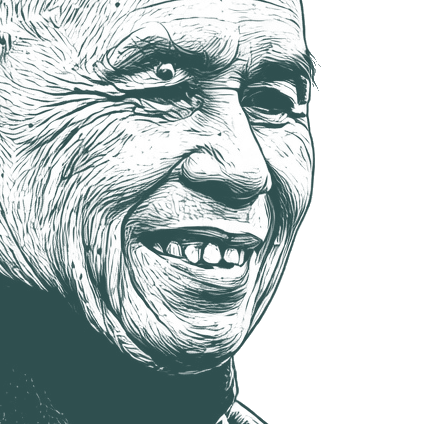
Thích Nhất Hạnh (born as Nguyễn Xuân Bảo; 11 October 1926 – 22 January 2022) was an expatriate Vietnamese Buddhist monk, peace activist, and prolific author in both Vietnamese and English. Nhất Hạnh is most commonly referred to as Thích Nhất Hạnh, in which the Vietnamese title Thích (釋), derived from "Thích Ca" or "Thích Già" (釋迦) and applied to all Vietnamese Buddhist monks and nuns, means "of the Shakya (Shakyamuni Buddha) clan".
Bio from: Wikiquote (CC BY-SA 4.0) · Portrait adapted from: Wikimedia Commons, Duc (pixiduc) from Paris, France. (CC BY-SA)
Alternative Names:
Nhat Hanh
•
Nguyễn Đình Lang
•
Nguyễn Xuân Bảo
•
Trừng Quang
•
Phùng Xuân
•
Thầy Nhất Hạnh
•
Thiền Sư Nhất Hạnh
•
Thich Nhat Hanh
From Wikidata (CC0)
Showing quotes in randomized order to avoid selection bias. Click Popular for most popular quotes.
When we recognize that we have a habit of replaying old events and reacting to new events as if they were the old ones, we can begin to notice when that habit energy comes up. We can then gently remind ourselves that we have another choice. We can look at the moment as it is, a fresh moment, and leave the past for a time when we can look at it compassionately.
Limited Time Offer
Premium members can get their quote collection automatically imported into their Quotewise collections.
"When we are angry, what do we usually do? We shout, scream, and try to blame someone else for our problems. But looking at anger with the eyes of impermanence, we can stop and breathe. Angry at each other in the ultimate dimension, we close our eyes and look deeply. We try to see three hundred years into the future. What will you be like? What will I be like? Where will you be? Where will I be? We need only to breathe in and out, look at our future and at the other person's future.
Looking at the future, we see that the other person is very precious to us. When we know we can lose them at any moment, we are no longer angry. We want to embrace her or him and say: "How wonderful, you are still alive. I am so happy. How could I be angry with you? Both of us have to die someday, and while we are still alive and together it is foolish to be angry at each other."
The reason we are foolish enough to make ourselves suffer and make the other person suffer is that we forget that we and the other person are impermanent. Someday when we die we will lose all our possessions, our power, our family, everything. Our freedom, peace, and joy in the present moment is the most important thing we have."
"All love may begin by being passionate, especially for younger people. But in the process of living together, they have to learn and practice love, so that selfishness — the tendency to possess — will diminsh, and the elemetns of understanding and gratitude will settle in, little by little, until their love becomes nourishing, protecting, and reassuring," (41).
Unlimited Quote Collections
Organize your favorite quotes without limits. Create themed collections for every occasion with Premium.
Worrying does not accomplish anything. Even if you worry twenty times more, it will not change the situation of the world. In fact, your anxiety will only make things worse. Even though things are not as we would like, we can still be content, knowing we are trying our best and will continue to do so. If we don't know how to breathe, smile,and live every moment of our life deeply, we will never be able to help anyone. I am happy in the present moment. I do not ask for anything else. I do not expect any additional happiness or conditions that will bring about more happiness. The most important practice is aimlessness, not running after things, not grasping.
If your house is on fire, the most urgent thing to do is to go back and try to put out the fire, not to run after the person you believe to be the arsonist. If you run after the person you suspect has burned your house, your house will burn down while you are chasing him or her. That is not wise. You must go back and put out the fire. So when you are angry, if you continue to interact with or argue with the other person, if you try to punish her, you are acting exactly like someone who runs after the arsonist while everything goes up in flames.
Interpenetration is an important teaching, but it still suggests that things outside of one another penetrate into each other. Interbeing is a step forward. We are already inside, so we don't have to enter. In contemporary nuclear physics, people talk about implicit order and explicit order. In the explicit order, things exist outside of each other — the table outside of the flower, the sunshine outside of the cypress tree. In the implicit order, we see that they are inside each other — the sunshine inside the cypress tree. Interbeing is the implicit order. To practice mindfulness and to look deeply into the nature of things is to discover the true nature of interbeing. There we find peace and develop the strength to be in touch with everything. With this understanding, we can easily sustain the work of loving and caring for the Earth and for each other for a long time.