English modernist writer (1882–1941)
Virginia Woolf (25 January 1882 – 28 March 1941), born Adeline Virginia Stephen, was a British writer who is considered to be one of the foremost modernist/feminist literary figures of the twentieth century.
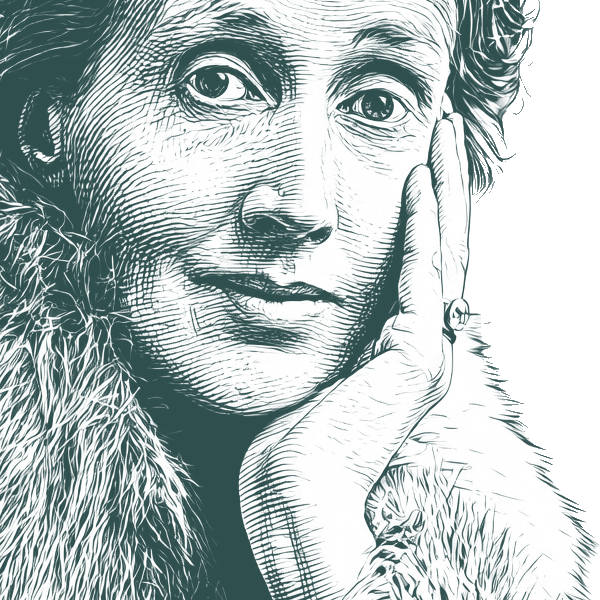
Bio from: Wikiquote (CC BY-SA 4.0) · Portrait adapted from: Wikimedia Commons (Public domain / CC0)
From Wikidata (CC0)

...she took her hand and raised her brush. For a moment it stayed trembling in a painful but exciting ecstacy in the air. Where to begin? — that was the question at what point to make the first mark? One line placed on the canvas committed her to innumerable risks, to frequent and irrevocable decisions. All that in idea seemed simple became in practice immediately complex; as the waves shape themselves symmetrically from the cliff top, but to the swimmer among them are divided by steep gulfs, and foaming crests. Still the risk must run; the mark made.
What is meant by “reality”? It would seem to be something very erratic, very undependable — now to be found in a dusty road, now in a scrap of newspaper in the street, now a daffodil in the sun. It lights up a group in a room and stamps some casual saying. It overwhelms one walking home beneath the stars and makes the silent world more real than the world of speech — and then there it is again in an omnibus in the uproar of Piccadilly. Sometimes, too, it seems to dwell in shapes too far away for us to discern what their nature is. But whatever it touches, it fixes and makes permanent. That is what remains over when the skin of the day has been cast into the hedge; that is what is left of past time and of our loves and hates.
Memory is the seamstress, and a capricious one at that. Memory runs her needle in and out, up and down, hither and thither. We know not what comes next, or what follows after. Thus, the most ordinary movement in the world, such as sitting down at a table and pulling the inkstand towards one, may agitate a thousand odd, disconnected fragments, now bright, now dim, hanging and bobbing and dipping and flaunting, like the underlinen of a family of fourteen on a line in a gale of wind.
Advanced Search Filters
Filter search results by source, date, and more with our premium search tools.
There it was before her - life. Life: she thought but she did not finish her thought. She took a look at life, for she had a clear sense of it there, something real, something private, which she shared neither with her children nor with her husband. A sort of transaction went on between them, in which she was on one side, and life was on another, and she was always trying to get the better of it, as it was of her; and sometimes they parleyed (when she sat alone); there were, she remembered, great reconciliation scenes; but for the most part, oddly enough, she must admit that she felt this thing that she called life terrible, hostile, and quick to pounce on you if you gave it a chance.
So he was deserted. The whole world was clamouring: Kill yourself, kill yourself, for our sakes. But why should he kill himself for their sakes? Food was pleasant; the sun hot; and this killing oneself, how does one set about it, with a table knife, uglily, with floods of blood, - by sucking a gaspipe? He was too weak; he could scarcely raise his hand. Besides, now that he was quite alone, condemned, deserted, as those who are about to die are alone, there was a luxury in it, an isolation full of sublimity; a freedom which the attached can never know.
All this pitting of sex against sex, of quality against quality; all this claiming of superiority and imputing of inferiority, belong to the private-school stage of human existence where there are 'sides,' and it is necessary for one side to beat another side, and of the utmost importance to walk up to a platform and receive from the hands of the Headmaster himself a highly ornamental pot.