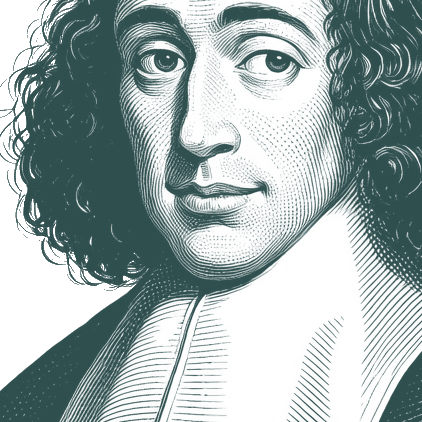
Meum institutum non est verborum significationem sed rerum naturam explicare - Benedictus de Spinoza
""
Meum institutum non est verborum significationem sed rerum naturam explicare
Latin
Collect this quote
About
Benedictus de Spinoza
Benedictus de Spinoza (24 November 1632 – 21 February 1677) was a social and metaphysical philosopher known for the elaborate development of his monist philosophy, which has become known as Spinozism. Controversy regarding his ideas led to his excommunication from the Jewish community of his native Amsterdam. He was named Baruch ("blessed" in Hebrew) Spinoza by his synagogue elders and known as Bento de Spinoza or Bento d'Espiñoza, but afterwards used the name Benedictus ("blessed" in Latin) de Spinoza.
Native Name:
בָּרוּךְ שְׂפִּינוֹזָה
•
Benedito de Espinosa
Alternative Names:
Benedict de Spinoza
•
Baruch de Espinosa
•
Barukh Shpinozah
•
Benoît de Spinoza
•
Sbīnūzā
•
Ispīnūzā
•
Barukh Spinoza
•
Bento de Espinosa
•
Baruch d' Espinoza
•
Shpinozah
•
Baruch de Spinoza
•
Spinoza
•
Benoit de Spinoza
•
Benedictus De Spinoza
•
Benedictus Spinoza
•
Baruch Spinoza
•
Baruch Benedictus de Spinoza
Tota felicitas aut infelicitas in hoc solo sita est; videlicet in qualitate obiecti, cui adhaeremus amore.
For many years I did not dare look into a Latin author or at anything which evoked an image of Italy. If this happened by chance, I suffered agonies. Herder often used to say mockingly that I had learned all my Latin from Spinoza, for that was the only Latin book he had ever seen me reading. He did not realize how carefully I had to guard myself against the classics, and that it was sheer anxiety which drove me to take refuge in the abstractions of Spinoza. [Original in German: Schon einige Jahre her durft' ich keinen lateinischen Autor ansehen, nichts betrachten, was mir ein Bild Italiens erneute. Geschah es zufällig, so erduldete ich die entsetzlichsten Schmerzen. Herder spottete oft über mich, daß ich all mein Latein aus dem Spinoza lerne, denn er hatte bemerkt, daß dies das einzige lateinische Buch war, das ich las; er wußte aber nicht, wie sehr ich mich vor den Alten hüten mußte, wie ich mich in jene abstrusen Allgemeinheiten nur ängstlich flüchtete.]
George Eliot herself had recognised Spinoza's importance some year before Arnold paid the philosopher this elaborate double-edged compliment. In a letter to Charles Bray in 1849 she wrote, diagnostically: "What is wanted in English is not a translation of Spinoza's works, but a true estimate of his life and system. After one has rendered his Latin faithfully into English, one feels that there is another yet more difficult process of translation for the reader to effect, and that the only mode of making Spinoza accessible to a larger number is to study his books, then shut them out and give an analysis." Since she began writing fiction only months after finishing work on the Ethics, it is plausible to consider Eliot's novels as attempting this larger project of Spinozan translation [...] But the detached voice speaking in this letter widens its import beyond the personal, for what animates Eliot here is an issue with a much broader horizon than private ambition: she is hinting at a more general correlation between Spinoza and contemporary British thought. Spinoza has become a crucial figure, she is insisting, one who speaks relevantly to the intellectual predicaments and debates of the mid-nineteenth century.