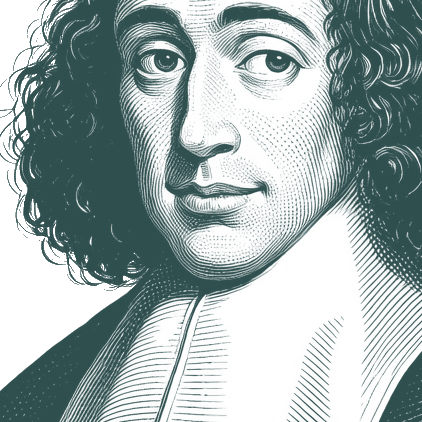
Perhaps, a return to the philosopher who is Deleuze's unsurpassable point of reference will help us to unravel this ambiguity in Deleuze's ontologica… - Benedictus de Spinoza
""
Perhaps, a return to the philosopher who is Deleuze's unsurpassable point of reference will help us to unravel this ambiguity in Deleuze's ontological edifice: Spinoza. Deleuze is far from alone in his unconditional admiration for Spinoza. One of the unwritten rules of today's academia, from France to America, is the injunction to love Spinoza. Everyone loves him, from the Althusserian strict “scientific materialists” to Deleuzean schizoanarchists, from rationalist critics of religion to the partisans of liberal freedoms and tolerances, not to mention feminists like Genevieve Lloyd, who propose to decipher a mysterious third type of knowledge in the Ethics as feminine intuitive knowledge (a knowledge surpassing the male analytic understanding). Is it, then, possible at all not to love Spinoza? Who can be against a lone Jew who, on top of it, was excommunicated by the “official” Jewish community itself? One of the most touching expressions of this love is how one often attributes to him almost divine capacities—like Pierre Macherey, who, in his otherwise admirable Hegel ou Spinoza), against the Hegelian critique of Spinoza, claims that one cannot avoid the impression that Spinoza had already read Hegel and in advance answered his reproaches. Perhaps the most appropriate first step in rendering problematic this status of Spinoza is to draw attention to the fact that it is totally incompatible with what is arguably the hegemonic stance in today's Cultural Studies, that of the ethicotheological “Judaic” turn of deconstruction best exemplified by the couple Derrida/Levinas—is there a philosopher more foreign to this orientation than Spinoza, more foreign to the Jewish universe, which, precisely, is the universe of God as radical Otherness, of the enigma of the divine, of the God of negative prohibitions instead of positive injunctions? Were, then, the Jewish priests in a way not right to excommunicate Spinoza?
Benedictus de Spinoza (24 November 1632 – 21 February 1677) was a social and metaphysical philosopher known for the elaborate development of his monist philosophy, which has become known as Spinozism. Controversy regarding his ideas led to his excommunication from the Jewish community of his native Amsterdam. He was named Baruch ("blessed" in Hebrew) Spinoza by his synagogue elders and known as Bento de Spinoza or Bento d'Espiñoza, but afterwards used the name Benedictus ("blessed" in Latin) de Spinoza.
Native Name:
בָּרוּךְ שְׂפִּינוֹזָה
•
Benedito de Espinosa
Alternative Names:
Benedict de Spinoza
•
Baruch de Espinosa
•
Barukh Shpinozah
•
Benoît de Spinoza
•
Sbīnūzā
•
Ispīnūzā
•
Barukh Spinoza
•
Bento de Espinosa
•
Baruch d' Espinoza
•
Shpinozah
•
Baruch de Spinoza
•
Spinoza
•
Benoit de Spinoza
•
Benedictus De Spinoza
•
Benedictus Spinoza
•
Baruch Spinoza
•
Baruch Benedictus de Spinoza
Spinoza es — según la conocida expresión de Erich Fromm — de los que no temen a la libertad, y sabe que para lograrla en este caso debe combatir «los prejuicios de los teólogos»,
Note II. — From all that has been said above it is clear, that we, in many cases, perceive and form our general notions: — (1.) From particular things represented to our intellect fragmentarily, confusedly, and without order through our senses (II. xxix. Coroll.); I have settled to call such perceptions by the name of knowledge from the mere suggestions of experience.4 (2.) From symbols, e.g., from the fact of having read or heard certain words we remember things and form certain ideas concerning them, similar to those through which we imagine things (II. xviii. note). I shall call both these ways of regarding things knowledge of the first kind, opinion, or imagination. (3.) From the fact that we have notions common to all men, and adequate ideas of the properties of things (II. xxxviii. Coroll., xxxix. and Coroll. and xl.); this I call reason and knowledge of the second kind. Besides these two kinds of knowledge, there is, as I will hereafter show, a third kind of knowledge, which we will call intuition. This kind of knowledge proceeds from an adequate idea of the absolute essence of certain attributes of God to the adequate knowledge of the essence of things. I will illustrate all three kinds of knowledge by a single example. Three numbers are given for finding a fourth, which shall be to the third as the second is to the first. Tradesmen without hesitation multiply the second by the third, and divide the product by the first; either because they have not forgotten the rule which they received from a master without any proof, or because they have often made trial of it with simple numbers, or by virtue of the proof of the nineteenth proposition of the seventh book of Euclid, namely, in virtue of the general property of proportionals. But with very simple numbers there is no need of this. For instance, one, two, three, being given, everyone can see that the fourth proportional is six; and this is much clearer, because we infer the fourth number from an intuitive gr
Works in ChatGPT, Claude, or Any AI
Add semantic quote search to your AI assistant via MCP. One command setup.
Hay hombres cuyo espíritu es completamente ciego, sea de nacimiento o por prejuicios, es decir, debido a algo externo. En efecto, ni siquiera poseen conciencia de si mismos: si afirman cualquier cosa o dudan de ella, no saben que afirman o que dudan; dicen que no saben nada y hasta declaran ignorar que no saben nada; esto mismo lo dicen con restricción, pues temen confesar que existen, puesto que como nada saben, deben callar por temor de admitir algo que huela a verdad. En definitiva, es preciso abstenerse de hablar de ciencias con ellos (pues en lo concerniente a la vida y a la sociedad la necesidad les fuerza a reconocer su propia existencia, a buscar lo que les es útil, a afirmar y a negar bajo juramento muchas cosas). En efecto, si se les prueba algo, no saben si la argumentación es probatoria o defectuosa; si niegan, conceden u oponen una objeción, no saben que niegan, conceden u objetan; hay que considerarlos, pues, como autómatas enteramente desprovistos de pensamiento.