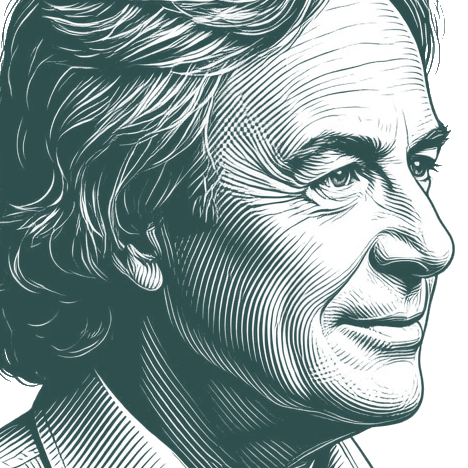
Richard Phillips Feynman (May 11, 1918 – February 15, 1988) was an American theoretical physicist. He is known for the work he did in the path integral formulation of quantum mechanics, the theory of quantum electrodynamics, the physics of the superfluidity of supercooled liquid helium, and in particle physics, for which he proposed the parton model. For his contributions to the development of quantum electrodynamics, Feynman received the Nobel Prize in Physics in 1965 jointly with Julian Schwinger and Shin'ichirō Tomonaga. Feynman developed a widely used pictorial representation scheme for the mathematical expressions describing the behavior of subatomic particles, which later became known as Feynman diagrams. During his lifetime, Feynman became one of the best-known scientists in the world.
Biography information from
Wikiquote·
Portrait adapted from
Wikimedia Commons, Copyright Tamiko Thiel 1984 (CC BY-SA)
Also Known As
Pen Names:
Ofey
Native Name:
Richard Phillips Feynman
Alternative Names:
Feynman
•
Dick Feynman
•
Richard P. Feynman
In this age of specialization men who thoroughly know one field are often incompetent to discuss another. The great problems of the relations between one and another aspect of human activity have for this reason been discussed less and less in public. When we look at the past great debates on these subjects we feel jealous of those times, for we should have liked the excitement of such argument. The old problems, such as the relation of science and religion, are still with us, and I believe present as difficult dilemmas as ever, but they are not often publicly discussed because of the limitations of specialization.
[T]he size of the arrow depends upon the... materials... [Y]ou make an arrow, and depending upon the time it takes for the light to get from the source to... where you... count it, you turn that arrow like a clock... round, round, depending on how much time it takes... every second it goes around... 1 followed by 15 zeros [<math>10^{15}</math>] times... It doesn't take light very long to get from the source... but it still turns a lot of times... It's like the roulette wheel and just the moment it hits the counter, it happens to be setting at some angle... It can look like a small angle when you're done, but you had to turn... like a clock hand after 25 years... it can start at 2:00 and end up at 2:15. ...That's ...the arrow for the first surface. Now the arrow for the second surface. Rule: same as the arrow for the first surface... [rotated] in the... opposite direction... When you go from air to glass it's one way... glass to air you change it around. ...You start this way for the second surface, and you turn this [arrow]... for the time, and when you get finished with this roulette wheel in the second one it comes out so. And now you add them together... and that's the laws of... light, and that will tell you whether it reflects or doesn't reflect.
Works in ChatGPT, Claude, or Any AI
Add semantic quote search to your AI assistant via MCP. One command setup.