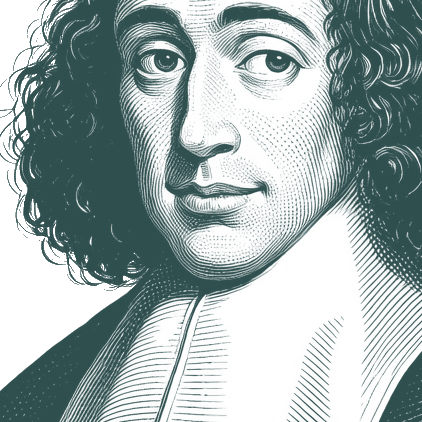
It was on Spinoza that I worked the most seriously according to the norms of the history of philosophy — but he more than any other gave me the feeli… - Benedictus de Spinoza
""
It was on Spinoza that I worked the most seriously according to the norms of the history of philosophy — but he more than any other gave me the feeling of a gust of air from behind each time you read him, of a witch's broom which he makes you mount. We have not yet begun to understand Spinoza, and I myself no more than others.
English
Collect this quote
About
Benedictus de Spinoza
Benedictus de Spinoza (24 November 1632 – 21 February 1677) was a social and metaphysical philosopher known for the elaborate development of his monist philosophy, which has become known as Spinozism. Controversy regarding his ideas led to his excommunication from the Jewish community of his native Amsterdam. He was named Baruch ("blessed" in Hebrew) Spinoza by his synagogue elders and known as Bento de Spinoza or Bento d'Espiñoza, but afterwards used the name Benedictus ("blessed" in Latin) de Spinoza.
Native Name:
בָּרוּךְ שְׂפִּינוֹזָה
•
Benedito de Espinosa
Alternative Names:
Benedict de Spinoza
•
Baruch de Espinosa
•
Barukh Shpinozah
•
Benoît de Spinoza
•
Sbīnūzā
•
Ispīnūzā
•
Barukh Spinoza
•
Bento de Espinosa
•
Baruch d' Espinoza
•
Shpinozah
•
Baruch de Spinoza
•
Spinoza
•
Benoit de Spinoza
•
Benedictus De Spinoza
•
Benedictus Spinoza
•
Baruch Spinoza
•
Baruch Benedictus de Spinoza
The various critics who have assumed that Spinoza held a paramount position in Goethe's world view have much direct evidence from Goethe's own pen. In one of the Zahme Xenien Goethe calls Spinoza "the philosopher whom I trust most." From the 1780's onward numerous references to Spinoza appear in Goethe's work. How well Goethe knew Spinoza's philosophy before his arrival at Weimar is a matter of some uncertainty, but already in 1773 a book of Spinoza's, probably the Ethics, is mentioned as an object of his study. The letters of 1784-86 indicate that Goethe read and discussed the Ethics with Charlotte von Stein and that he disputed with Friedrich Heinrich Jacobi about Spinoza's concept of God/Nature. During that same period Goethe had written that although he did not himself share Spinoza's way of representing nature (seine Vorstellungsart von Natur), if he were to name one book that agreed the most completely with his own conception of nature, it would have to be the Ethics: doch wenn die Rede wäre ein Buch anzugeben, das unter allen die ich kenne, am meisten mit der meinigen übereinkommt, die Ethik nennen müsste. In a conversation with Boisserée of August 3, 1815, Goethe said: "I always carry the Ethics of Spinoza with me." The most extended references to Spinoza are to found in Goethe's autobiography Poetry and Truth.
Spinoza's philosophy introduced an unprecedented theoretical revolution in the history of philosophy, probably the greatest philosophical revolution of all time, insofar as we can regard Spinoza as Marx's only direct ancestor, from the philosophical standpoint. However, this radical revolution was the object of a massive historical repression, and Spinozist philosophy suffered much the same fate as Marxist philosophy used to and still does suffer in some countries: it served as damning evidence for a charge of ‘atheism’. The insistence of the seventeenth and eighteenth century establishment's hounding of Spinoza's memory, and the distance every writer had ineluctably to take with respect to Spinoza in order to obtain the right to speak (cf. Montesquieu) are evidence both of the repulsion and the extraordinary attraction of his thought. The history of philosophy's repressed Spinozism thus unfolded as a subterranean history acting at other sites (autres lieux), in political and religious ideology (deism) and in the sciences, but not on the illuminated stage of visible philosophy. And when Spinoza re-appeared on this stage in German idealism's ‘Atheismusstreit’, and then in academic interpretations, it was more or less under the aegis of a misunderstanding.
Works in ChatGPT, Claude, or Any AI
Add semantic quote search to your AI assistant via MCP. One command setup.
The first person ever to have posed the problem of reading, and in consequence, of writing, was Spinoza, and he was also the first in the world to have proposed both a theory of history and a philosophy of the opacity of the immediate. With him, for the first time ever, a man linked together in this way the essence of reading and the essence of history in a theory of the difference between the imaginary and the true. This explains to us why Marx could not possibly have become Marx except by founding a theory of history and a philosophy of the historical distinction between ideology and science, and why in the last analysis this foundation was consummated in the dissipation of the religious myth of reading.