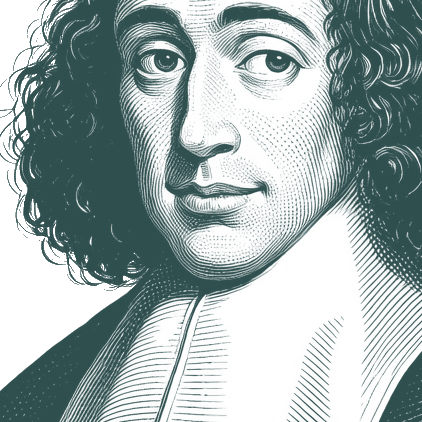
Monist is, in fact, every philosophy that is not an eclectic patchwork. Therefore, I gladly admit to you that I myself consider my positions even mor… - Benedictus de Spinoza
""
Monist is, in fact, every philosophy that is not an eclectic patchwork. Therefore, I gladly admit to you that I myself consider my positions even more monist than yours, because I try to give my monism a broader extension, following as far as possible the example of the greatest of all monists: Spinoza.
Benedictus de Spinoza (24 November 1632 – 21 February 1677) was a social and metaphysical philosopher known for the elaborate development of his monist philosophy, which has become known as Spinozism. Controversy regarding his ideas led to his excommunication from the Jewish community of his native Amsterdam. He was named Baruch ("blessed" in Hebrew) Spinoza by his synagogue elders and known as Bento de Spinoza or Bento d'Espiñoza, but afterwards used the name Benedictus ("blessed" in Latin) de Spinoza.
Native Name:
בָּרוּךְ שְׂפִּינוֹזָה
•
Benedito de Espinosa
Alternative Names:
Benedict de Spinoza
•
Baruch de Espinosa
•
Barukh Shpinozah
•
Benoît de Spinoza
•
Sbīnūzā
•
Ispīnūzā
•
Barukh Spinoza
•
Bento de Espinosa
•
Baruch d' Espinoza
•
Shpinozah
•
Baruch de Spinoza
•
Spinoza
•
Benoit de Spinoza
•
Benedictus De Spinoza
•
Benedictus Spinoza
•
Baruch Spinoza
•
Baruch Benedictus de Spinoza
There is no place in Spinoza's system for a sense of mystery in the face of nature. Such an attitude is to be dispelled by the intelligibility of things. Religious wonder is bred by ignorance, he believes. Spinoza contrasts the person who "is eager, like an educated man, to understand natural things" with the person who "wonders at them, like a fool". For Spinoza, anyone who would approach nature with the kind of worshipful awe usually demanded by the religious attitude represents the latter. By definition, and in substance, pantheism is not atheism. And Spinoza is an atheist.
We have thus begun to think of Spinoza's "radicalism" differently than the past century did. Now we see that the bold innovations of Spinoza were only consequences, rather than foundations. The fact that now gains in importance is that — compared to the significance of Descartes, Hobbes, and Leibniz — Spinoza is only of secondary significance in the history of the core sciences, that is, in the history of natural science, on the one hand, and of natural right, on the other. And the fact that Spinoza achieved more general recognition only toward the end of the eighteenth century is now also understandable: he could be accepted only at the moment when the "querelle des anciens et des modemes" within philosophy had been decided on the main point in favor of the moderns, and when what mattered was the restoration, for the purpose of correcting the modern idea, of certain positions of the premodern world that had been knocked over in the first onslaught; for Spinoza — who stood on the foundation of modern philosophy laid by Descartes and Hobbes — had carried along into the modern world, which he already found in existence, the ideal of life of the premodern (ancient-medieval) tradition, the ideal of the (theoretical) knowledge of God.
Limited Time Offer
Premium members can get their quote collection automatically imported into their Quotewise collections.