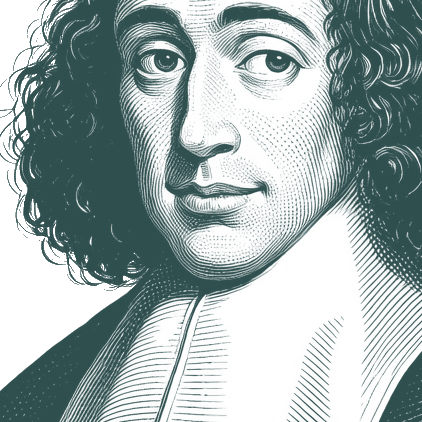
Is Spinoza baroque? No, but if we find, through this line of thinking, a spurious and worn-out figure that rejects the crisis, that repeats the utopi… - Benedictus de Spinoza
""
Is Spinoza baroque? No, but if we find, through this line of thinking, a spurious and worn-out figure that rejects the crisis, that repeats the utopia in its ingenuous Renaissance form, what we have found is merely Spinozism. When classical idealism takes up Spinoza, in effect it only takes up (or invents?) Spinozism, a Renaissance philosophy of the bourgeois revolution of the capitalist market!
English
Collect this quote
About
Benedictus de Spinoza
Benedictus de Spinoza (24 November 1632 – 21 February 1677) was a social and metaphysical philosopher known for the elaborate development of his monist philosophy, which has become known as Spinozism. Controversy regarding his ideas led to his excommunication from the Jewish community of his native Amsterdam. He was named Baruch ("blessed" in Hebrew) Spinoza by his synagogue elders and known as Bento de Spinoza or Bento d'Espiñoza, but afterwards used the name Benedictus ("blessed" in Latin) de Spinoza.
Native Name:
בָּרוּךְ שְׂפִּינוֹזָה
•
Benedito de Espinosa
Alternative Names:
Benedict de Spinoza
•
Baruch de Espinosa
•
Barukh Shpinozah
•
Benoît de Spinoza
•
Sbīnūzā
•
Ispīnūzā
•
Barukh Spinoza
•
Bento de Espinosa
•
Baruch d' Espinoza
•
Shpinozah
•
Baruch de Spinoza
•
Spinoza
•
Benoit de Spinoza
•
Benedictus De Spinoza
•
Benedictus Spinoza
•
Baruch Spinoza
•
Baruch Benedictus de Spinoza
Las traslúcidas manos del judío Labran en la penumbra los cristales Y la tarde que muere es miedo y frío. (Las tardes a las tardes son iguales.) Las manos y el espacio de jacinto Que palidece en el confín del Ghetto Casi no existen para el hombre quieto Que está soñando un claro laberinto. No lo turba la fama, ese reflejo De sueños en el sueño de otro espejo, Ni el temeroso amor de las doncellas. Libre de la metáfora y del mito abra un arduo cristal: el infinito Mapa de Aquél que es todas Sus estrellas. (Here in the twilight the translucent hands Of the Jew polishing the crystal glass. The dying afternoon is cold with bands Of fear. Each day the afternoons all pass The same. The hands and space of hyacinth Paling in the confines of the ghetto walls Barely exists for the quiet man who stalls There, dreaming up a brilliant labyrinth. Fame doesn't trouble him (that reflection of Dreams in the dream of another mirror), nor love, The timid love women. Gone the bars, He's free, from metaphor and myth, to sit Polishing a stubborn lens: the infinite Map of the One who now is all His stars.) [Translated from the Spanish by Willis Barnstone]
I have striven not to laugh at human actions, not to weep at them, nor to hate them, but to understand them.
Go Premium
Support Quotewise while enjoying an ad-free experience and premium features.
I do not think it necessary for salvation to know Christ according to the flesh : but with regard to the Eternal Son of God, that is the Eternal Wisdom of God, which has manifested itself in all things and especially in the human mind, and above all in Christ Jesus, the case is far otherwise. For without this no one can come to a state of blessedness, inasmuch as it alone teaches, what is true or false, good or evil. And, inasmuch as this wisdom was made especially manifest through Jesus Christ, as I have said, his disciples preached it, in so far as it was revealed to them through him, and thus showed that they could rejoice in that spirit of Christ more than the rest of mankind. The doctrines added by certain churches, such as that God took upon himself human nature, I have expressly said that I do not understand; in fact, to speak the truth, they seem to me no less absurd than would a statement, that a circle had taken upon itself the nature of a square. This I think will be sufficient explanation of my opinions concerning the three points mentioned. Whether it will be satisfactory to Christians you will know better than I.