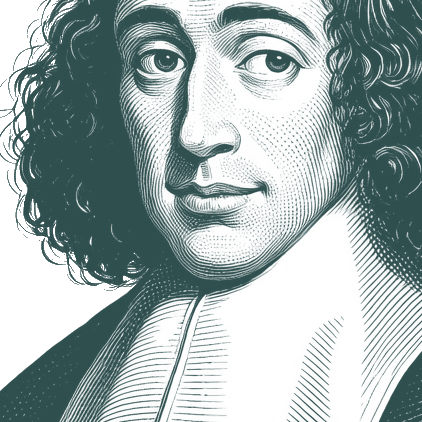
Every philosophy of philosophy that excludes Spinoza must be spurious. [Original in German: Jede Philosophie der Philosophie, nach der Spinosa kein P… - Benedictus de Spinoza
""
Every philosophy of philosophy that excludes Spinoza must be spurious. [Original in German: Jede Philosophie der Philosophie, nach der Spinosa kein Philosoph ist muß verdächtig scheinen.]
Benedictus de Spinoza (24 November 1632 – 21 February 1677) was a social and metaphysical philosopher known for the elaborate development of his monist philosophy, which has become known as Spinozism. Controversy regarding his ideas led to his excommunication from the Jewish community of his native Amsterdam. He was named Baruch ("blessed" in Hebrew) Spinoza by his synagogue elders and known as Bento de Spinoza or Bento d'Espiñoza, but afterwards used the name Benedictus ("blessed" in Latin) de Spinoza.
Native Name:
בָּרוּךְ שְׂפִּינוֹזָה
•
Benedito de Espinosa
Alternative Names:
Benedict de Spinoza
•
Baruch de Espinosa
•
Barukh Shpinozah
•
Benoît de Spinoza
•
Sbīnūzā
•
Ispīnūzā
•
Barukh Spinoza
•
Bento de Espinosa
•
Baruch d' Espinoza
•
Shpinozah
•
Baruch de Spinoza
•
Spinoza
•
Benoit de Spinoza
•
Benedictus De Spinoza
•
Benedictus Spinoza
•
Baruch Spinoza
•
Baruch Benedictus de Spinoza
In Spinoza, Hegel finds the fully developed “standpoint of substance” which cannot, however, be the highest standpoint because Being is not yet thought equally fundamentally and resolutely as thinking thinking itself. Being, as substance and substantiality, has not yet developed into the subject in its absolute subjectivity. Still, spinoza appeals always afresh to the whole thinking of German Idealism, and at the same time provokes its contradiction, because he lets thinking begin with the absolute.
Novalis was cried down as an enthusiastic mystic by the prosaic, and Spinoza as godless by the literalists. It was incumbent upon me to protest against this view of Spinoza, seeing I would review the whole sphere of piety. Something essential would have been wanting in the ex position of my views if I had not in some way said that the mind and heart of this great man seemed deeply influenced by piety, even though it were not Christian piety. The result might have been different, had not the Christianity of that time been so distorted and obscured by dry formulas and vain subtilties that the divine form could not be expected to win the regard of a stranger. This I said in the first edition, somewhat youthfully indeed, yet so that I have found nothing now needing to be altered, for there was no reason to believe that I ascribed the Holy Spirit to Spinoza in the special Christian sense of the word.
Limited Time Offer
Premium members can get their quote collection automatically imported into their Quotewise collections.
Spinoza is the clear and luminous side of Modern philosophy. He is the negation of bourgeois mediation and of all the logical, metaphysical, and juridical fictions that organize its expansion. He is the attempt to determine the continuity of the revolutionary project of humanism. With Spinoza, philosophy succeeds for the first time in negating itself as a science of mediation. In Spinoza there is the sense of a great anticipation of the future centuries; there is the intuition of such a radical truth of future philosophy that it not only keeps him from being flattened onto seventeenth-century thought but also, it often seems, denies any confrontation, any comparison. Really, none of his contemporaries understands him or refutes him.