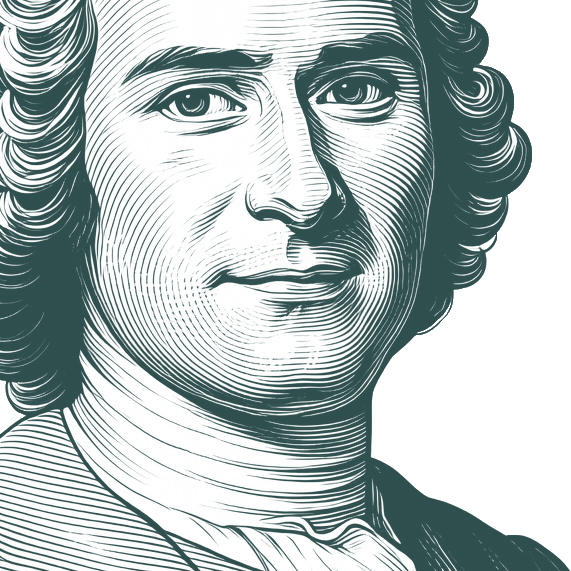
The more I study the works of men in their institutions, the more clearly I see that, in their efforts after independence, they become slaves, and th… - Jean-Jacques Rousseau
""
The more I study the works of men in their institutions, the more clearly I see that, in their efforts after independence, they become slaves, and that their very freedom is wasted in vain attempts to assure its continuance. That they may not be carried away by the flood of things, they form all sorts of attachments; then as soon as they wish to move forward they are surprised to find that everything drags them back. It seems to me that to set oneself free we need do nothing, we need only continue to desire freedom.
Jean-Jacques Rousseau (June 28, 1712 – July 2, 1778) was a major French-speaking Genevan philosopher of Enlightenment whose political ideas influenced the French Revolution, the development of socialist theory, and the growth of nationalism.
Biography information from
Wikiquote·
Portrait adapted from
Wikimedia Commons, Maurice Quentin de La Tour (Public domain / CC0)
Also Known As
Alternative Names:
Citizen of Geneva
•
Jean Jacques Rousseau
•
J. J. Rousseau
•
Rousseau
•
J.J. Rousseau
•
JJ Rousseau
"I will simply ask: What is philosophy? What do the writings of the best known philosophers contain? What are the lessons of these friends of wisdom? To listen to them, would one not take them for a troupe of charlatans crying out in a public square, each from his own corner: "Come to me. I'm the only one who is not wrong"?"
Supposons dix hommes, dont chacun a dix sortes de besoins. Il faut que chacun, pour son nécessaire, s'applique à dix sortes de travaux ; mais, vu la différence de génie et de talent, l'un réussira moins à quelqu'un de ces travaux, l'autre à un autre. Tous, propres à diverses choses, feront les mêmes, et seront mal servis. Formons une société de ces dix hommes, et que chacun s'applique, pour lui seul et pour les neuf autres, au genre d'occupation qui lui convient le mieux ; chacun profitera des talents des autres comme si lui seul les avait tous ; chacun perfectionnera le sien par un continuel exercice ; et il arrivera que tous les dix, parfaitement bien pourvus, auront encore du surabondant pour d'autres. Voilà le principe apparent de toutes nos institutions.
Leben heißt nicht atmen, sondern handeln; es heißt, sich unserer Organe, unserer Sinne, unserer Fähigkeiten, sich also aller derjenigen Teile von uns zu bedienen, die uns die Empfindung unseres Daseins verleihen. Nicht derjenige Mensch hat am meisten gelebt, der die meisten Lebensjahre gezählt hat, sondern der, welcher sein Leben am meisten empfunden hat.