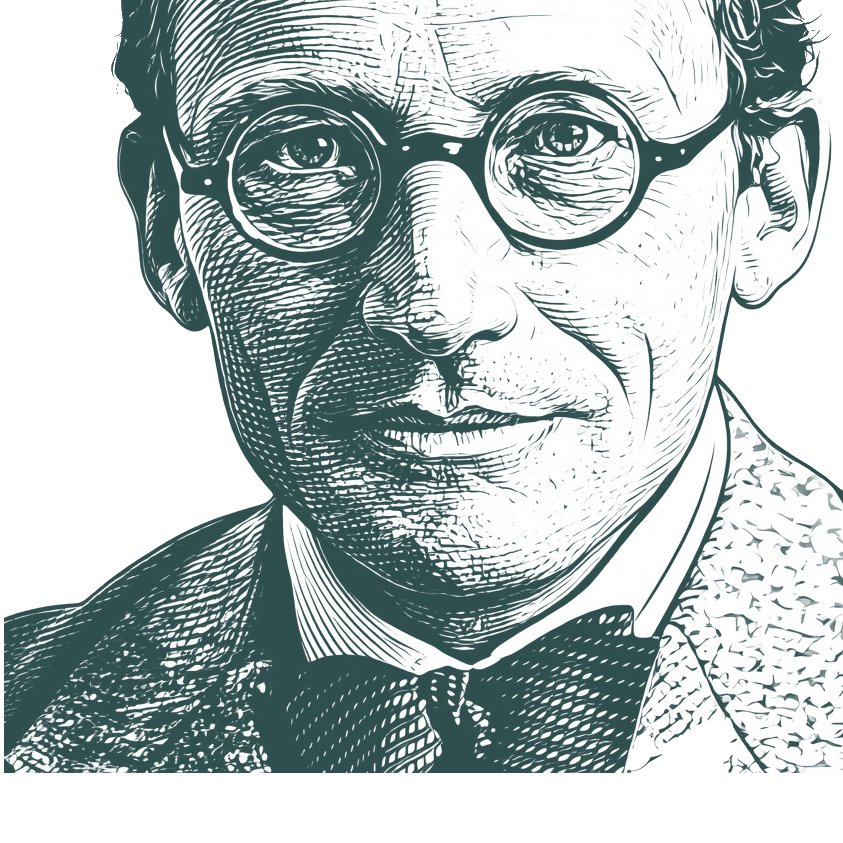
However insignificant the frictional and heating effects in a clock may be from the practical point of view, there can be no doubt that the second at… - Erwin Schrödinger
""
However insignificant the frictional and heating effects in a clock may be from the practical point of view, there can be no doubt that the second attitude, which does not neglect them, is the more fundamental one, even when we are faced with the regular motion of a clock that is driven by a spring. For it must not be believed that the driving mechanism really does away with the statistical nature of the process. The true physical picture includes the possibility that even a regularly going clock should all at once invert its motion and, working backward, rewind its own spring – at the expense of the heat of the environment.
Erwin Rudolf Josef Alexander Schrödinger (12 August 1887 – 4 January 1961) was an Austrian physicist, one of the founders of quantum theory, and winner of the 1933 Nobel Prize in Physics. His ideas were heavily influenced by monist philosophy and he is particularly well known for original interpretations of the significance of the wave function and for devising the Schrödinger's cat thought experiment.
Alternative Names:
Erwin Rudolf Josef Alexander Schröndinger
•
Erwin Schrodinger
•
Erwin Schroedinger
•
Schrödinger
•
Schrodinger
•
Ervinus Rudolphus Iosephus Alexandrus Schrödinger
Related quotes. More quotes will automatically load as you scroll down, or you can use the load more buttons.
Shorter versions of this quote
However insignificant the frictional and heating effects in a clock may be from the practical point of view, there can be no doubt that the second attitude, which does not neglect them, is the more fundamental one, even when we are faced with the regular motion of a clock that is driven by a spring.
"No self is of itself alone. It has a long chain of intellectual ancestors. The "I" is chained to ancestry by many factors… This is not mere allegory, but an eternal memory."
some species or even large groups seem to have reached the end of their evolutionary possibilities a very long time ago, yet they have not died out, but have remained unchanged, or without significant change, for many millions of years.
PREMIUM FEATURE
Advanced Search Filters
Filter search results by source, date, and more with our premium search tools.
Only in the co-operation of an enormously large number of atoms do statistical laws begin to operate and control the behaviour of these assemblées with an accuracy increasing as the number of atoms involved increases. It is in that way that the events acquire truly orderly features. All the physical and chemical laws that are known to play an important part in the life of organisms are of this statistical kind; any other kind of lawfulness and orderliness that one might think of is being perpetually disturbed and made inoperative by the unceasing heat motion of the atoms.