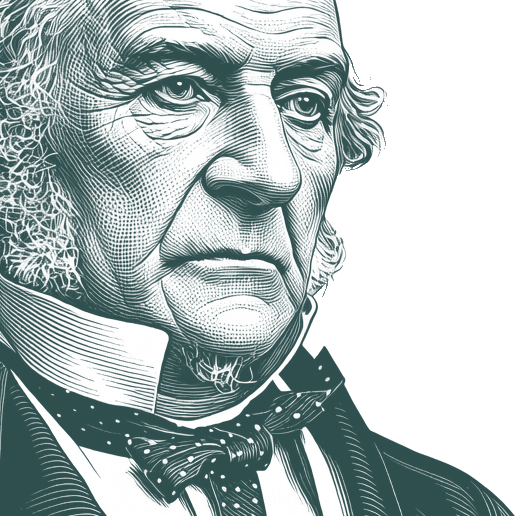
Sir, there are three principles, greater than all others, on which, in my opinion, all good finance should be based. The first of them is that there … - William Ewart Gladstone
""
Sir, there are three principles, greater than all others, on which, in my opinion, all good finance should be based. The first of them is that there should always be a certainty that whatever the charge may be it can be paid. That, I believe, is of vital importance. The second is that, in times of peace and prosperity, the people of the country should reduce their Debt; and the third point is that they should reduce their Expenditure.
William Ewart Gladstone (29 December 1809 – 19 May 1898) was a British Liberal politician and Prime Minister (1868–1874, 1880–1885, 1886 and 1892–1894). He was a notable political reformer, known for his populist speeches, and was for many years the main political rival of Benjamin Disraeli.
Biography information from
Wikiquote·
Portrait adapted from
Wikimedia Commons, Samuel Alexander Walker (Public domain / CC0)
Also Known As
Pen Names:
Scrutator
Alternative Names:
William Gladstone
•
Gladstone
•
W. E. Gladstone
•
The Rt Hon William Ewart Gladstone
•
Gladstone, W. E. (William Ewart)
The coercion which has been introduced has not been a coercion against crime...It has been a coercion against combination. And combination—it stands and glares upon us from every page in the history of Ireland—is the only arm by which a poor and destitute and feeble population are able to make good their ground, even in the slightest degree, against the domineering power of the State and of the wealthy with England at their back.
Keadilan yang terlambat itu bukanlah keadilan.
Works in ChatGPT, Claude, or Any AI
Add semantic quote search to your AI assistant via MCP. One command setup.
Sir, there was once a time when close relations of amity were established between the Governments of England and France. It was in the reign of the later Stuarts; and it marks a dark spot in our annals, because it was an union formed in a spirit of domineering ambition on the one side, and of base and vile subserviency on the other. But that, Sir, was not an union of the nations; it was an union of the Governments. This is not be an union of the Governments; it is to be an union of the nations.