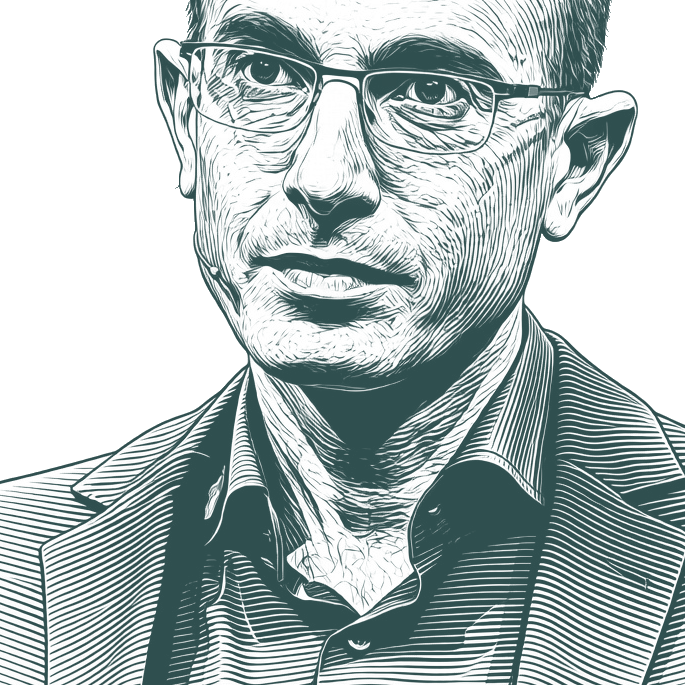
Voltaire said about God that ‘there is no God, but don’t tell that to my servant, lest he murder me at night’. Hammurabi would have said the same abo… - Yuval Noah Harari
""
Voltaire said about God that ‘there is no God, but don’t tell that to my servant, lest he murder me at night’. Hammurabi would have said the same about his principle of hierarchy, and Thomas Jefferson about human rights. Homo sapiens has no natural rights, just as spiders, hyenas and chimpanzees have no natural rights. But don’t tell that to our servants, lest they murder us at night.
Yuval Noah Harari (Hebrew: יובל נח הררי; born 24 February 1976) is an Israeli professor of history at the Hebrew University of Jerusalem and the author of Sapiens: A Brief History of Humankind.
True, hundreds of millions may nevertheless go on believing in Islam, Christianity or Hinduism. But numbers alone don’t count for much in history. History is often shaped by small groups of forward-looking innovators rather than by the backward-looking masses. Ten thousand years ago most people were hunter-gatherers and only a few pioneers in the Middle East were farmers. Yet the future belonged to the farmers. In 1850 more than 90 per cent of humans were peasants, and in the small villages along the Ganges, the Nile and the Yangtze nobody knew anything about steam engines, railroads or telegraph lines. Yet the fate of those peasants had already been sealed in Manchester and Birmingham by the handful of engineers, politicians and financiers who spearheaded the Industrial Revolution. Steam engines, railroads and telegraphs transformed the production of food, textiles, vehicles and weapons, giving industrial powers a decisive edge over traditional agricultural societies.
Farmers tend to eat a very limited and unbalanced diet. Especially in premodern times, most of the calories feeding an agricultural population came from a single crop – such as wheat, potatoes or rice – that lacks some of the vitamins, minerals and other nutritional materials humans need. The typical peasant in traditional China ate rice for breakfast, rice for lunch, and rice for dinner. If she were lucky, she could expect to eat the same on the following day. By contrast, ancient foragers regularly ate dozens of different foodstuffs. The peasant’s ancient ancestor, the forager, may have eaten berries and mushrooms for breakfast; fruits, snails and turtle for lunch; and rabbit steak with wild onions for dinner. Tomorrow’s menu might have been completely different. This variety ensured that the ancient foragers received all the necessary nutrients.
PREMIUM FEATURE
Advanced Search Filters
Filter search results by source, date, and more with our premium search tools.
Just as when two clashing musical notes played together force a piece of music forward, so discord in our thoughts, ideas and values compel us to think, re-evaluate and criticise. Consistency is the playground of dull minds.