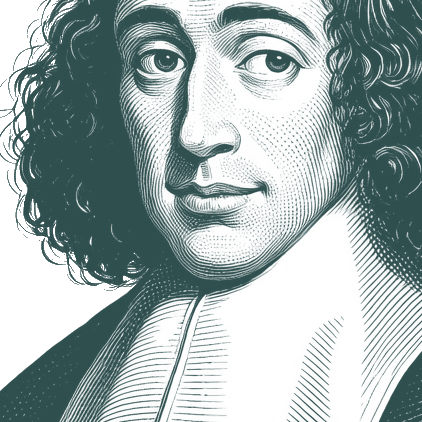
This, then, is the end for which I strive, to attain to such a character myself, and to endeavor that many should attain to it with me. In other word… - Benedictus de Spinoza
""
This, then, is the end for which I strive, to attain to such a character myself, and to endeavor that many should attain to it with me. In other words, it is part of my happiness to lend a helping hand, that many others may understand even as I do, so that their understanding and desire may entirely agree with my own. In order to bring this about, it is necessary to understand as much of nature as will enable us to attain to the aforesaid character, and also to form a social order such as is most conducive to the attainment of this character by the greatest number with the least difficulty and danger.
English
Collect this quote
About
Benedictus de Spinoza
Benedictus de Spinoza (24 November 1632 – 21 February 1677) was a social and metaphysical philosopher known for the elaborate development of his monist philosophy, which has become known as Spinozism. Controversy regarding his ideas led to his excommunication from the Jewish community of his native Amsterdam. He was named Baruch ("blessed" in Hebrew) Spinoza by his synagogue elders and known as Bento de Spinoza or Bento d'Espiñoza, but afterwards used the name Benedictus ("blessed" in Latin) de Spinoza.
Native Name:
בָּרוּךְ שְׂפִּינוֹזָה
•
Benedito de Espinosa
Alternative Names:
Benedict de Spinoza
•
Baruch de Espinosa
•
Barukh Shpinozah
•
Benoît de Spinoza
•
Sbīnūzā
•
Ispīnūzā
•
Barukh Spinoza
•
Bento de Espinosa
•
Baruch d' Espinoza
•
Shpinozah
•
Baruch de Spinoza
•
Spinoza
•
Benoit de Spinoza
•
Benedictus De Spinoza
•
Benedictus Spinoza
•
Baruch Spinoza
•
Baruch Benedictus de Spinoza
The philosophy of a purely theoretical thinker, who contemplates all things from the point of view of things in themselves, belongs in the same class as the attempt to apply abstract thought to the entire field of consciousness without meeting any byways or stops. Look at Baruch Spinoza, that true hero of thought, who studied in his own person the way in which the emotions and passions, as expressions of his internal mechanism, transform themselves for him into objects of geometrical analysis! In the meantime, until the heroism of Baruch Spinoza shall become the matter-of-fact virtue of everyday life in the higher developed humanity of the future, and until myths, poetry, metaphysics and religion shall no longer overshadow the field of consciousness, let us be content that up to now, and for the present, philosophy in its differentiated and its improved sense has served, and serves, as a critical instrument and helps science to keep its formal methods and logical processes clear; that it helps us in our lives to reduce the obstacles, which the fantastic projections of the emotions, passions, fears and hopes pile in the way of free thought; that it helps and serves, as Spinoza himself would say, to vanquish imaginationem et ignorantiam.
We feel and experience ourselves to be eternal.
PREMIUM FEATURE
Advanced Search Filters
Filter search results by source, date, and more with our premium search tools.
The superstitious, who know how to reprove vices rather than how to teach virtues, and who strive, not to lead people by reason, but to restrain them by fear in such a way that they flee what is bad rather than love the virtues, simply intend all other people to be as miserable as they are, and so it is not surprising that they are for the most part irksome and hateful to human beings.