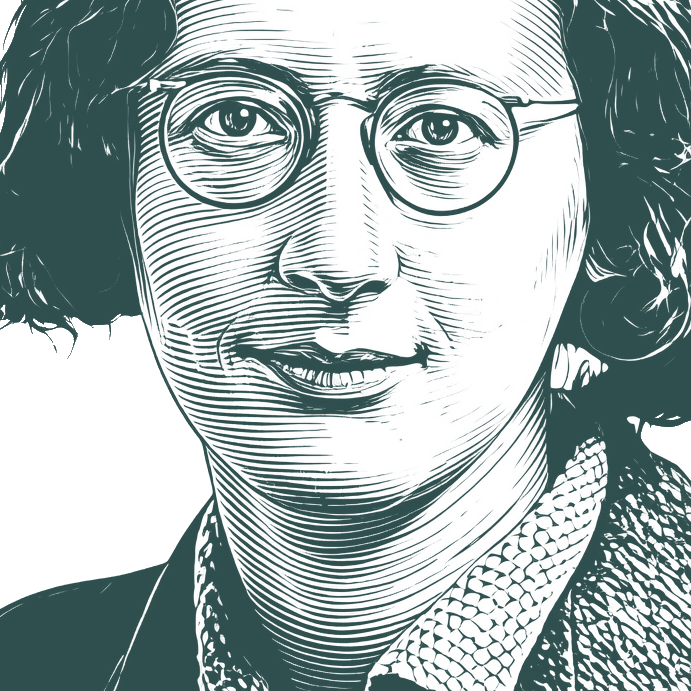
God created through love and for love. God did not create anything except love itself, and the means to love. He created love in all its forms. He cr… - Simone Weil
""
God created through love and for love. God did not create anything except love itself, and the means to love. He created love in all its forms. He created beings capable of love from all possible distances. Because no other could do it, he himself went to the greatest possible distance, the infinite distance. This infinite distance between God and God, this supreme tearing apart, this agony beyond all others, this marvel of love, is the crucifixion. Nothing can be further from God than that which has been made accursed.
Simone Adolphine Weil (3 February 1909 – 24 August 1943) was a French social and religious philosopher, and Christian mystic. Politically active, during the Spanish Civil War she joined the Anarchist military unit known as the Durruti Column, and took part in the French Resistance during World War II. She was the sister of mathematician André Weil, with whom she shared an interest in ancient Greek and Indian thought.
One can never really give a proof of the reality of anything; reality is not something open to proof, it is something established. It is established just because proof is not enough. It is this characteristic of language, at once indispensable and inadequate, which shows the reality of the external world. Most people hardly ever realize this, because it is rare that the very same man thinks and puts his thought into action.
There are four evidences of divine mercy here below. The favors of God to beings capable of contemplation (these states exist and form part of their experience as creatures). The radiance of these beings, and their compassion, which is the divine compassion in them. The beauty of the world. The fourth evidence is the complete absence of mercy here below.
PREMIUM FEATURE
Advanced Search Filters
Filter search results by source, date, and more with our premium search tools.
The mind is not forced to believe in the existence of anything (subjectivism, absolute idealism, solipsism, skepticism: c.f. the Upanishads, the Taoists and Plato, who, all of them, adopt this philosophical attitude by way of purification). That is why the only organ of contact with existence is acceptance, love. That is why beauty and reality are identical. That is why joy and the sense of reality are identical.