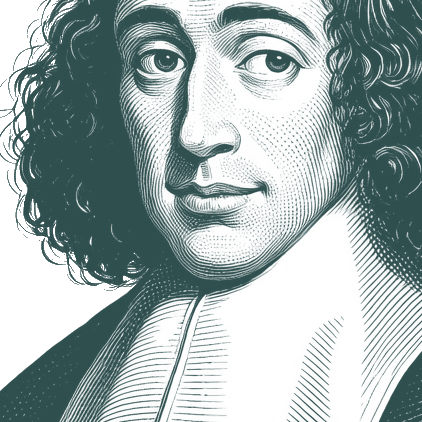
It is a pity that such a thinker as Spinoza had to leave our stage so soon. He could not live to see the enormous progress of science which would als… - Benedictus de Spinoza
""
It is a pity that such a thinker as Spinoza had to leave our stage so soon. He could not live to see the enormous progress of science which would also have improved his system.
Benedictus de Spinoza (24 November 1632 – 21 February 1677) was a social and metaphysical philosopher known for the elaborate development of his monist philosophy, which has become known as Spinozism. Controversy regarding his ideas led to his excommunication from the Jewish community of his native Amsterdam. He was named Baruch ("blessed" in Hebrew) Spinoza by his synagogue elders and known as Bento de Spinoza or Bento d'Espiñoza, but afterwards used the name Benedictus ("blessed" in Latin) de Spinoza.
Native Name:
בָּרוּךְ שְׂפִּינוֹזָה
•
Benedito de Espinosa
Alternative Names:
Benedict de Spinoza
•
Baruch de Espinosa
•
Barukh Shpinozah
•
Benoît de Spinoza
•
Sbīnūzā
•
Ispīnūzā
•
Barukh Spinoza
•
Bento de Espinosa
•
Baruch d' Espinoza
•
Shpinozah
•
Baruch de Spinoza
•
Spinoza
•
Benoit de Spinoza
•
Benedictus De Spinoza
•
Benedictus Spinoza
•
Baruch Spinoza
•
Baruch Benedictus de Spinoza
Benedict Spinoza teaches: there is only one substance, and that is God. This one substance is infinite; it is absolute. All finite substances originate from it, are contained in it, arise out of it, are immersed in it; they have only a relative, transient, accidental existence. The absolute substance is revealed to us both in the form of infinite thought and in the form of infinite dimension. These two, infinite thought and infinite dimension, are the two attributes of the absolute substance. We recognize only these two attributes, but it is possible that God, the absolute substance, has other attributes that we do not know. "Non dico, me deum omnino cognoscere, sed me quaedam ejus attributa, non autem omnia, neque maximam intelligere partem." Only stupidity and malice could attach to this doctrine the epithet "atheistic." No one has ever spoken more sublimely of the Deity than Spinoza. Instead of saying that he denied God, one might say that he denied man. All finite things are to him only modi of the infinite substance. All finite things are contained in God; the human mind is but a light‑ray of infinite thought; the human body is but a particle of the infinite dimension. God is the infinite cause of both, of spirits and of bodies, natura naturans.
PREMIUM FEATURE
Advanced Search Filters
Filter search results by source, date, and more with our premium search tools.
You seem to wish to employ reason, and ask me, "How I know that my philosophy is the best among all that have ever been taught in the world, or are being taught, or ever will be taught?" a question which I might with much greater right ask you ; for I do not presume that I have found the best philosophy, I know that I understand the true philosophy. If you ask in what way I know it, I answer: In the same way as you know that the three angles of a triangle are equal to two right angles: that this is sufficient, will be denied by no one whose brain is sound, and who does not go dreaming of evil spirits inspiring us with false ideas like the true. For the truth is the index of itself and of what is false. But you, who presume that you have at last found the best religion, or rather the best men, on whom you have pinned your credulity, you, "who know that they are the best among all who have taught, do now teach, or shall in future teach other religions. Have you examined all religions, ancient as well as modern, taught here and in India and everywhere throughout the world? And, if you, have duly examined them, how do you know that you have chosen the best" since you can give no reason for the faith that is in you? But you will say, that you acquiesce in the inward testimony of the Spirit of God, while the rest of mankind are ensnared and deceived by the prince of evil spirits. But all those outside the pale of the Romish Church can with equal right proclaim of their own creed what you proclaim of yours. As to what you add of the common consent of myriads of men and the uninterrupted ecclesiastical succession, this is the very catch-word of the Pharisees. They with no less confidence than the devotees of Rome bring forward their myriad witnesses, who as pertinaciously as the Roman witnesses repeat what they have heard, as though it were their personal experience. Further, they carry back their line to Adam. They boast with equal arrogance, that their Church has continued to this day unmoved and unimpaired in spite of the hatred of Christians and heathen. They more than any other sect are supported by antiquity. They exclaim with one voice, that they have received their traditions from God himself, and that they alone preserve the word of God, both written and unwritten. That all heresies have issued from them, and that they have remained constant through thousands of years under no constraint of temporal dominion, but by the sole efficacy of their superstition, no one can deny. The miracles they tell of would tire a thousand tongues. But their chief boast is that they count a far greater number of martyrs than any other nation, a number which is daily increased by those who suffer with singular constancy for the faith they profess; nor is their boasting false. I myself knew among others of a certain Judah called the faithful, who in the midst of the flames, when he was already thought to be dead, lifted his voice to sing the hymn beginning, "To thee, o God, I offer up my soul", and so singing perished.