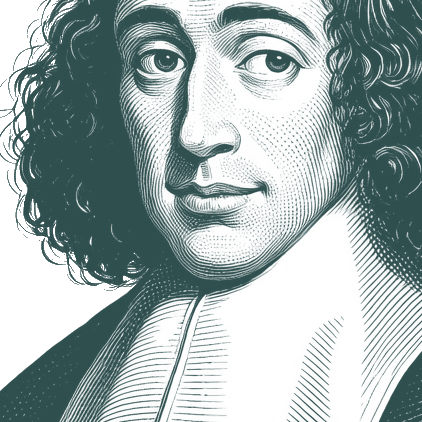
We there showed that the idea of body and body, that is, mind and body (II. xiii.), are one and the same individual conceived now under the attribute… - Benedictus de Spinoza
""
We there showed that the idea of body and body, that is, mind and body (II. xiii.), are one and the same individual conceived now under the attribute of thought, now under the attribute of extension; wherefore the idea of the mind and the mind itself are one and the same thing, which is conceived under one and the same attribute, namely, thought.
Benedictus de Spinoza (24 November 1632 – 21 February 1677) was a social and metaphysical philosopher known for the elaborate development of his monist philosophy, which has become known as Spinozism. Controversy regarding his ideas led to his excommunication from the Jewish community of his native Amsterdam. He was named Baruch ("blessed" in Hebrew) Spinoza by his synagogue elders and known as Bento de Spinoza or Bento d'Espiñoza, but afterwards used the name Benedictus ("blessed" in Latin) de Spinoza.
Native Name:
בָּרוּךְ שְׂפִּינוֹזָה
•
Benedito de Espinosa
Alternative Names:
Benedict de Spinoza
•
Baruch de Espinosa
•
Barukh Shpinozah
•
Benoît de Spinoza
•
Sbīnūzā
•
Ispīnūzā
•
Barukh Spinoza
•
Bento de Espinosa
•
Baruch d' Espinoza
•
Shpinozah
•
Baruch de Spinoza
•
Spinoza
•
Benoit de Spinoza
•
Benedictus De Spinoza
•
Benedictus Spinoza
•
Baruch Spinoza
•
Baruch Benedictus de Spinoza
But, after men began to form general ideas, to think out types of houses, buildings, towers, &c., and to prefer certain types to others, it came about, that each man called perfect that which he saw agree with the general idea he had formed of the thing in question, and called imperfect that which he saw agree less with his own preconceived type, even though it had evidently been completed in accordance with the idea of its artificer. This seems to be the only reason for calling natural phenomena, which, indeed, are not made with human hands, perfect or imperfect: for men are wont to form general ideas of things natural, no less than of things artificial, and such ideas they hold as types, believing that Nature (who they think does nothing without an object) has them in view, and has set them as types before herself. Therefore, when they behold something in Nature, which does not wholly conform to the preconceived type which they have formed of the thing in question, they say that Nature has fallen short or has blundered, and has left her work incomplete.
In the year 1888, before leaving the Normal School to face the experiences of actual life, he wrote Credo quia verum. This is a remarkable document, a spiritual testament, a moral and philosophical confession. It remains unpublished, but a friend of Rolland's youth assures us that it contains the essential elements of his untrammeled outlook on the world. Conceived in the Spinozist spirit, based not upon "Cogito ergo sum" but upon "Cogito ergo est," it builds up the world, and thereon establishes its god.
Unlimited Quote Collections
Organize your favorite quotes without limits. Create themed collections for every occasion with Premium.
Spinoza was a Jew, It is a certified fact that he was born and educated as a Jew. But should we mention the names of other men, perhaps of equal rank with Spinoza, who were likewise bom and educated as Jews, and whom scarcely any Jew would dare to remember proudly and gratefully as a Jew? We need not mention these names, and can indeed regard the proposition as proven, that the Jewish origin and education of a great man, taken by themselves, do not give us the right to claim his greatness for Judaism. Therefore, if one disregards the fact that Spinoza was born and educated as a Jew {a fact from which perhaps not much can be concluded), and if in addition one is not satisfied with vague speculations on Spinoza's Jewish cast of mind; if therefore one wants to know clearly and distinctly where Judaism is lodged in Spinoza's thought, that is, which of Spinoza's decisive ideas bear a peculiarly Jewish imprint — then one will turn with deserved trust to those scholars who have endeavored to determine the Jewish sources of Spinoza's doctrine.