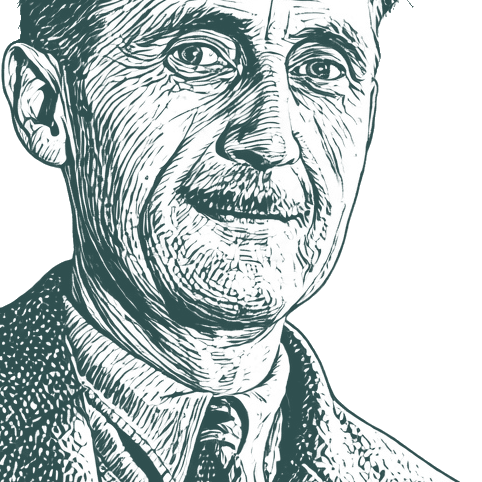
For, after all, how do we know that two and two make four? Or that the force of gravity works? Or that the past is unchangeable? If both the past and… - George Orwell
""
For, after all, how do we know that two and two make four? Or that the force of gravity works? Or that the past is unchangeable? If both the past and the external world exist only in the mind, and if the mind itself is controllable – what then?
George Orwell (25 June 1903 – 21 January 1950) was the pen name of British novelist, essayist, and journalist Eric Arthur Blair, whose work is characterised by lucid prose, awareness of social injustice, opposition to totalitarianism, and strong support of democratic socialism.
Biography information from
Wikiquote·
Portrait adapted from
Wikimedia Commons, Cassowary Colorizations (CC BY)
Also Known As
Pen Names:
John Freeman
Birth Name:
Eric Arthur Blair
Alternative Names:
Orwell
•
Eric Blair
•
P. S. Burton
We are the dead. Our only true life is in the future.
England is not the jewelled isle of Shakespeare's much-quoted message, nor is it the inferno depicted by Dr Goebbels. More than either it resembles a family, a rather stuffy Victorian family, with not many black sheep in it but with all its cupboards bursting with skeletons. It has rich relations who have to be kow-towed to and poor relations who are horribly sat upon, and there is a deep conspiracy of silence about the source of the family income. It is a family in which the young are generally thwarted and most of the power is in the hands of irresponsible uncles and bedridden aunts. Still, it is a family. It has its private language and its common memories, and at the approach of an enemy it closes its ranks. A family with the wrong members in control - that, perhaps is as near as one can come to describing England in a phrase.
Go Premium
Support Quotewise while enjoying an ad-free experience and premium features.
One cannot see the modern world as it is unless one recognizes the overwhelming strength of patriotism, national loyalty. In certain circumstances it can break down, at certain levels of civilization it does not exist, but as a positive force there is nothing to set beside it. Christianity and international Socialism are as weak as straw in comparison with it. Hitler and Mussolini rose to power in their own countries very largely because they could grasp this fact and their opponents could not.