To conclude, I think there have been two really productive traditions of research that have unquestionable relevance to anyone concerned with the stu… - Noam Chomsky
""
To conclude, I think there have been two really productive traditions of research that have unquestionable relevance to anyone concerned with the study of language today. One is the tradition of philosophical grammar that flourished from the seventeenth century through romanticism; the second is the tradition that I have rather misleadingly been referring to as “structuralist,” which has dominated research for the past century, at least until the early 1950s. I have dwelt on the achievements of the former because of their unfamiliarity as well as their contemporary relevance. Structural linguistics has enormously broadened the scope of information available to us and has extended immeasurably the reliability of such data. It has shown that there are structural relations in language that can be studied abstractly. It has raised the precision of discourse about language to entirely new levels. But I think that its major contribution may prove to be one for which, paradoxically, it has been very severely criticized. I refer to the careful and serious attempt to construct “discovery procedures,” those techniques of segmentation and classification to which Saussure referred. This attempt was a failure – I think that is now generally understood. It was a failure because such techniques are at best limited to the phenomena of surface structure and cannot, therefore, reveal the mechanisms that underlie the creative aspect of language use and the expression of semantic content. But what remains of fundamental importance is that this attempt was directed to the basic question in the study of language, which was for the first time formulated in a clear and intelligible way. The problem raised is that of specifying the mechanisms that operate on the data of sense and produce knowledge of language – linguistic competence. It is obvious that such mechanisms exist. Children do learn a first language; the language that they learn is, in the traditional sense, an “instituted language,” not an innately specified system. The answer that was proposed in structural linguistic methodology has been shown to be incorrect, but this is of small importance when compared with the fact that the problem itself has now received a clear formulation.
English
Collect this quote
About
Noam Chomsky
Avram Noam Chomsky (born 7 December 1928) is an American linguist, analytical philosopher, cognitive scientist, political analyst, human rights activist and anarcho-socialist.
Biography information from
Wikiquote·
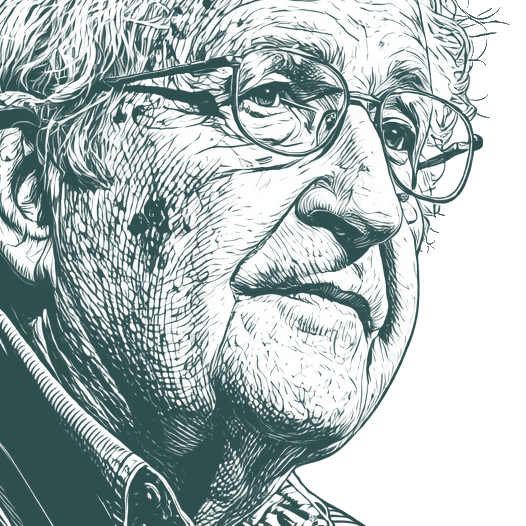
Portrait adapted from
Wikimedia Commons, Augusto Starita / Ministerio de Cultura de la Nación (CC BY-SA)
I think that’s a terrific technique of propaganda. To impose concision is a way of virtually guaranteeing that the party line gets repeated over and over again, and that nothing else is heard.
...if you ask me whether or not I'm an atheist, I wouldn't even answer. I would first want an explanation of what it is that I'm supposed not to believe in, and I've never seen an explanation.
Works in ChatGPT, Claude, or Any AI
Add semantic quote search to your AI assistant via MCP. One command setup.
Biden has pretty much picked up Trump’s foreign policy. He has eliminated some of the more gratuitously savage elements. Like in the case of Palestine, for example, Trump was not satisfied with just giving everything away to Israeli right-wing power—”do what you want”—and offering nothing to the Palestinians, just kicking them in the face. He even had to go beyond that to truly gratuitous savagery like cutting off the lifeline, the UNRWA lifeline, for Palestinians to be able to have at least minimal bare survival in the Israeli punching bag in Gaza. Even that, well, Biden removed those things. Other than that, pretty much followed the same policies.