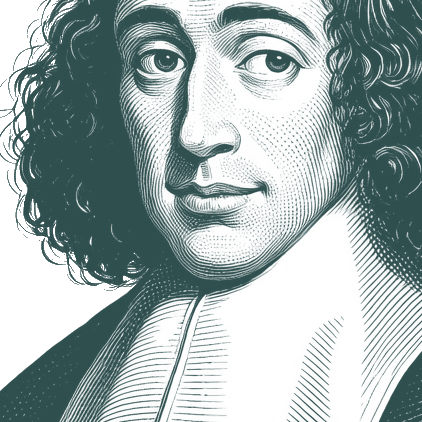
Just as Herder's cosmopolitanism allowed him to become very sympathetic to Judaism as a religion and cultural tradition, so it also allowed him to be… - Benedictus de Spinoza
""
Just as Herder's cosmopolitanism allowed him to become very sympathetic to Judaism as a religion and cultural tradition, so it also allowed him to become a great admirer of the most important Jewish philosopher of the modern period: Spinoza. As is well known, Herder's appropriation (and modification) of the metaphysical monism of Spinoza's Ethics in God: Some Conversations (1787) played a central role in generating the forms of neo-Spinozistic metaphysical monism that later dominated German Idealism and German Romanticism. But Herder's interest in and sympathy with Spinoza in fact reach much further back in time than that work, to the late 1760's, and his intellectual debts to Spinoza extend well beyond the principle of metaphysical monism. Thus, another important debt lies in the anti-dualistic and deterministic philosophy of mind that Herder presented, with explicit mention of Spinoza, in On the Cognition and Sensation of the Human Soul (1778), which is again heavily indebted to the Ethifcs. Moreover, even before Herder was influenced by the Ethics in the ways just mentioned, he was influenced by the Tractatus. Thus, another major area in which he owes debts to Spinoza is the theory of interpretation, especially biblical interpretation, where he borrowed principles from the Tractatus from the late 1760's on. And yet another debt can be seen in Herder's early turn, in about 1770, away from monarchy as a constitutional ideal towards the ideals of democracy and liberalism – for that turn was influenced by Spinoza's championing of the latter ideals in the Tractatus. Putting these cases together, one can indeed see that Herder beginning in the late 1760's engaged in a sort of progressive appropriation of increasingly fundamental levels of Spinoza's thought: first principles of interpretation, then political ideals, then philosophy of mind and metaphysics. All of the principles in question went on to play important roles within German Idealism and German Romanticism. Spinoza's contribution to those movements was thus far greater than has usually been realized.
English
Collect this quote
About
Benedictus de Spinoza
Benedictus de Spinoza (24 November 1632 – 21 February 1677) was a social and metaphysical philosopher known for the elaborate development of his monist philosophy, which has become known as Spinozism. Controversy regarding his ideas led to his excommunication from the Jewish community of his native Amsterdam. He was named Baruch ("blessed" in Hebrew) Spinoza by his synagogue elders and known as Bento de Spinoza or Bento d'Espiñoza, but afterwards used the name Benedictus ("blessed" in Latin) de Spinoza.
Native Name:
בָּרוּךְ שְׂפִּינוֹזָה
•
Benedito de Espinosa
Alternative Names:
Benedict de Spinoza
•
Baruch de Espinosa
•
Barukh Shpinozah
•
Benoît de Spinoza
•
Sbīnūzā
•
Ispīnūzā
•
Barukh Spinoza
•
Bento de Espinosa
•
Baruch d' Espinoza
•
Shpinozah
•
Baruch de Spinoza
•
Spinoza
•
Benoit de Spinoza
•
Benedictus De Spinoza
•
Benedictus Spinoza
•
Baruch Spinoza
•
Baruch Benedictus de Spinoza
The more you struggle to live, the less you live. Give up the notion that you must be sure of what you are doing. Instead, surrender to what is real within you, for that alone is sure....you are above everything distressing.
أوحي إلى نوح، بطريقةٍ على مستوى فَهْمه، بأنَّ الله سيُهلِك الجنس البشري. الواقع أنَّ نوحًا كان يَعتقِد أنَّ العالم كله، باستثناء فلسطين، لم يكُن مسكونًا، ولم يجهل الأنبياء مِثل هذه الأشياء فحسْب، بل جَهِلوا أيضًا أشياء أخرى كثيرةً أكثر أهمية، ولا يَنقُص جهلهم هذا من تقواهم شيئًا لأنهم لم يقولوا شيئًا خاصًّا يتعلَّق بصفات الله، بل كانت آراؤهم عنه هي بِعَينها الآراء المُتداولة، وكان الوحي الذي هبط عليهم مُتناسبًا مع آرائهم
Works in ChatGPT, Claude, or Any AI
Add semantic quote search to your AI assistant via MCP. One command setup.
The difficulty begins with the problem that there are several Spinozas with which to reckon, at least four by my count. The first is the accessible Spinoza, the radical religious scholar who disagrees with the churches of his time, presents a new conception of God, and proposes a new road to human salvation. Next comes Spinoza as political architect, the thinker who describes the traits of an ideal democratic state populated by responsible, happy citizens. The third Spinoza is the least accessible of the set: the philosopher who uses scientific facts, a method of geometric demonstration and intuition to formulate a conception of the universe and the human beings in it. Recognizing these three Spinozas and their web of dependencies is enough to suggest how convoluted Spinoza can be. But there is a fourth Spinoza: the protobiologist. This is the biological thinker concealed behind countless propositions, axioms, proofs, lemmas, and scholia. Given that many of the advances on the science of emotions and feeling are consonant with proposals that Spinoza began to articulate, my second purpose in this book is to connect this least-known Spinoza to some of the corresponding neurobiology of today. But I note, again, that this book is not about Spinoza's philosophy. I do not address Spinoza's thinking outside of the aspects I regard as pertinent to biology. The goal is more modest. One of the values of philosophy is that throughout its history it has prefigured science. In turn, I believe, science is well served by recognizing that historical effort.