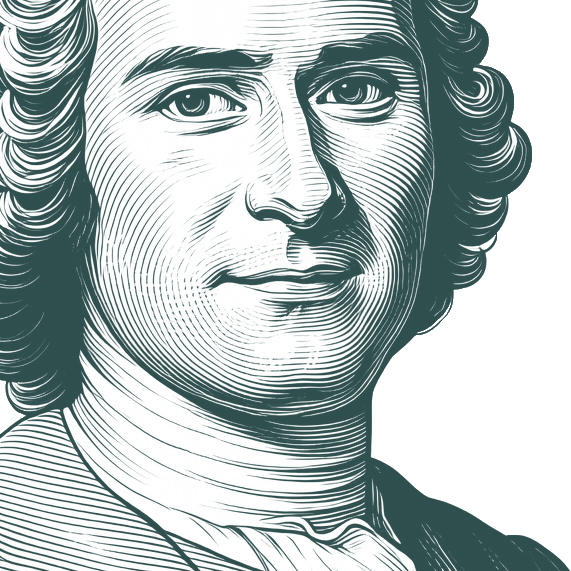
on ne connaît d'où est un homme qu'après qu'il a parlé. - Jean-Jacques Rousseau
""
on ne connaît d'où est un homme qu'après qu'il a parlé.
French
Collect this quote
About
Jean-Jacques Rousseau
Jean-Jacques Rousseau (June 28, 1712 – July 2, 1778) was a major French-speaking Genevan philosopher of Enlightenment whose political ideas influenced the French Revolution, the development of socialist theory, and the growth of nationalism.
Biography information from
Wikiquote·
Portrait adapted from
Wikimedia Commons, Maurice Quentin de La Tour (Public domain / CC0)
Also Known As
Alternative Names:
Citizen of Geneva
•
Jean Jacques Rousseau
•
J. J. Rousseau
•
Rousseau
•
J.J. Rousseau
•
JJ Rousseau
Respetad a la infancia y no os deis prisa en juzgarla ni para el bien ni para el mal.
One always wants what is good for oneself, but one does not always see it. The people is never corrupted, but it is often fooled, and only then does it appear to want what is bad.
PREMIUM FEATURE
Advanced Search Filters
Filter search results by source, date, and more with our premium search tools.
If it is good to know how to deal with men as they are, it is much better to make them what there is need that they should be. The most absolute authority is that which penetrates into a man's inmost being, and concerns itself no less with his will than with his actions. It is certain that all peoples become in the long run what the government makes them; warriors, citizens, men, when it so pleases: or merely populace and rabble, when it chooses to make them so. Hence every prince who despises his subjects, dishonours himself, in confessing that he does not know how to make them worthy of respect. Make men, therefore, if you would command men: if you would have them obedient to the laws, make them love the laws, and then they will need only to know what is their duty to do it. This was the great art of ancient governments, in those distant times when philosophers gave laws to men, and made use of their authority only to render them wise and happy. Thence arose the numerous sumptuary laws, the many regulations of morals, and all the public rules of conduct which were admitted or rejected with the greatest care. Even tyrants did not forget this important part of administration, but took as great pains to corrupt the morals of their slaves, as Magistrates took to correct those of their fellowcitizens. But our modern governments, which imagine they have done everything when they have raised money, conceive that it is unnecessary and even impossible to go a step further.