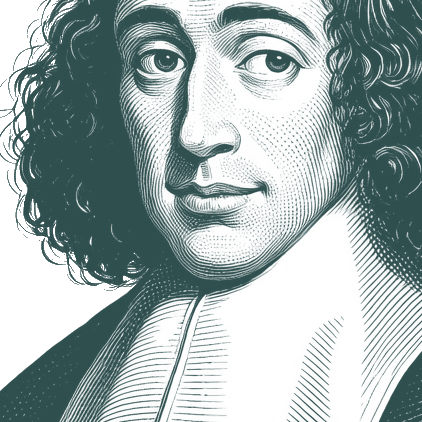
I will only say generally, that in proportion as any given body is more fitted than others for doing many actions or receiving many impressions at on… - Benedictus de Spinoza
""
I will only say generally, that in proportion as any given body is more fitted than others for doing many actions or receiving many impressions at once, so also is the mind, of which it is the object, more fitted than others for forming many simultaneous perceptions; and the more the actions of the body depend on itself alone, and the fewer other bodies concur with it in action, the more fitted is the mind of which it is the object for distinct comprehension. We may thus recognize the superiority of one mind over others, and may further see the cause, why we have only a very confused knowledge of our body, and also many kindred questions, which I will, in the following propositions, deduce from what has been advanced.
English
Collect this quote
About
Benedictus de Spinoza
Benedictus de Spinoza (24 November 1632 – 21 February 1677) was a social and metaphysical philosopher known for the elaborate development of his monist philosophy, which has become known as Spinozism. Controversy regarding his ideas led to his excommunication from the Jewish community of his native Amsterdam. He was named Baruch ("blessed" in Hebrew) Spinoza by his synagogue elders and known as Bento de Spinoza or Bento d'Espiñoza, but afterwards used the name Benedictus ("blessed" in Latin) de Spinoza.
Native Name:
בָּרוּךְ שְׂפִּינוֹזָה
•
Benedito de Espinosa
Alternative Names:
Benedict de Spinoza
•
Baruch de Espinosa
•
Barukh Shpinozah
•
Benoît de Spinoza
•
Sbīnūzā
•
Ispīnūzā
•
Barukh Spinoza
•
Bento de Espinosa
•
Baruch d' Espinoza
•
Shpinozah
•
Baruch de Spinoza
•
Spinoza
•
Benoit de Spinoza
•
Benedictus De Spinoza
•
Benedictus Spinoza
•
Baruch Spinoza
•
Baruch Benedictus de Spinoza
Spinoza's "theory" rejected every illusion about ideology, and especially about the number one ideology of that time, religion, by identifying it as imaginary. But at the same time it refused to treat ideology as a simple error, or as naked ignorance, because it based the system of this imaginary phenomenon on the relation of men to the world "expressed" by the state of their bodies. This materialism of the imaginary opened the way to a surprising conception of the First Level of Knowledge: not at all, in fact, as a "piece of knowledge", but as the material world of men as they live it, that of their concrete and historical existence. Is this a false interpretation? In certain respects, perhaps, but it is possible to read Spinoza in such a way. In fact his categories do function, daringly, in this way in the history of the Jewish people, of its prophets, of its religion, and of its politics, where the primacy of politics over religion stands out clearly, in the first work which, after Machiavelli, offered a theory of history. But this theory of the imaginary went still further. By its radical criticism of the central category of imaginary illusion, the Subject, it reached into the very heart of bourgeois philosophy, which since the fourteenth century had been built on the foundation of the legal ideology of the Subject. Spinoza's resolute anti-Cartesianism consciously directs itself to this point, and the famous "critical" tradition made no mistake here. On this point too Spinoza anticipated Hegel, but he went further. For Hegel, who criticized all theses of subjectivity, nevertheless found a place for the Subject, not only in the form of the "becoming-Subject of Substance" (by which he "reproaches" Spinoza for "wrongly" taking things no further than Substance), but in the interiority of the Telos of the process without a subject, which by virtue of the negation of the negation, realizes the designs and destiny of the Idea. Thus Spinoza showed us the secret alliance between Subject and Goal which "mystifies" the Hegelian dialectic.
There may be no philosopher in history (with the possible exceptions of Socrates and Nietzsche) who has received greater attention in artistic, literary and popular culture than Bento (Benedictus) de Spinoza (1632–1677). His life, ideas and influence have been the subject of numerous novels, plays, poems, paintings, sculptures, even musical pieces and opera. His name and his visage have been used in the marketing of various items in the worlds of entertainment, leisure and consumption, from cafés to rock bands to bagels. [...] A relatively simple explanation for Spinoza's unusually high profile outside the walls of academia is at hand. Spinoza was the most radical and iconoclastic thinker of his time. His ideas on religion, politics, ethics, human psychology and metaphysics, presented in difficult and sometimes mystifying treatises, lay the groundwork for much of what we now regard as “modern.” Perhaps most enticing of all, he was excommunicated from the Amsterdam Portuguese-Jewish community as a young man for reasons that remain obscure (although not hard to fathom). Everyone loves a rebel—especially one whose values they likely share and whom, they feel, was unjustly punished by those in power.
En la reminiscencia, en efecto, el alma tiene el pensamiento de esta sensación, pero no en la continuidad de su duración. Así, la idea de la sensación no es la duración misma de la sensación, es decir, ella no es propiamente su memoria. En cuanto a saber si las ideas mismas están sujetas a alguna corrupción, lo veremos en la Filosofía.