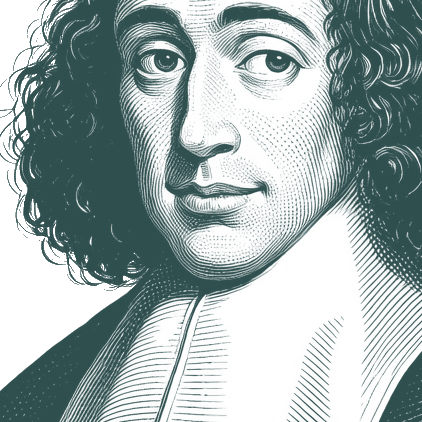
...The more a man knows about individual objects, the more he knows about God. Translating Spinoza's language into ours, we can say: The more a man k… - Benedictus de Spinoza
""
...The more a man knows about individual objects, the more he knows about God. Translating Spinoza's language into ours, we can say: The more a man knows about himself in relation to every kind of experience, the greater his chance of suddenly, one fine morning, realizing who in fact he is...
Benedictus de Spinoza (24 November 1632 – 21 February 1677) was a social and metaphysical philosopher known for the elaborate development of his monist philosophy, which has become known as Spinozism. Controversy regarding his ideas led to his excommunication from the Jewish community of his native Amsterdam. He was named Baruch ("blessed" in Hebrew) Spinoza by his synagogue elders and known as Bento de Spinoza or Bento d'Espiñoza, but afterwards used the name Benedictus ("blessed" in Latin) de Spinoza.
Native Name:
בָּרוּךְ שְׂפִּינוֹזָה
•
Benedito de Espinosa
Alternative Names:
Benedict de Spinoza
•
Baruch de Espinosa
•
Barukh Shpinozah
•
Benoît de Spinoza
•
Sbīnūzā
•
Ispīnūzā
•
Barukh Spinoza
•
Bento de Espinosa
•
Baruch d' Espinoza
•
Shpinozah
•
Baruch de Spinoza
•
Spinoza
•
Benoit de Spinoza
•
Benedictus De Spinoza
•
Benedictus Spinoza
•
Baruch Spinoza
•
Baruch Benedictus de Spinoza
Sed amor erga rem aeternam et infinitam sola laetitia pascit animum, ipsaque omnis tristitiae est expers; quod valde est desiderandum totisque viribus quaerendum.
After 1785 public opinion of Spinoza changed from almost universal contempt to almost universal admiration, largely as a result of the publication of Jacobi's Briefe, in which he revealed Lessing's Spinozism. Lessing was the most admired figure of the Aufklarung, and his credo automatically gave a stamp of legitimacy to every secret Spinozist. One after another the Spinozists could now come out of their closets and form a file behind Lessing. If Lessing was an honorable man and a Spinozist, then they could be too. Ironically, Jacobi's Briefe did not destroy Lessing's reputation, as Mendelssohn feared. It did the very opposite, making him a hero in the eyes of the nonconformists. Lessing made it a fashion to be unorthodox; and to be fashionably unorthodox was to be a Spinozist. Of course, Lessing's credo explains only how Spinozism became respectable. It accounts for why a Spinozist might go public, but not for why he became a Spinozist in the first place. To understand why Spinozism became the credo of so many other thinkers, we have to consider the new situation of the sciences at the close of the eighteenth century. The rise in the fortunes of Spinozism resulted in part from the consequence of the decline of theism and deism.
Go Premium
Support Quotewise while enjoying an ad-free experience and premium features.