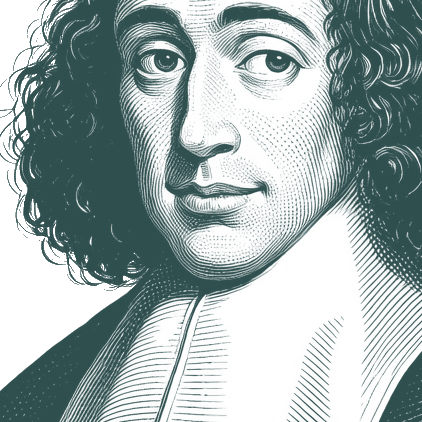
One of Spinoza's more famous, influential and incendiary doctrines concerns the origin and status of Scripture. The Bible, Spinoza argues in the Theo… - Benedictus de Spinoza
""
One of Spinoza's more famous, influential and incendiary doctrines concerns the origin and status of Scripture. The Bible, Spinoza argues in the Theological-Political Treatise, was not literally authored by God. God or Nature is metaphysically incapable of proclaiming or dictating, much less writing, anything. Scripture is not ‘a message for mankind sent down by God from heaven’. Rather, it is a very mundane document. Texts from a number of authors of various socio-economic backgrounds, writing at different points over a long stretch of time and in differing historical and political circumstances, were passed down through generations in copies after copies after copies. [...] Spinoza supplements his theory of the human origins of Scripture with an equally deflationary account of its authors. The prophets were not especially learned individuals. They did not enjoy a high level of education or intellectual sophistication. They certainly were not philosophers or physicists or astronomers. There are no truths about nature or the cosmos to be found in their writings (Joshua believed that the Sun revolved around the Earth). Neither are they a source of metaphysical or even theological truths. The prophets often had naïve, even philosophically false beliefs about God.
English
Collect this quote
About
Benedictus de Spinoza
Benedictus de Spinoza (24 November 1632 – 21 February 1677) was a social and metaphysical philosopher known for the elaborate development of his monist philosophy, which has become known as Spinozism. Controversy regarding his ideas led to his excommunication from the Jewish community of his native Amsterdam. He was named Baruch ("blessed" in Hebrew) Spinoza by his synagogue elders and known as Bento de Spinoza or Bento d'Espiñoza, but afterwards used the name Benedictus ("blessed" in Latin) de Spinoza.
Native Name:
בָּרוּךְ שְׂפִּינוֹזָה
•
Benedito de Espinosa
Alternative Names:
Benedict de Spinoza
•
Baruch de Espinosa
•
Barukh Shpinozah
•
Benoît de Spinoza
•
Sbīnūzā
•
Ispīnūzā
•
Barukh Spinoza
•
Bento de Espinosa
•
Baruch d' Espinoza
•
Shpinozah
•
Baruch de Spinoza
•
Spinoza
•
Benoit de Spinoza
•
Benedictus De Spinoza
•
Benedictus Spinoza
•
Baruch Spinoza
•
Baruch Benedictus de Spinoza
Spinoza was the man I believed in always, as the alternative to Catholicism. And it is only in Spinoza's manner that I am a positivist at all. I believe in the real world, in the world of thought and extension, of psychology and physics. God or substance with Spinoza equals reality; and this reality, which may have countless forms, we find only in space and in (other men's) consciousness. I say in other men's, because Spinoza was too sane to care to discuss anything from the point of view of subjective idealism. When one prints a book to convince other people, one oughtn't to discuss in it whether they exist. But this is all by the way, although some other day I will discuss with you the question of Spinoza's hedonism.
self-preservation is the primary and only foundation of virtue.
[The] right of the individual is co-extensive with its determinate power. ... Nature's bounds are not set by the laws of human reason which aim only at man's true interest and his preservation ... man is but a particle.