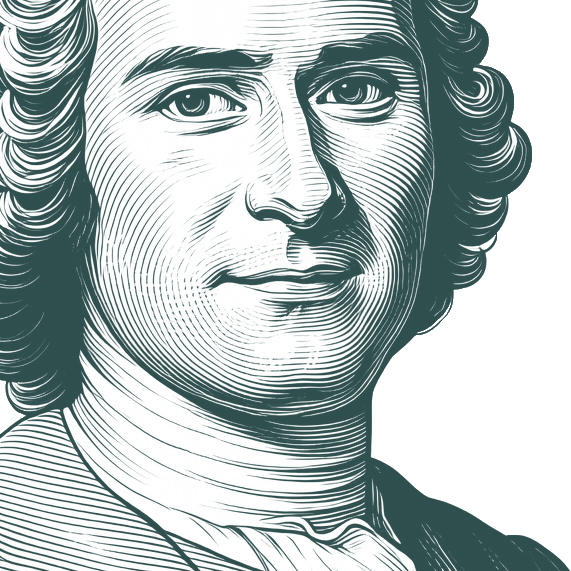
Let us not forget what befits our present state in the pursuit of vain fancies. Mankind has its place in the sequence of things; childhood has its pl… - Jean-Jacques Rousseau

" "

Let us not forget what befits our present state in the pursuit of vain fancies. Mankind has its place in the sequence of things; childhood has its place in the sequence of human life; the man must be treated as a man and the child as a child. Give each his place, and keep him there. Control human passions according to man's nature; that is all we can do for his welfare. The rest depends on external forces, which are beyond our control.

English
Collect this quote

About Jean-Jacques Rousseau

Jean-Jacques Rousseau (June 28, 1712 – July 2, 1778) was a major French-speaking Genevan philosopher of Enlightenment whose political ideas influenced the French Revolution, the development of socialist theory, and the growth of nationalism.

Biography information from Wikiquote

Also Known As

Alternative Names: Citizen of Geneva Jean Jacques Rousseau J. J. Rousseau Rousseau J.J. Rousseau JJ Rousseau
Try QuoteGPT

Chat naturally about what you need. Each answer links back to real quotes with citations.

Related quotes. More quotes will automatically load as you scroll down, or you can use the load more buttons.

Additional quotes by Jean-Jacques Rousseau

Un homme était-il éminent en pouvoir, en vertu, en richesses ou en crédit, il fut seul élu magistrat, et l’état devint monarchique. Si plusieurs, à peu près égaux entre eux, l’emportaient sur tous les autres, ils furent élus conjointement, et l’on eut une aristocratie. Ceux dont la fortune ou les talents étaient moins disproportionnés, et qui s’étaient le moins éloignés de l’état de nature, gardèrent en commun l’administration suprême, et formèrent une démocratie.

They say that Caliph Omar, when consulted about what had to be done with the library of Alexandria, answered as follows: 'If the books of this library contain matters opposed to the Koran, they are bad and must be burned. If they contain only the doctrine of the Koran, burn them anyway, for they are superfluous.' Our learned men have cited this reasoning as the height of absurdity. However, suppose Gregory the Great was there instead of Omar and the Gospel instead of the Koran. The library would still have been burned, and that might well have been the finest moment in the life of this illustrious pontiff.

Works in ChatGPT, Claude, or Any AI

Add semantic quote search to your AI assistant via MCP. One command setup.

Sensitivity is the principle of all action. A being, albeit animated, who would feel nothing, would never act, for what would its motive for acting be? God himself is sensitive since he acts. All men are therefore sensitive, and perhaps to the same degree, but not in the same manner. There is a purely passive physical and organic sensitivity which seems to have as its end only the preservation of our bodies and of our species through the direction of pleasure and pain. There is another sensitivity that I call active and moral which is nothing other than the faculty of attaching our affections to beings who are foreign to us. This type, about which study of nerve pairs teaches nothing, seems to offer a fairly clear analogy for souls to the magnetic faculty of bodies. Its strength is in proportion to the relationships we feel between ourselves and other beings, and depending on the nature of these relationships it sometimes acts positively by attraction, sometimes negatively by repulsion, like the poles of a magnet. The positive or attracting action is the simple work of nature, which seeks to extend and reinforce the feeling of our being; the negative or repelling action, which compresses and diminishes the being of another, is a combination produced by reflection. From the former arise all the loving and gentle passions, and from the latter all the hateful and cruel passions.

Loading...