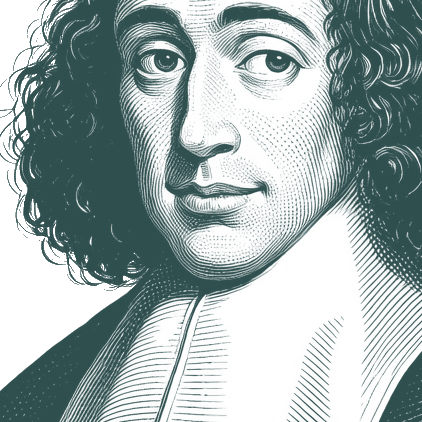
The Declaration of Independence, that extraordinary document first drafted by Thomas Jefferson, softly echoes Spinoza. John Locke, Spinoza's contempo… - Benedictus de Spinoza
""
The Declaration of Independence, that extraordinary document first drafted by Thomas Jefferson, softly echoes Spinoza. John Locke, Spinoza's contemporary — both were born in 1632 — is a more obvious influence on Jefferson than Spinoza was. But Locke had himself been influenced by Spinoza's ideas on tolerance, freedom and democracy. In fact, Locke spent five formative years in Amsterdam, in exile because of the political troubles of his patron, the Earl of Shaftesbury. Though Spinoza was already dead, Locke met in Amsterdam men who almost certainly spoke of Spinoza. Locke's library not only included all of Spinoza's important works, but also works in which Spinoza had been discussed and condemned. It's worth noting that Locke emerged from his years in Amsterdam a far more egalitarian thinker, having decisively moved in the direction of Spinoza. He now accepted, as he had not before, the fundamental egalitarian claim that the legitimacy of the state's power derives from the consent of the governed, a phrase that would prominently find its way into the Declaration. Locke's claims on behalf of reason did not go as far as Spinoza's. He was firm in defending Christianity's revelation as the one true religion against Spinoza's universalism. In some of the fundamental ways in which Spinoza and Locke differed, Jefferson's view was more allied with Spinoza. (Spinoza's collected works were also in Jefferson's library, so Spinoza's impact may not just have been by way of Locke.)
English
Collect this quote
About
Benedictus de Spinoza
Benedictus de Spinoza (24 November 1632 – 21 February 1677) was a social and metaphysical philosopher known for the elaborate development of his monist philosophy, which has become known as Spinozism. Controversy regarding his ideas led to his excommunication from the Jewish community of his native Amsterdam. He was named Baruch ("blessed" in Hebrew) Spinoza by his synagogue elders and known as Bento de Spinoza or Bento d'Espiñoza, but afterwards used the name Benedictus ("blessed" in Latin) de Spinoza.
Native Name:
בָּרוּךְ שְׂפִּינוֹזָה
•
Benedito de Espinosa
Alternative Names:
Benedict de Spinoza
•
Baruch de Espinosa
•
Barukh Shpinozah
•
Benoît de Spinoza
•
Sbīnūzā
•
Ispīnūzā
•
Barukh Spinoza
•
Bento de Espinosa
•
Baruch d' Espinoza
•
Shpinozah
•
Baruch de Spinoza
•
Spinoza
•
Benoit de Spinoza
•
Benedictus De Spinoza
•
Benedictus Spinoza
•
Baruch Spinoza
•
Baruch Benedictus de Spinoza
...Of the Weimarian trio, Herder theologian, poet, historian, critic, philosopher, and metrician was the first to apply Spinozism to historiography and to literary history. He was also the only one to recognize in Spinoza the renovator of a form of ancient theism. Living under the shadow of Goethe and his personality cult, he conceived pantheism under the aspect of personality.
That by the decrees and volitions, and consequently the providence of God, Scripture (as I will prove by Scriptural examples) means nothing but Nature's order following necessarily from her eternal laws.
...The rise, triumph, and victory of Spinozism in Europe are reminiscent of the power of ancient Buddhism because both are religiosity rather than philosophy. Spinozism is religion even when it operates with bizarre formulas. Its starting-point is a dead God, who is reminiscent of Buddha's Brahma. It is man's metaphysical fear and not the idea of a living God which is the driving force in religiosity. True religiosity is not an understanding of how God is correlated to man and to the world but the feeling of man's insignificance in the cosmos, giving birth to a state of meekness, humbleness, compassion, and pity. Only when man is crushed and overwhelmed by the thought of his insignificance in this vast universe does he become truly religious. These feelings are as present in Spinozism as they are in Buddhism.