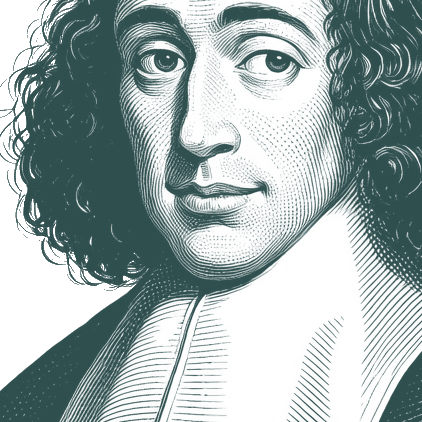
I read Spinoza's Ethics for the first time when I was thirteen years old. Of course at school we studied the Bible – which for me is the ultimate phi… - Benedictus de Spinoza
""
I read Spinoza's Ethics for the first time when I was thirteen years old. Of course at school we studied the Bible – which for me is the ultimate philosophical work. However, reading Spinoza opened up a new dimension for me, which is the reason for my continuing dedication to his works. Spinoza's simple principle 'man thinks' has become an existential mindset for me; my copy of his Ethics has become dog-eared and torn. For years I took it with me on my travels and in hotel rooms or intervals in concerts became absorbed by many of its principles. Spinoza's Ethics is the best training ground for the intellect, above all because Spinoza teaches the radical freedom of thought more completely than any other philosopher. This Spinozan brand of freedom is not a release from discipline into arbitrariness of thought, but an active process. The more one is able to determine one's own thoughts – in fact, causing one's own thoughts, thereby creating one's own experience of reality – the more it is possible to become self-determined, to be truly free.
Benedictus de Spinoza (24 November 1632 – 21 February 1677) was a social and metaphysical philosopher known for the elaborate development of his monist philosophy, which has become known as Spinozism. Controversy regarding his ideas led to his excommunication from the Jewish community of his native Amsterdam. He was named Baruch ("blessed" in Hebrew) Spinoza by his synagogue elders and known as Bento de Spinoza or Bento d'Espiñoza, but afterwards used the name Benedictus ("blessed" in Latin) de Spinoza.
Native Name:
בָּרוּךְ שְׂפִּינוֹזָה
•
Benedito de Espinosa
Alternative Names:
Benedict de Spinoza
•
Baruch de Espinosa
•
Barukh Shpinozah
•
Benoît de Spinoza
•
Sbīnūzā
•
Ispīnūzā
•
Barukh Spinoza
•
Bento de Espinosa
•
Baruch d' Espinoza
•
Shpinozah
•
Baruch de Spinoza
•
Spinoza
•
Benoit de Spinoza
•
Benedictus De Spinoza
•
Benedictus Spinoza
•
Baruch Spinoza
•
Baruch Benedictus de Spinoza
None are more taken in by flattery than the proud, who wish to be the first and are not.
The brilliance of the solution of the problem of the relation of thinking to the world of bodies in space outside thought (i.e. outside the head of man), which Spinoza formulated in the form of the thesis that thought and extension are not two substances, but only two attributes of one and the same substance, can hardly be exaggerated. This solution immediately rejected every possible kind of interpretation and investigation of thought by the logic of spiritualist and dualist constructions, so making it possible to find a real way out both from the blind alley of the dualism of mind and body and from the specific blind alley of Hegelianism. It is not fortuitous that Spinoza’s profound idea only first found true appreciation by the dialectical materialists Marx and Engels. Even Hegel found it a hard nut to crack. In fact, on the decisive point, he returned again to the position of Descartes, to the thesis that pure thought is the active cause of all the changes occurring in the ‘thinking body of man’, i.e. in the matter of the brain and sense organs, in language, in actions and their results, including in that the instruments of labour and historical events.
Go Premium
Support Quotewise while enjoying an ad-free experience and premium features.
...That a Spinozist social science should be of French concoction is no coincidence: from the historical scholarship of Martial Guéroult to Alexandre Matheron's pioneering study of the individual and community in Spinoza; from the centrality of Spinoza's materialism to the Althusserian project to Gilles Deleuze's radical re-working of his philosophy of immanence and the advances of contemporary scholarship, France has an altogether impressive tradition of Spinoza interpretation. At the heart of this retooling of a seventeenth-century metaphysics is the liquidation of the ‘Cartesian’ bourgeois-individual subject which supposedly animated the humanist visions of French phenomenology and existentialism. Althusser, of course, approached Spinoza's work philosophically—as a detour, seeking grounds for a critique of idealism, en route to a properly materialist Marxist philosophy—but also critically, noting for example its lack of a theory of contradiction. Lordon, by contrast, was looking for a conceptual framework through which to rethink social, economic and political life; Spinoza's work is only glancingly contrasted to that of his peers—there is no ‘outside’ to his thinking here. Yet, as with Althusser or Deleuze, Lordon's perspective would remain anchored in the affirmation of Spinoza as the thinker who can emancipate us from the delusions of free will or untrammelled individual choice, allowing us to grasp human struggles for existence in a disabused materialist fashion.