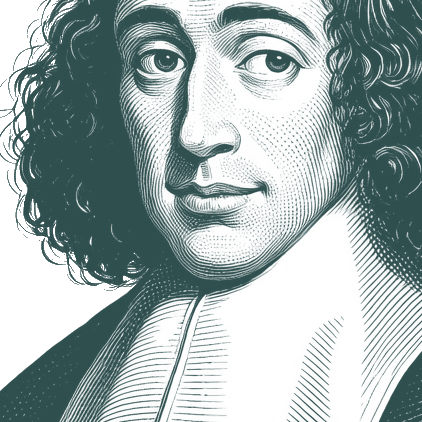
If slavery, barbarism and desolation are to be called peace, men can have no worse misfortune. No doubt there are usually more and sharper quarrels b… - Benedictus de Spinoza

" "

If slavery, barbarism and desolation are to be called peace, men can have no worse misfortune. No doubt there are usually more and sharper quarrels between parents and children, than between masters and slaves ; yet it advances not the art of household management to change a father's right into a right of property, and count children but as slaves. Slavery, then, and not peace, is furthered by handing the whole authority to one man.

English
Collect this quote

About Benedictus de Spinoza

Benedictus de Spinoza (24 November 1632 – 21 February 1677) was a social and metaphysical philosopher known for the elaborate development of his monist philosophy, which has become known as Spinozism. Controversy regarding his ideas led to his excommunication from the Jewish community of his native Amsterdam. He was named Baruch ("blessed" in Hebrew) Spinoza by his synagogue elders and known as Bento de Spinoza or Bento d'Espiñoza, but afterwards used the name Benedictus ("blessed" in Latin) de Spinoza.

Biography information from Wikiquote

Also Known As

Native Name: בָּרוּךְ שְׂפִּינוֹזָה Benedito de Espinosa
Alternative Names: Benedict de Spinoza Baruch de Espinosa Barukh Shpinozah Benoît de Spinoza Sbīnūzā Ispīnūzā Barukh Spinoza Bento de Espinosa Baruch d' Espinoza Shpinozah Baruch de Spinoza Spinoza Benoit de Spinoza Benedictus De Spinoza Benedictus Spinoza Baruch Spinoza Baruch Benedictus de Spinoza
Limited Time Offer

Premium members can get their quote collection automatically imported into their Quotewise collections.

Related quotes. More quotes will automatically load as you scroll down, or you can use the load more buttons.

Additional quotes by Benedictus de Spinoza

Your question is the most difficult in the world. It is not a question I can answer simply with yes or no. I am not an Atheist. I do not know if I can define myself as a Pantheist. The problem involved is too vast for our limited minds. May I not reply with a parable? The human mind, no matter how highly trained, cannot grasp the universe. We are in the position of a little child, entering a huge library whose walls are covered to the ceiling with books in many different tongues. The child knows that someone must have written those books. It does not know who or how. It does not understand the languages in which they are written. The child notes a definite plan in the arrangement of the books, a mysterious order, which it does not comprehend, but only dimly suspects. That, it seems to me, is the attitude of the human mind, even the greatest and most cultured, toward God. We see a universe marvelously arranged, obeying certain laws, but we understand the laws only dimly. Our limited minds cannot grasp the mysterious force that sways the constellations. I am fascinated by Spinoza's Pantheism. I admire even more his contributions to modern thought. Spinoza is the greatest of modern philosophers, because he is the first philosopher who deals with the soul and the body as one, not as two separate things.

...Note that in saying this, Feuerbach stands close to Spinoza, whose philosophy he was already setting forth with great sympathy at the time his own breakaway from idealism was taking shape, that is, when he was writing his history of modern philosophy. In 1843 he made the subtle observation, in his Grundsätze, that pantheism is a theological materialism, a negation of theology but as yet on a theological standpoint. This confusion of materialism and theology constituted Spinoza's inconsistency, which, however, did not prevent him from providing a ‘correct – at least for his time – philosophical expression for the materialist trend of modern times’. That was why Feuerbach called Spinoza ‘the Moses of the modern free-thinkers and materialists’. In 1847 Feuerbach asked: ‘What then, under careful examination, is that which Spinoza calls Substance, in terms of logics or metaphysics, and God in terms of theology?’ To this question he replied categorically: ‘Nothing else but Nature.’ He saw Spinozism’s main shortcoming in the fact that ‘in it the sensible, anti-theological essence of Nature assumes the aspect of an abstract, metaphysical being’. Spinoza eliminated the dualism of God and Nature, since he declared that the acts of Nature were those of God. However, it was just because he regarded the acts of Nature to be those of God, that the latter remained, with Spinoza, a being distinct from Nature, but forming its foundation. He regarded God as the subject and Nature as the predicate. A philosophy that has completely liberated itself from theological traditions must remove this important shortcoming in Spinoza's philosophy, which in its essence is sound. ‘Away with this contradiction!’, Feuerbach exclaimed. ‘Not Deus sive Natura but aut Deus aut Natura is the watchword of Truth.’ Thus, Feuerbach's ‘humanism’ proved to be nothing else but Spinozism disencumbered of its theological pendant. And it was the standpoint of this kind of Spinozism, which Feuerbach had freed of its theological pendant, that Marx and Engels adopted when they broke with idealism. However, disencumbering Spinozism of its theological appendage meant revealing its true and materialist content. Consequently, the Spinozism of Marx and Engels was indeed materialism brought up to date.

Try QuoteGPT

Chat naturally about what you need. Each answer links back to real quotes with citations.

Loading...