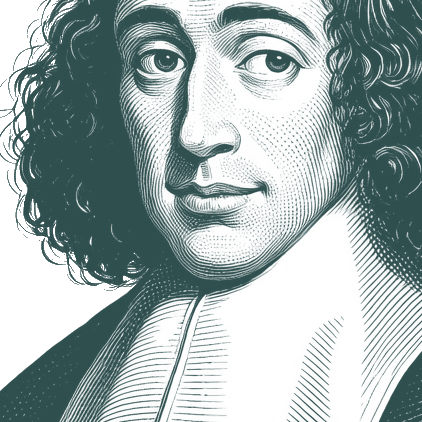
I believe there is another reason also why Spinoza seems to me so pre-eminent: that in spite of being traditional, or because he was not distracted b… - Benedictus de Spinoza
""
I believe there is another reason also why Spinoza seems to me so pre-eminent: that in spite of being traditional, or because he was not distracted by side issues, he was an entire and majestic mind, a singularly consecrated soul. All these trite dogmas and problems lived in him and were the natural channels for his intuitions and emotions. That is what I feel to make a real philosopher and not, what we are condemned to be, professors of the philosophy of other people, or of our own opinions.
Benedictus de Spinoza (24 November 1632 – 21 February 1677) was a social and metaphysical philosopher known for the elaborate development of his monist philosophy, which has become known as Spinozism. Controversy regarding his ideas led to his excommunication from the Jewish community of his native Amsterdam. He was named Baruch ("blessed" in Hebrew) Spinoza by his synagogue elders and known as Bento de Spinoza or Bento d'Espiñoza, but afterwards used the name Benedictus ("blessed" in Latin) de Spinoza.
Native Name:
בָּרוּךְ שְׂפִּינוֹזָה
•
Benedito de Espinosa
Alternative Names:
Benedict de Spinoza
•
Baruch de Espinosa
•
Barukh Shpinozah
•
Benoît de Spinoza
•
Sbīnūzā
•
Ispīnūzā
•
Barukh Spinoza
•
Bento de Espinosa
•
Baruch d' Espinoza
•
Shpinozah
•
Baruch de Spinoza
•
Spinoza
•
Benoit de Spinoza
•
Benedictus De Spinoza
•
Benedictus Spinoza
•
Baruch Spinoza
•
Baruch Benedictus de Spinoza
Is Spinoza baroque? No, but if we find, through this line of thinking, a spurious and worn-out figure that rejects the crisis, that repeats the utopia in its ingenuous Renaissance form, what we have found is merely Spinozism. When classical idealism takes up Spinoza, in effect it only takes up (or invents?) Spinozism, a Renaissance philosophy of the bourgeois revolution of the capitalist market!
Spinoza used the terminology of Descartes, and also published an account of his system. For we find the first of Spinoza's works entitled “An Exposition according to the geometrical method of the principles of the Cartesian philosophy.” Some time after this he wrote his Tractatus theologico-politicus, and by it gained considerable reputation. Great as was the hatred which Spinoza roused amongst his Rabbis, it was more than equalled by the odium which he brought upon himself amongst Christian, and especially amongst Protestant theologians — chiefly through the medium of this essay. It contains his views on inspiration, a critical treatment of the books of Moses and the like chiefly from the point of view that the laws therein contained are limited in their application to the Jews. Later Christian theologians have written critically on this subject, usually making it their object to show that these books were compiled at a later time, and that they date in part from a period subsequent to the Babylonian captivity; this has become a crucial point with Protestant theologians, and one by which the modern school distinguishes itself from the older, greatly pluming itself thereon. All this, however, is already to be found in the above-mentioned work of Spinoza. But Spinoza drew the greatest odium upon himself by his philosophy proper, which we must now consider as it is given to us in his Ethics. While Descartes published no writings on this subject, the Ethics of Spinoza is undoubtedly his greatest work; it was published after his death by Ludwig Mayer, a physician, who had been Spinoza's most intimate friend. It consists of five parts; the first deals with God (De Deo). General metaphysical ideas are contained in it, which include the knowledge of God and nature. The second part deals with the nature and origin of mind (De natura et origine mentis). We see thus that Spinoza does not treat of the subject of natural philosophy, extension and motion at all, for he passes immediately from God to the philosophy of mind, to the ethical point of view; and what refers to knowledge, intelligent mind, is brought forward in the first part, under the head of the principles of human knowledge. The third book of the Ethics deals with the origin and nature of the passions (De oriqine et natura affectuum); the fourth with the powers of the same, or human slavery (De servitute humana seu de affectuum viribus); the fifth, lastly, with the power of the understanding, with thought, or with human liberty (De potentia intellectus seu de libertate humana). Kirchenrath Professor Paulus published Spinoza's works in Jena; I had a share in the bringing out of this edition, having been entrusted with the collation of French translations.
PREMIUM FEATURE
Advanced Search Filters
Filter search results by source, date, and more with our premium search tools.