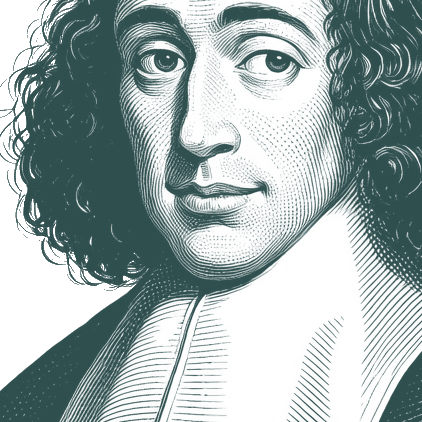
Now I am working on an 'Ethics' à la Spinoza. It is designed to establish the highest principles of all philosophy, in which theoretical and practica… - Benedictus de Spinoza
""
Now I am working on an 'Ethics' à la Spinoza. It is designed to establish the highest principles of all philosophy, in which theoretical and practical reason are united. I have become a Spinozist! Don't be astonished. You will soon hear how.
English
Collect this quote
About
Benedictus de Spinoza
Benedictus de Spinoza (24 November 1632 – 21 February 1677) was a social and metaphysical philosopher known for the elaborate development of his monist philosophy, which has become known as Spinozism. Controversy regarding his ideas led to his excommunication from the Jewish community of his native Amsterdam. He was named Baruch ("blessed" in Hebrew) Spinoza by his synagogue elders and known as Bento de Spinoza or Bento d'Espiñoza, but afterwards used the name Benedictus ("blessed" in Latin) de Spinoza.
Native Name:
בָּרוּךְ שְׂפִּינוֹזָה
•
Benedito de Espinosa
Alternative Names:
Benedict de Spinoza
•
Baruch de Espinosa
•
Barukh Shpinozah
•
Benoît de Spinoza
•
Sbīnūzā
•
Ispīnūzā
•
Barukh Spinoza
•
Bento de Espinosa
•
Baruch d' Espinoza
•
Shpinozah
•
Baruch de Spinoza
•
Spinoza
•
Benoit de Spinoza
•
Benedictus De Spinoza
•
Benedictus Spinoza
•
Baruch Spinoza
•
Baruch Benedictus de Spinoza
He [Spinoza] does not prove the existence of God, existence is God. And if for this reason others would brand him Atheum then I would praise him and call him theissimum and christianissimum. [Original in German: Du erkennst die höchste Realität an, welche der Grund des ganzen Spinozismus ist, worauf alles übrige ruht, woraus alles übrigefliest. Er [Spinoza] beweist nicht das Daseyn Gottes, das Daseyn ist Gott. Und wenn ihn andre deshalb Atheum schelten, so mögte ich ihn theissimum ja christianissimum nennen und preisen.]
[Alberto Knox] Spinoza belonged to the Jewish community of Amsterdam, but he was excommunicated for heresy. Few philosophers in more recent times have been so blasphemed and so persecuted for their ideas as this man. It happened because he criticized the established religion. He believed that Christianity and Judaism were only kept alive by rigid dogma and outer ritual. He was the first to apply what we call a historico-critical interpretation of the Bible.
Limited Time Offer
Premium members can get their quote collection automatically imported into their Quotewise collections.
By posing the question of the ‘givenness’ of the object, Marx poses the question of the object itself, of its nature and limits, and therefore of the domain of its existence, since the modality according to which a theory thinks its object affects not only the nature of that object but also the situation and extent of its domain of existence. As an indication, let us adopt a famous thesis of Spinoza's: as a first approximation, we can suggest that Political Economy's existence is no more possible than the existence of any science of ‘conclusions’ as such: a science of ‘conclusions’ is not a science, since it would be the actual ignorance (‘ignorance en acte’) of its ‘premises’ – it is only the Imaginary in action (the ‘first kind’).