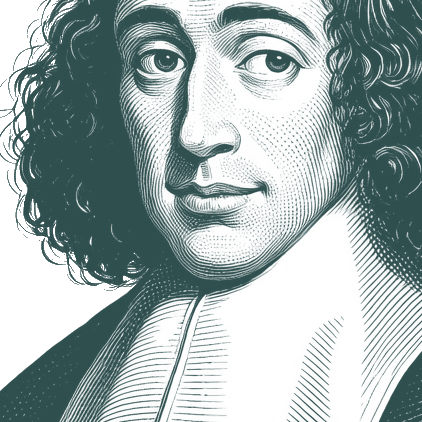
[In the 18th century] Whether one reads the underground texts or those of the great Enlightenment authors, one has the impression that Spinozism was … - Benedictus de Spinoza
""
[In the 18th century] Whether one reads the underground texts or those of the great Enlightenment authors, one has the impression that Spinozism was everywhere; but at the same time, it can be said, strictly speaking, there were no Spinozists (except as convenient phantoms for apologists); there were only thinkers who make use of Spinoza. Naturally, they could do so with more or less creativity, style, and depth.
Benedictus de Spinoza (24 November 1632 – 21 February 1677) was a social and metaphysical philosopher known for the elaborate development of his monist philosophy, which has become known as Spinozism. Controversy regarding his ideas led to his excommunication from the Jewish community of his native Amsterdam. He was named Baruch ("blessed" in Hebrew) Spinoza by his synagogue elders and known as Bento de Spinoza or Bento d'Espiñoza, but afterwards used the name Benedictus ("blessed" in Latin) de Spinoza.
Native Name:
בָּרוּךְ שְׂפִּינוֹזָה
•
Benedito de Espinosa
Alternative Names:
Benedict de Spinoza
•
Baruch de Espinosa
•
Barukh Shpinozah
•
Benoît de Spinoza
•
Sbīnūzā
•
Ispīnūzā
•
Barukh Spinoza
•
Bento de Espinosa
•
Baruch d' Espinoza
•
Shpinozah
•
Baruch de Spinoza
•
Spinoza
•
Benoit de Spinoza
•
Benedictus De Spinoza
•
Benedictus Spinoza
•
Baruch Spinoza
•
Baruch Benedictus de Spinoza
When we read Spinoza, we are seized with a feeling like that of seeing nature at its grandest in most vigorous repose: a forest of thoughts, tall as the sky, whose blooming tree-tops sway back and forth, while imperturbable trunks stand rooted in the eternal soil. There is a certain soft breeze in the writings of Spinoza which is inexplicable. It stirs the reader with the winds of the future. The spirit of the Hebrew prophets still rested perhaps on their late descendant. At the same time, there is a seriousness to him, a self-confident pride, a grandeur of thought which also seems to be an inheritance, since Spinoza belonged to one of those families of martyrs which had been expelled from Spain by those most Catholic kings.
That I might investigate the subject matter of this science with the same freedom of spirit we generally use in mathematics, I have labored carefully not to mock, lament, or execrate human actions, but to understand them; and to this end I have looked upon passions such as love, hatred, anger, envy, ambition, pity, and other perturbations of the mind, not in the light of vices of human nature, but as properties just as pertinent to it as are heat, cold, storm, thunder, and the like to the nature of the atmosphere.
Unlimited Quote Collections
Organize your favorite quotes without limits. Create themed collections for every occasion with Premium.