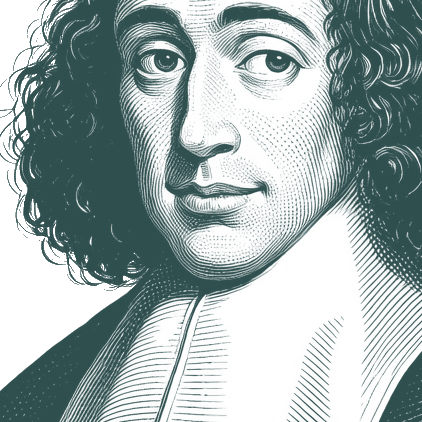
When we read Spinoza, we are seized with a feeling like that of seeing nature at its grandest in most vigorous repose: a forest of thoughts, tall as … - Benedictus de Spinoza
""
When we read Spinoza, we are seized with a feeling like that of seeing nature at its grandest in most vigorous repose: a forest of thoughts, tall as the sky, whose blooming tree-tops sway back and forth, while imperturbable trunks stand rooted in the eternal soil. There is a certain soft breeze in the writings of Spinoza which is inexplicable. It stirs the reader with the winds of the future. The spirit of the Hebrew prophets still rested perhaps on their late descendant. At the same time, there is a seriousness to him, a self-confident pride, a grandeur of thought which also seems to be an inheritance, since Spinoza belonged to one of those families of martyrs which had been expelled from Spain by those most Catholic kings.
Benedictus de Spinoza (24 November 1632 – 21 February 1677) was a social and metaphysical philosopher known for the elaborate development of his monist philosophy, which has become known as Spinozism. Controversy regarding his ideas led to his excommunication from the Jewish community of his native Amsterdam. He was named Baruch ("blessed" in Hebrew) Spinoza by his synagogue elders and known as Bento de Spinoza or Bento d'Espiñoza, but afterwards used the name Benedictus ("blessed" in Latin) de Spinoza.
Native Name:
בָּרוּךְ שְׂפִּינוֹזָה
•
Benedito de Espinosa
Alternative Names:
Benedict de Spinoza
•
Baruch de Espinosa
•
Barukh Shpinozah
•
Benoît de Spinoza
•
Sbīnūzā
•
Ispīnūzā
•
Barukh Spinoza
•
Bento de Espinosa
•
Baruch d' Espinoza
•
Shpinozah
•
Baruch de Spinoza
•
Spinoza
•
Benoit de Spinoza
•
Benedictus De Spinoza
•
Benedictus Spinoza
•
Baruch Spinoza
•
Baruch Benedictus de Spinoza
Do you remember Goethe's wise words about reading Spinoza? — “I always preferred knowing what an author himself said, to knowing what others thought he ought to have said.”
I do not think it necessary for salvation to know Christ according to the flesh : but with regard to the Eternal Son of God, that is the Eternal Wisdom of God, which has manifested itself in all things and especially in the human mind, and above all in Christ Jesus, the case is far otherwise. For without this no one can come to a state of blessedness, inasmuch as it alone teaches, what is true or false, good or evil. And, inasmuch as this wisdom was made especially manifest through Jesus Christ, as I have said, his disciples preached it, in so far as it was revealed to them through him, and thus showed that they could rejoice in that spirit of Christ more than the rest of mankind. The doctrines added by certain churches, such as that God took upon himself human nature, I have expressly said that I do not understand; in fact, to speak the truth, they seem to me no less absurd than would a statement, that a circle had taken upon itself the nature of a square. This I think will be sufficient explanation of my opinions concerning the three points mentioned. Whether it will be satisfactory to Christians you will know better than I.
Enhance Your Quote Experience
Enjoy ad-free browsing, unlimited collections, and advanced search features with Premium.
After 1785 public opinion of Spinoza changed from almost universal contempt to almost universal admiration, largely as a result of the publication of Jacobi's Briefe, in which he revealed Lessing's Spinozism. Lessing was the most admired figure of the Aufklarung, and his credo automatically gave a stamp of legitimacy to every secret Spinozist. One after another the Spinozists could now come out of their closets and form a file behind Lessing. If Lessing was an honorable man and a Spinozist, then they could be too. Ironically, Jacobi's Briefe did not destroy Lessing's reputation, as Mendelssohn feared. It did the very opposite, making him a hero in the eyes of the nonconformists. Lessing made it a fashion to be unorthodox; and to be fashionably unorthodox was to be a Spinozist. Of course, Lessing's credo explains only how Spinozism became respectable. It accounts for why a Spinozist might go public, but not for why he became a Spinozist in the first place. To understand why Spinozism became the credo of so many other thinkers, we have to consider the new situation of the sciences at the close of the eighteenth century. The rise in the fortunes of Spinozism resulted in part from the consequence of the decline of theism and deism.