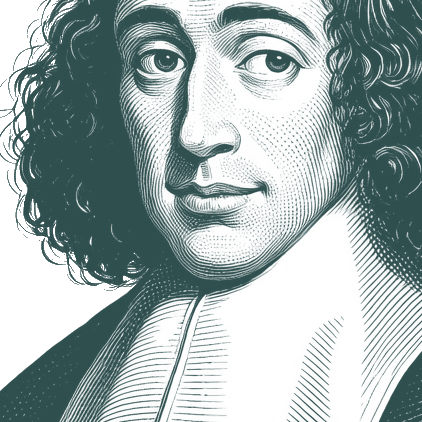
After 1785 public opinion of Spinoza changed from almost universal contempt to almost universal admiration, largely as a result of the publication of… - Benedictus de Spinoza
""
After 1785 public opinion of Spinoza changed from almost universal contempt to almost universal admiration, largely as a result of the publication of Jacobi's Briefe, in which he revealed Lessing's Spinozism. Lessing was the most admired figure of the Aufklarung, and his credo automatically gave a stamp of legitimacy to every secret Spinozist. One after another the Spinozists could now come out of their closets and form a file behind Lessing. If Lessing was an honorable man and a Spinozist, then they could be too. Ironically, Jacobi's Briefe did not destroy Lessing's reputation, as Mendelssohn feared. It did the very opposite, making him a hero in the eyes of the nonconformists. Lessing made it a fashion to be unorthodox; and to be fashionably unorthodox was to be a Spinozist. Of course, Lessing's credo explains only how Spinozism became respectable. It accounts for why a Spinozist might go public, but not for why he became a Spinozist in the first place. To understand why Spinozism became the credo of so many other thinkers, we have to consider the new situation of the sciences at the close of the eighteenth century. The rise in the fortunes of Spinozism resulted in part from the consequence of the decline of theism and deism.
English
Collect this quote
About
Benedictus de Spinoza
Benedictus de Spinoza (24 November 1632 – 21 February 1677) was a social and metaphysical philosopher known for the elaborate development of his monist philosophy, which has become known as Spinozism. Controversy regarding his ideas led to his excommunication from the Jewish community of his native Amsterdam. He was named Baruch ("blessed" in Hebrew) Spinoza by his synagogue elders and known as Bento de Spinoza or Bento d'Espiñoza, but afterwards used the name Benedictus ("blessed" in Latin) de Spinoza.
Native Name:
בָּרוּךְ שְׂפִּינוֹזָה
•
Benedito de Espinosa
Alternative Names:
Benedict de Spinoza
•
Baruch de Espinosa
•
Barukh Shpinozah
•
Benoît de Spinoza
•
Sbīnūzā
•
Ispīnūzā
•
Barukh Spinoza
•
Bento de Espinosa
•
Baruch d' Espinoza
•
Shpinozah
•
Baruch de Spinoza
•
Spinoza
•
Benoit de Spinoza
•
Benedictus De Spinoza
•
Benedictus Spinoza
•
Baruch Spinoza
•
Baruch Benedictus de Spinoza
I can always say to myself that my atheism, like that of Spinoza, is true piety towards the universe and denies only gods fashioned by men in their own image, to be servants of their human interests; and that even in this denial I am no rude iconoclast, but full of secret sympathy with the impulses of idolaters.
I now want, much more briefly, to take another path across my essays in order to look at another group of theses developed there on the question of "knowledge". I cannot hide the fact that in this matter I depended heavily on Spinoza. I said a moment ago that Marx was close to Hegel in his critique of the idea of a theory of knowledge. But this Hegelian critique is already present in Spinoza. What does Spinoza in fact mean when he writes, in a famous phrase, "Habemus enim ideam veram..."? That we have a true idea? No: the weight of the phrase lies on the "enim". It is in fact because and only because we have a true idea that we can produce others, according to its norm. And it is in fact because and only because we have a true idea that we can know that it is true, because it is "index sui". Where does this true idea come from? That is quite a different question. But it is a fact that we do have it (habemus), and whatever it may be that produces this result, it governs everything that can be said about it and derived from it. Thus Spinoza in advance makes every theory of knowledge, which reasons about the justification of knowledge, dependent on the fact of the knowledge which we already possess. And so every question of the Origin, Subject and Justification of knowledge, which lie at the root of all theories of knowledge, is rejected. But that does not prevent Spinoza from talking about knowledge: not in order to understand its Origin, Subject and Justification, but in order to determine the process and its moments, the famous "three levels", which moreover appear very strange when you look at them close up, because the first is properly the lived world, and the last is specially suited to grasping the "singular essence" -- or what Hegel would in his language call the "universal concrete" -- of the Jewish people, which is heretically treated in the Theologico-Political Treatise. I am sorry if some people consider, apparently out of theoretical opportunism, that I thus fall into a heresy, but I would say that Marx -- not only the Marx of the 1857 Introduction, which in fact opposes Hegel through Spinoza, but the Marx of Capital, together with Lenin -- is in fact on close terms with Spinoza's positions.
Unlimited Quote Collections
Organize your favorite quotes without limits. Create themed collections for every occasion with Premium.